Currency volatility can erode your app's revenue if left unaddressed. When local currencies weaken against the US dollar, your earnings shrink unless prices are adjusted. Conversely, stronger currencies can make your app feel underpriced, leaving potential revenue untapped. The solution? A dynamic, regional pricing strategy that balances affordability with profitability.
Key takeaways:
- Currency shifts impact revenue: Weak currencies reduce USD earnings; strong currencies create pricing gaps.
- Localized pricing is essential: Adjust for local purchasing power, taxes, and psychological pricing to improve conversions.
- Tools simplify pricing management: Platforms like Mirava provide data-driven price recommendations, while RevenueCat and Adapty handle billing and paywalls.
- Actionable strategies include: Pricing zones, real-time adjustments, and purchasing power parity (PPP).
How to price your subscription app globally - Featuring Jacob Rushfinn
sbb-itb-43fe43a
How Currency Volatility Impacts Regional Pricing
How Currency Volatility Impacts App Pricing and Revenue
What Currency Volatility Means
To navigate regional pricing effectively, it's crucial to grasp the concept of currency volatility. This term describes how often and how significantly one currency's value shifts relative to another - commonly measured against the US dollar on global app platforms. When volatility is high, price changes become unpredictable, posing financial risks for both developers and users.
Factors like geopolitical instability, fluctuating inflation rates, central bank policies, and national debt contribute to these rapid shifts. A prime example is the Turkish lira, which has depreciated by 30–50% annually in recent years. Such extreme devaluation forces app developers into a tough spot: either frequently raise prices or endure steep revenue losses. For local users, a drastic drop in currency value can turn an app's price from affordable to unreasonably expensive almost overnight.
These fluctuations directly affect how apps price their services and how much revenue developers can retain.
Effects on App Pricing and Revenue
Currency fluctuations can significantly impact your bottom line. When a local currency loses value against the dollar, your effective revenue shrinks. Even if you don’t adjust your prices, the amount you receive after conversion decreases. For instance, in October 2022, Apple raised App Store prices across the Eurozone by roughly 20%, increasing the base tier from €0.99 to €1.19. This move was a response to the Euro reaching parity with the US dollar for the first time in two decades, helping developers maintain their USD-equivalent earnings despite the weaker Euro [1].
The opposite scenario creates its own challenges. If your prices remain fixed in USD while a local currency collapses, your app can suddenly feel overpriced in that region. What was once a fair price might become unaffordable, leading to higher churn rates and fewer conversions.
"Value isn't universal - it's relative. You're not just competing with other apps, you're competing with the local economy" [2].
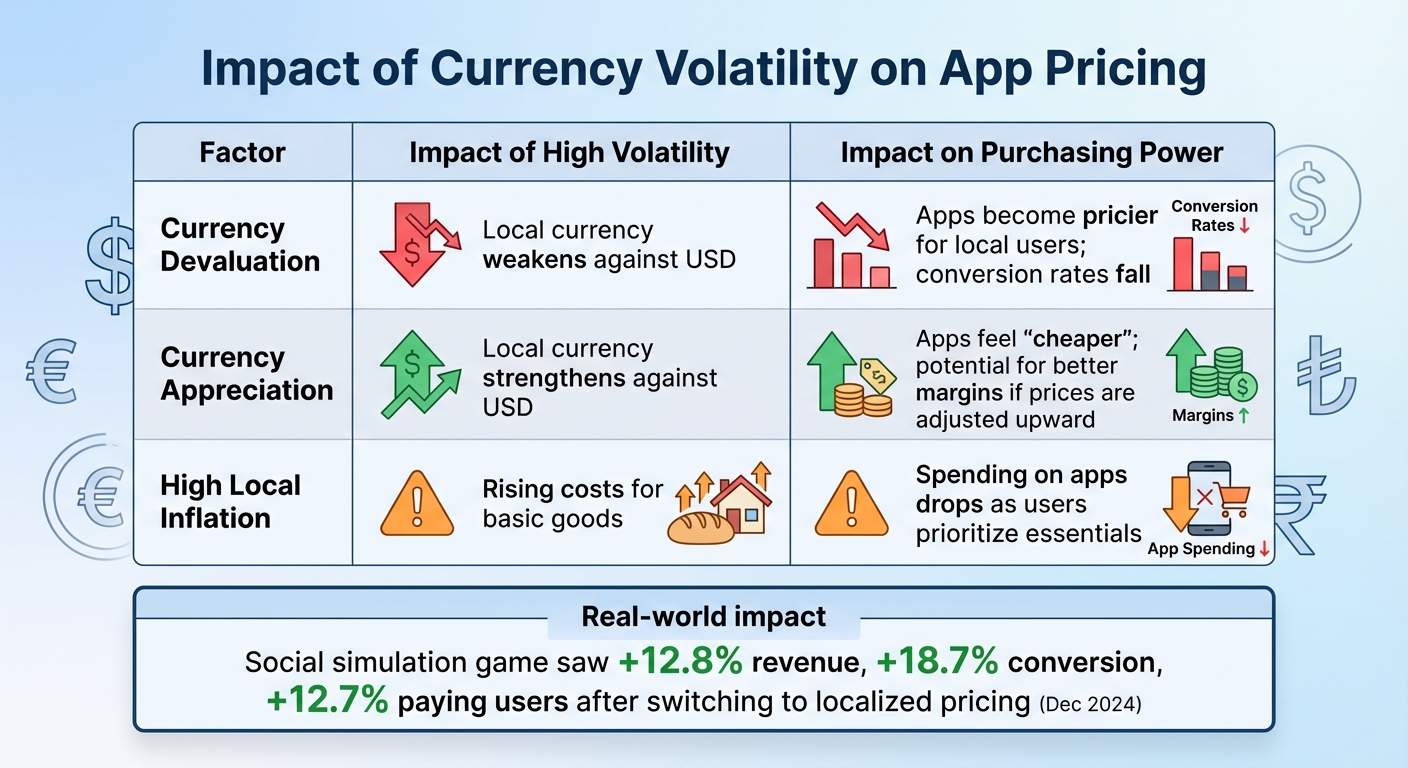
The table below outlines how different volatility scenarios impact pricing and purchasing power:
| Factor | Impact of High Volatility | Impact on Purchasing Power |
|---|---|---|
| Currency Devaluation | Local currency weakens against USD | Apps become pricier for local users; conversion rates fall |
| Currency Appreciation | Local currency strengthens against USD | Apps feel "cheaper"; potential for better margins if prices are adjusted upward |
| High Local Inflation | Rising costs for basic goods | Spending on apps drops as users prioritize essentials |
Delays in platform adjustments exacerbate these issues. Apple and Google periodically update price tiers to account for exchange rate changes, but these adjustments aren’t instant. During the lag, developers bear the brunt of currency devaluation. Meanwhile, operating costs - like cloud hosting on AWS or Azure, advertising on Meta or Google, and API services - remain in USD. This mismatch between revenue in a weakening currency and expenses in a stable one can quickly erode profit margins.
A social simulation mobile game offers a real-world example. In December 2024, the game shifted from fixed USD pricing to localized regional pricing. The result? A 12.8% increase in overall revenue, an 18.7% improvement in payment conversion, and a 12.7% rise in its paying user base [3]. The key was aligning prices with local economic conditions rather than relying on rigid currency conversions.
What to Consider When Setting Regional Prices
Setting regional prices during periods of currency volatility requires a clear understanding of local economic factors, consumer behavior, and operational expenses. Let’s break down how these elements influence pricing strategies across different regions.
Local Economic Conditions
Factors like inflation, taxes, and tariffs heavily influence what customers can afford and what businesses can charge. In countries with high inflation, such as Argentina or Turkey, the value of a fixed price can diminish rapidly. A price that feels reasonable today could become impractical in just a few months. Research highlights that price differences for identical products can exceed 100% between regions, driven by these economic variables [4].
It’s also critical to account for VAT or sales tax rates in each region, as these directly affect the final price customers pay. On the flip side, a strengthening local currency can make your pricing appear more competitive without requiring any adjustments on your end.
Price Sensitivity by Market
Consumer willingness to pay varies greatly depending on the region. For example, high-income countries like Switzerland, Norway, Singapore, and Denmark can often absorb prices 50–200% higher than a flat $29/year USD rate without negatively impacting conversions [6]. Conversely, markets like India, Turkey, Brazil, and Indonesia are far more price-sensitive. In these regions, higher USD-equivalent prices can deter conversions, making it crucial to adjust pricing to match local purchasing power. This often involves addressing common app pricing questions regarding PPP and market-specific adjustments.
Market dynamics also play a role. In competitive markets, lower prices might be necessary to attract customers, while in regions with fewer competitors, businesses may have the flexibility to set higher prices [4]. Regular competitive analysis is essential - using mobile app pricing tools to understand what similar apps charge in each region and recognizing that a dominant competitor in one market might have minimal presence in another. Striking a balance between affordability and profitability is key to staying competitive across diverse markets.
Operating Costs and Currency Exposure
Pricing decisions must also account for the full cost of serving each market. Many expenses, such as server infrastructure on AWS or Azure, advertising on platforms like Meta or Google, and API services, are typically billed in USD, regardless of where your customers are located. If you’re earning revenue in a weakening currency but incurring costs in USD, your margins can quickly erode.
To avoid losses, calculate all expenses tied to each region. This includes payment processor fees (which range from 2–5% depending on region and payment method), customer support costs (which vary based on local labor rates), and currency conversion fees for transferring revenue back to your base currency [5]. Establishing a regional "price floor" - the minimum price required to cover these costs and platform commissions - is crucial. Pricing below this threshold risks negative margins, no matter how many sales you make.
Methods for Managing Currency Fluctuations
Once you've assessed local pricing factors, the next step is to adopt strategies that safeguard your revenue from the impact of shifting exchange rates. Below are four practical methods to help maintain stable pricing in unpredictable markets.
Group Countries into Pricing Zones
Managing individual prices for every country can be overwhelming, so consider grouping markets into economic tiers based on indicators like GDP per capita or purchasing power. For instance:
- Tier 1: High-income regions such as the US, UK, and Germany.
- Tier 2: Mid-range economies like Poland or Malaysia.
- Tier 3: Emerging markets with lower purchasing power, such as India or Indonesia.
This structure simplifies pricing strategies across multiple storefronts. For countries with significant currency volatility - like Argentina, Turkey, or Egypt - you can create a separate "High-Frequency Update" zone. This allows for more frequent price adjustments in these regions without disrupting your broader pricing framework. Similarly, group countries with currencies pegged to major ones like the USD or EUR together, as their exchange rates tend to move in sync, ensuring consistent margins within that zone.
These tiers lay the foundation for more dynamic and automated pricing adjustments in response to market changes.
Use Real-Time Multi-Currency Pricing
Real-time pricing tools can automatically adjust your prices based on current exchange rates, reducing the need for manual updates and minimizing errors. These tools handle transactions efficiently during rapid rate changes [10]. They also help avoid poorly-timed currency conversions [7].
"By investing in the right technology and partnering with efficient forex payment solutions, a company can centralize its AP and AR data, streamline payment processing, eliminate manual errors and missteps, and reduce reliance on high fee spot transactions." - Megan Doyle, American Express Business Class Freelance Contributor [7]
Additionally, multicurrency accounts offer flexibility by allowing you to hold revenue in various currencies. This enables you to delay conversions until rates are more favorable while also offering customers the option to pay in their local currency, which can improve conversion rates [7][8].
Apply Purchasing Power Parity (PPP)
Using PPP alongside digital purchasing behavior data from platforms like Netflix or Spotify can provide precise benchmarks for pricing digital products. This method acknowledges that a $9.99 subscription might be reasonable in the US but out of reach in countries like Brazil, even after accounting for exchange rates.
Flexibility is key here. Many global companies rely on this approach to navigate currency volatility and trade uncertainties [11]. You can also adopt natural hedging by matching revenue and expenses in the same currency. For example, if you earn revenue in Brazilian reals, allocate some of that income to local expenses like marketing or server costs in Brazil. This reduces the risk of exchange rate exposure [7][10].
Lock in Average Exchange Rates
Instead of reacting to every currency fluctuation, consider locking in exchange rates over a set period - 30, 60, or 90 days - by calculating an average rate for that timeframe. This approach ensures stable pricing and predictable revenue, shielding you from daily volatility.
While you might miss out on favorable rate movements, this strategy protects against sudden downturns. Pairing this with pricing zones allows for quarterly reviews and adjustments, while maintaining stable prices in the interim. Keep an eye on major central bank decisions, like those from the Federal Reserve or European Central Bank, as changes in interest rates can significantly influence currency values and signal when to recalibrate your locked-in rates [9].
Together, these strategies provide a solid framework for managing the challenges of currency fluctuations effectively.
Tools for Regional Pricing Management
When it comes to managing regional pricing, the right tools can streamline processes and adapt to market dynamics efficiently.
Mirava: Pricing Intelligence Platform
Mirava serves as a pricing intelligence layer for mobile apps, covering over 170 countries. Unlike traditional methods based solely on GDP or purchasing power parity, Mirava leverages real-world digital purchasing patterns. It benchmarks against platforms like Netflix, Spotify, Apple Music, and YouTube Premium to generate pricing recommendations tailored to user behavior [6]. The platform also tracks foreign exchange trends, normalizing prices to protect revenue from currency fluctuations [6].
Mirava’s willingness-to-pay engine analyzes mobile usage patterns and regional subscription habits to suggest optimal pricing. It even incorporates psychological pricing strategies, such as using .99 endings in some regions or whole numbers in others, to align with local preferences and maximize perceived value [6][14]. These features help developers navigate the challenges of shifting exchange rates while integrating with subscription management platforms for a seamless pricing solution.
"The country-level pricing and rounding logic helped us increase conversion in emerging markets without hurting revenue in core regions. That balance is extremely hard to get right at scale." – Markus Vogel, Director of Product, Multi-App Studio [14]
Mirava also addresses pricing drift caused by currency shifts or manual adjustments [13][14]. Developers can set price boundaries, schedule updates, and easily reverse changes when needed [12]. Its centralized dashboard consolidates pricing management across iOS, Android, and web platforms (e.g., Stripe), eliminating the need for fragmented spreadsheets. By applying localized strategies, apps could see a 15–30% increase in trials and paid subscriptions without additional traffic investment [12].
RevenueCat, Adapty, Purchasely, and Superwall
While Mirava focuses on pricing optimization, tools like RevenueCat, Adapty, Purchasely, and Superwall handle the infrastructure side - managing billing, paywalls, entitlements, and subscription analytics. These platforms work seamlessly with Mirava’s pricing insights to maintain consistent revenue despite currency volatility. Mirava directly updates prices on the App Store and Google Play, and these platforms automatically sync the new data without requiring SDK or code changes [13].
Adapty, for example, uses its Pricing Index - based on $1.9 billion in analyzed revenue across 11,000+ apps - to help developers benchmark regional pricing against global trends [15]. Regional subscription prices often differ significantly, ranging from 62% higher to 63% lower than the U.S. baseline [15]. By combining Mirava’s pricing recommendations with Adapty or Superwall’s ability to test paywall designs, developers can create a data-driven strategy that balances pricing and conversion optimization.
Payment and Accounting Platforms
For web-based subscriptions, Stripe provides essential features like multi-currency support and fraud prevention, making it a go-to tool for developers selling across iOS, Android, and web. On the financial reporting side, platforms like Xero help track currency gains and losses, ensuring accurate accounting across diverse markets. Together, these tools automate pricing updates and transactions, laying the groundwork for the next step: monitoring performance and safeguarding against abuse.
Monitoring Performance and Preventing Abuse
This section focuses on how to evaluate pricing strategies and safeguard revenue from misuse, building on the concepts of managed zones and dynamic pricing.
Track and Adjust Pricing Performance
To determine whether regional pricing strategies are working, convert all regional revenue into a stable base currency. This helps you identify genuine market growth, especially in regions with fluctuating currencies. In high-volatility markets, total revenue might not reflect actual performance, so monitor key metrics like conversion rate (CVR) and average revenue per paying user (ARPPU) by region. These indicators reveal whether pricing adjustments effectively balance inflation and customer retention. CVR, in particular, shows how well customers accept new prices after currency changes.
Set up alerts for currency volatility - for example, if a market's currency shifts by more than 10% within 30 days, it may be time to reassess pricing. Use cohort analysis to compare the lifetime value (LTV) of users acquired during inflationary periods versus stable ones. Always segment performance data based on the user’s App Store or Google Play storefront region rather than their IP address. This approach filters out noise from VPN users and ensures your data reflects actual local pricing.
While these steps help assess pricing effectiveness, protecting revenue from misuse is just as critical.
Block Proxy and VPN Abuse
Revenue can take a hit when users exploit geographic arbitrage - using VPNs to access lower subscription prices meant for other regions. To counter this, implement location-locked pricing tied to a user's verified payment method or store account region instead of their IP address. IP-based methods are easily bypassed by basic VPNs and often lead to inaccurate data, whereas account-based locking is now the industry standard.
While some VPN traffic is legitimate, focus on blocking high-risk sources like anonymous proxies, Tor, and data center IPs. Use tools such as Stripe Radar to automatically flag and block suspicious transactions originating from known VPN exit nodes.
"Fraud prevention isn't one-size-fits-all, and blocking every VPN user isn't a long-term solution. The real win is building a smarter, data-driven strategy that keeps fraud out while keeping conversions high." – Mark Stiltner, Fraud & Risk, Rapyd [16]
To minimize false positives, combine VPN detection with device fingerprinting, IP reputation checks, and behavioral analytics. Watch for "impossible travel" scenarios where a single account appears to jump between global locations unrealistically fast. Additionally, compare chargeback rates between VPN users and non-VPN users to refine fraud rules without unnecessarily impacting legitimate conversions [16][17].
Run A/B Tests on Pricing
Once performance metrics are monitored, A/B testing can validate the impact of pricing adjustments. Test new price points against existing ones to measure price elasticity and its effect on churn. Platforms like Superwall allow developers to experiment with different pricing models and localized paywall designs. In markets experiencing hyperinflation, it’s important to review pricing performance weekly instead of monthly to prevent revenue loss due to rapid currency devaluation.
When running tests, track not only conversion rates but also realized revenue. This metric accounts for platform fees (typically 15–30% from Apple or Google) and currency conversion costs, giving a clearer picture of actual margins in volatile regions. By combining these insights, you can refine pricing strategies to maximize both revenue and customer retention.
Conclusion
Effectively managing currency volatility is crucial for mobile app developers operating on a global scale. Relying on flat global pricing often means losing potential revenue in wealthier markets - where customers might pay 50–200% more - and alienating users in price-sensitive regions. As Mirava puts it, "Local pricing outperforms flat global pricing Every. Single. Time." [6]
Handling tasks like syncing App Store tiers, tracking exchange rate fluctuations, and applying psychological price rounding across over 170 countries is incredibly complex. Pricing intelligence platforms such as Mirava simplify this by determining optimal, market-specific prices based on real purchasing data. These platforms benchmark against global leaders like Netflix, Spotify, Apple, and YouTube to ensure competitive pricing. Tools like RevenueCat, Adapty, Purchasely, and Superwall then manage billing, paywalls, and entitlements, seamlessly integrating into your monetization workflow. This streamlined approach not only resolves technical hurdles but also fosters user trust through consistent and transparent pricing.
Currency fluctuations can distort pricing, leading to erratic shifts and awkward price points that harm user confidence. To counter this, leading services frequently update pricing to reflect exchange rate changes and local economic conditions [6].
Shifting from manual updates to automated pricing intelligence helps capture revenue that might otherwise be lost due to affordability challenges or missed opportunities in premium markets. Localized pricing strategies lead to better conversion rates and improved lifetime value. Additionally, Apple and Google's official frameworks ensure that these localized adjustments apply only to new customers, safeguarding your existing subscribers.
FAQs
How often should I update regional prices when exchange rates swing?
When currency exchange rates shift significantly, it's crucial to adjust regional prices promptly. Relying on data-driven insights and automation can make this process far more efficient. Platforms like Mirava are invaluable here, offering bulk price update capabilities and real-time pricing analysis. This allows you to react swiftly to market changes without manually recalculating prices for each region.
By combining regular monitoring with automated updates, you can keep your pricing strategy aligned with local economic conditions. This not only helps protect revenue but also reduces the risk of losing customers due to poorly adjusted pricing.
What’s the best way to set regional prices without hurting conversions?
To adjust regional prices effectively without compromising conversions, align your pricing with local economic realities and customer expectations rather than relying solely on currency exchange rates. A localized pricing strategy should consider factors like purchasing power parity (PPP), market-specific costs, and local willingness to pay. Leveraging tools such as Mirava allows you to update prices dynamically, using data that reflects actual purchasing behavior. Additionally, integrating platforms like RevenueCat, Adapty, Purchasely, and Superwall ensures smooth management of billing and paywalls.
How do I prevent VPN users from buying in cheaper regions?
To tackle the issue of VPN users taking advantage of regional pricing, implement IP geolocation to confirm users' true locations and block attempts to mask them with VPNs. Pair this with behavioral analytics to spot discrepancies in location data or unusual patterns that could indicate misuse. Platforms like RevenueCat, Adapty, Purchasely, or Superwall offer fraud detection tools that can assist in identifying and addressing these activities. While Mirava delivers pricing intelligence to fine-tune regional pricing strategies, it relies on these enforcement tools to maintain integrity.