Regional pricing is no longer optional for SaaS companies - it’s a necessity. By early 2026, SaaS inflation hit 12.2%, far exceeding general inflation rates. Companies that adjusted prices based on local economic conditions saw substantial growth. For example, Stripe boosted customer acquisition by 45% in emerging markets, while HubSpot increased international revenue by 65% year-over-year.
Key takeaways:
- SaaS inflation is outpacing general inflation: SaaS inflation is 321% higher than market inflation in G7 economies, with per-employee SaaS spending rising from $7,900 in 2023 to $9,100 in 2026.
- Localized pricing drives results: Adjusting prices for purchasing power parity (PPP) has proven effective. Spotify’s reduced pricing in India led to 92.6% revenue growth there, while Flo achieved profitability in Brazil by cutting subscription costs.
- Inflation-indexed contracts work: Companies using inflation-indexed pricing reported 14% higher net dollar retention compared to those with fixed pricing.
- Pricing models affect costs: Hybrid models combining per-user fees, usage-based pricing, and AI surcharges are driving SaaS costs higher. For example, Slack raised prices by 20%, and Adobe increased fees by 16.7% in 2025.
To stay competitive, SaaS companies must embrace regional pricing best practices that reflect local economic realities. Tools like Mirava simplify this process, enabling automated updates based on PPP and inflation trends. Companies that update pricing quarterly see up to 4x better revenue per user growth compared to annual adjustments.
Bottom line: Regional pricing isn’t just about lowering costs - it’s about aligning prices with local markets to increase revenue and customer retention.
Mastering Pricing Localization: How SaaS Teams Win International Markets
sbb-itb-43fe43a
SaaS Inflation Trends Across Different Regions
SaaS Inflation vs Consumer Inflation: Regional Comparison 2023-2026
SaaS Inflation vs. Consumer Inflation
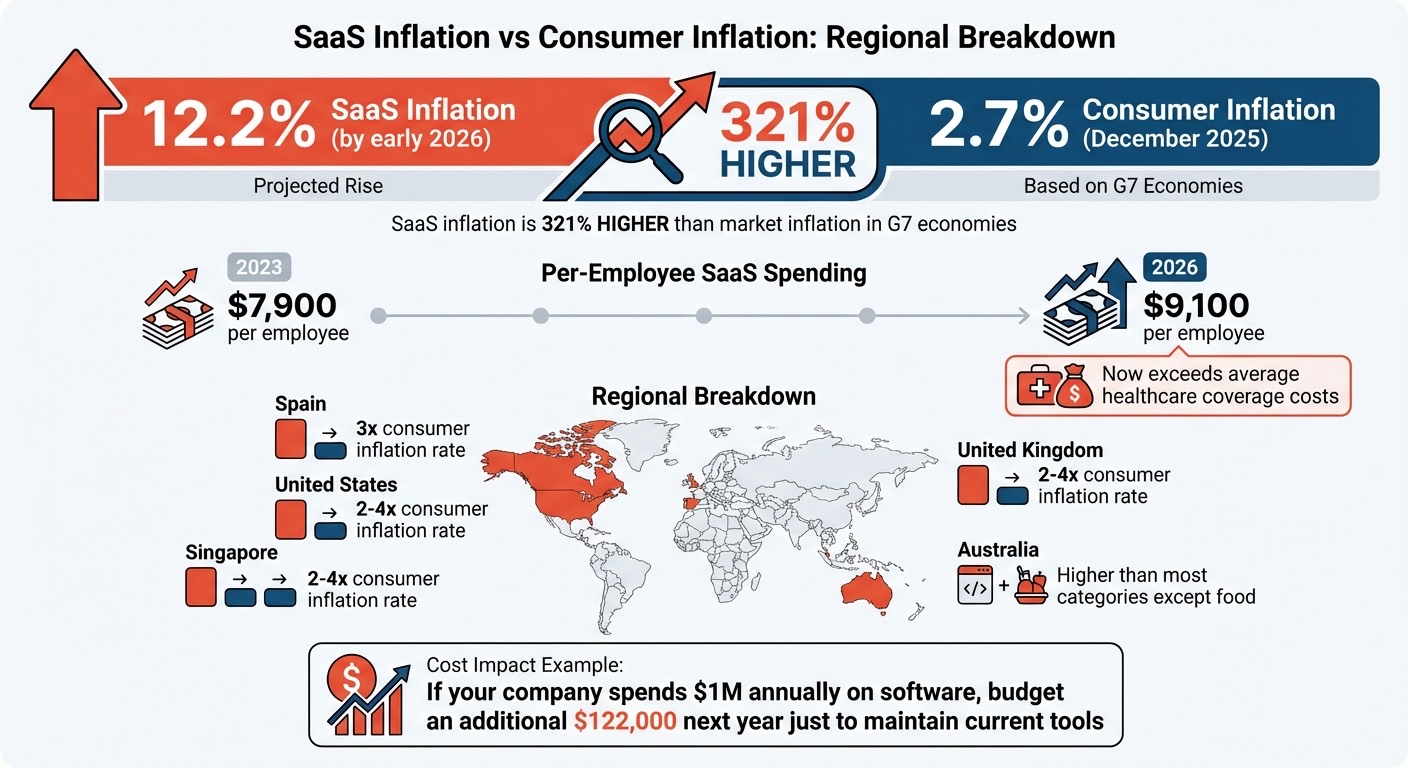
By December 2025, U.S. consumer inflation had dropped to 2.7% [5]. In stark contrast, SaaS inflation surged to 12.2% by early 2026 [4], more than quadrupling the general inflation rate. For businesses, this means significant cost increases - if a company spends $1,000,000 annually on software, they’ll need to budget an additional $122,000 next year just to maintain their current tools [4].
This trend isn’t limited to the U.S. In G7 countries, SaaS inflation is 321% higher than overall market inflation [4]. On a per-employee basis, SaaS spending climbed from $7,900 in 2023 to $9,100 in 2026, surpassing the average employer contribution for healthcare coverage [4][6]. Unlike consumer goods, software pricing seems immune to the typical economic pressures and central bank policies that generally help curb inflation [4][6].
How SaaS Inflation Differs by Region
Regional data shows even more variation in SaaS pricing trends. In Spain, SaaS inflation reached three times the rate of consumer inflation [6]. Meanwhile, in the U.S., Singapore, and Canada, SaaS inflation typically runs two to four times higher than local consumer inflation rates [4][6]. In countries like the U.K. and Australia, where consumer inflation remains elevated, SaaS prices are still rising faster than most other product categories, with the exception of food [6].
These regional differences are often shaped by vendor strategies. For instance, many companies adjust their prices to account for currency fluctuations, a practice known as currency harmonization. Additionally, vendors may implement steeper price increases in markets where customers are more willing to pay or less likely to push back against hikes [4]. This creates regional pricing models that are tailored to specific local conditions, rather than relying on a single global standard. This is especially critical when developing an emerging market app pricing strategy to capture growth in developing economies.
How Vendor Pricing Strategies Drive Inflation
Vendor pricing strategies play a big role in driving SaaS inflation. By using complex pricing models and strategic price adjustments, vendors create multiple pathways for costs to rise. This has made it increasingly important for businesses, especially in mobile app development, to consider flexible pricing approaches tailored to different regions.
Pricing Models That Push SaaS Costs Higher
Per-user or seat-based pricing, which is used by 57% of companies, is a prime example. Even when companies reduce their workforce, they often can't lower their license count, effectively increasing the cost per remaining employee [7][4].
Usage-based pricing has also gained traction, with 43% of companies adopting it by 2025 [7]. This model allows for subtle cost increases through credit adjustments. For instance, what used to cost 10 credits might suddenly require 20 credits, without any change to the subscription fee [8]. On top of that, hybrid models - which combine seat licenses, usage fees, and platform charges - are now the most common, with a 61% adoption rate [7]. The added complexity of these models makes it harder for businesses to pinpoint where costs are rising.
Additionally, 60% of vendors now include AI features in their offerings, often increasing prices by 10–20%. Microsoft has also introduced a 5% surcharge for monthly billing [8]. Together, these pricing strategies create fertile ground for vendor-driven price increases. For developers, navigating these changes also requires understanding iOS and Android price tier mapping to maintain global consistency.
Notable Price Hikes from Major Vendors
Recent years have seen significant price hikes from major SaaS vendors, demonstrating how these pricing models are put into practice. For example:
- Salesforce raised prices for its Enterprise and Unlimited Editions by 6% on August 1, 2025. This followed a 9% increase in 2023 and contributed to 72% of Salesforce’s forward growth, driven more by price adjustments than by acquiring new customers [8].
- Slack increased its Business+ plan by 20% in August 2025, moving from $12.50 to $15 per user per month [8].
- Adobe rebranded its "Creative Cloud All Apps" plan to "Creative Cloud Pro" in June 2025, raising the monthly fee from $59.99 to $69.99 - a 16.7% jump, justified by the addition of AI features [8].
- Snowflake implemented a striking 31% price hike, while Monday.com raised its prices by 29% [4].
"For many enterprise SaaS companies, price increases have become the primary growth lever, not new customer acquisition." - Jason Lemkin, Founder, SaaStr [8]
Other examples include HubSpot, which introduced a seat-based model with AI "credit packs" priced at $10 for 1,000 credits. If users exceed their limit, they are automatically upgraded to higher credit tiers [8]. Similarly, Zendesk raised prices by about 15% during renewals [8].
These examples highlight how vendors rely on pricing strategies - not just external factors - to drive SaaS inflation [4].
How to Optimize Regional Pricing for Mobile Apps
With SaaS inflation rising faster than general inflation, mobile app developers need to rethink pricing strategies to stay competitive. One effective approach is regional pricing, which aligns costs with local economic conditions. Let’s dive into some practical strategies.
Adjusting Prices for Purchasing Power Parity (PPP)
Purchasing Power Parity (PPP) reflects what people can afford in their local economy, rather than relying solely on exchange rates. For example, a $9.99/month subscription in the U.S. might need to be priced at $2.50 in India, based on India’s PPP factor of approximately 0.25 [11]. To implement this, multiply your U.S. base price by the PPP factor for each country, using reliable sources like the World Bank.
This approach has delivered impressive results. Spotify, for instance, set its Indian subscription price at ₹119/month (versus $10.99 in the U.S.) and achieved 92.6% revenue growth in India, capturing a 26% market share within four years [9]. Similarly, Duolingo saw a 45% increase in non-U.S. revenue in 2022, with Latin America and Asia contributing $48 million in Q4 2023 [9].
Market segmentation plays a big role here. Developers often categorize markets into three tiers:
- Tier 1: Countries like the U.S., U.K., and Germany, where prices are maintained or increased by 10–20%.
- Tier 2: Regions like Eastern Europe and Latin America, where prices are reduced by 20–40%.
- Tier 3: Economies like India, Southeast Asia, and Africa, where prices are cut by 50–70% [9].
For example, reducing prices by 50% in Tier 3 markets boosted conversion rates by 73%, jumping from 0.79% to 1.37% [9]. On top of that, small psychological tweaks, such as pricing at ₹99 instead of ₹100, can lift conversions by 15–20% [9].
Using Automation to Manage Regional Pricing
Managing pricing for multiple regions is no small feat. With SaaS inflation running at 11–12% annually and global pricing strategies constantly shifting, manual updates across 175+ countries just isn’t feasible [11][12]. This is where automation comes in.
Platforms like Mirava offer tools designed for mobile apps on iOS, Android, and web platforms. These tools:
- Sync PPP data automatically
- Map price tiers
- Handle tax compliance
- Enable price updates across regions with a single click
Mirava also allows you to preview the impact of pricing changes and collaborate with your team through approval workflows - changes go live on your approval or within rules-based caps. Premium costs $49 per app per month ($499 per year, 2 months free), with a free plan covering account connection, the price audit, and flat price updates.
Growing Revenue While Keeping Customers
Balancing revenue growth and customer retention is tricky but achievable with thoughtful segmentation and pricing flexibility. Apps that adopt regional pricing often see overall revenue growth of 22–35%, with total revenue increases ranging from 35–50% [9]. However, flat price hikes can alienate users in price-sensitive regions.
A smarter approach is combining tiered pricing with usage-based models. For instance, you might charge a base fee of $99/month for 500 queries, with additional queries priced at $0.10 each, adjusted for PPP [10][11]. This lets customers scale usage without hitting pricing barriers that might cause them to churn.
Another tactic is grandfathering existing accounts for 12–24 months when introducing price increases, particularly in markets where you’re still building market share. For at-risk customers in low-PPP regions, bundling extra value - like AI-powered features - can justify modest increases of 5–10% rather than passing along the full inflation rate. In one case, this granular pricing strategy boosted net revenue retention from 95% to 115% [10][11].
Finally, segmenting markets into profit centers allows tailored pricing strategies. For example, average revenue per user (ARPU) in North America ranges from $8.54 to $11.20, compared to $2.52 in Europe and just $1.09 in other regions [9]. Tailoring your pricing to these differences can make a significant impact.
Conclusion: What SaaS Inflation Data Teaches Us About Regional Pricing
The data makes one thing clear: the era of one-size-fits-all pricing is over. Currency fluctuations - like the U.S. Dollar Index shifting by as much as 20% in just two years - show the need for pricing strategies that respond to local economic conditions [3]. Companies that adopt regional pricing see real results, including 25% higher revenue per customer and 18% faster growth [1].
Here's the key takeaway: basic app store localization falls short. Most platforms focus on exchange rates and taxes, ignoring purchasing power. That’s why conversion rates in places like India can be five times lower than in the U.S. [2]. To succeed globally, pricing must reflect what customers in each region can actually afford. For instance, Flo achieved 80% growth in non-English-speaking markets in 2024 by aligning its prices with local affordability [2].
Another major insight? Frequent pricing updates are essential. Knowing when to start price localization is the first step toward this agility. Companies that revise their pricing quarterly see up to four times better ARPU growth over five years compared to those that only adjust annually [13]. In inflation-heavy markets, delaying updates makes your pricing unintentionally expensive, which can hurt both conversions and revenue. This is where efficient pricing tools become crucial.
And let’s not forget the role of automation. Managing prices manually across more than 175 countries is simply not feasible. Pricing tools like Mirava make it easier to implement purchasing power parity (PPP)-based pricing. At $49 per app per month for the Premium plan, these tools allow developers to make the precise, frequent adjustments that drive results - each applied on approval or within caps they control.
The bottom line? Regional pricing isn’t about offering discounts - it’s a strategy to align with local market realities and boost revenue [9].
FAQs
How does regional pricing support revenue growth for SaaS companies?
Regional pricing lets SaaS companies adjust their pricing to better fit the purchasing power of various markets. By tailoring prices to local economic conditions, businesses can make their products more accessible. This often translates into higher conversion rates and a wider global reach.
But it’s not just about accessibility - it’s also about profitability. Pricing that aligns with local market realities ensures competitiveness while maintaining the product’s value. This approach can increase revenue and help businesses establish stronger relationships with a diverse range of customers worldwide.
How does SaaS inflation affect businesses and their pricing strategies?
SaaS inflation is hitting businesses hard, pushing software costs higher without necessarily delivering extra features or benefits. Take this for example: with SaaS inflation hovering around 12.2% to 12.3%, a company spending $1,000,000 a year on software could suddenly see an additional $122,000 to $123,000 tacked onto their bill - for the exact same services. What’s worse, these increases often outstrip general consumer inflation, making it even tougher to manage budgets effectively.
To navigate this, companies might need to rethink their pricing and cost management strategies to stay competitive and protect their bottom line. This could mean reevaluating subscriptions, renegotiating contracts with vendors, or finding ways to make better use of existing software licenses. By staying ahead of these rising costs, businesses can strike a balance between growth and financial stability in today’s increasingly pricey SaaS landscape.
What is purchasing power parity, and why does it matter for regional pricing?
Purchasing power parity (PPP) is a concept designed to align pricing with the economic realities of a specific region. By factoring in elements like local income levels and currency values, businesses can adjust their prices to make products more affordable and accessible to people worldwide.
This pricing strategy does more than just balance costs - it helps avoid scenarios where customers feel overcharged or undercharged. It also discourages piracy and fosters broader adoption of products or services. For companies, PPP offers a smart way to grow their market presence and boost revenue, all while ensuring pricing feels fair across diverse regions.