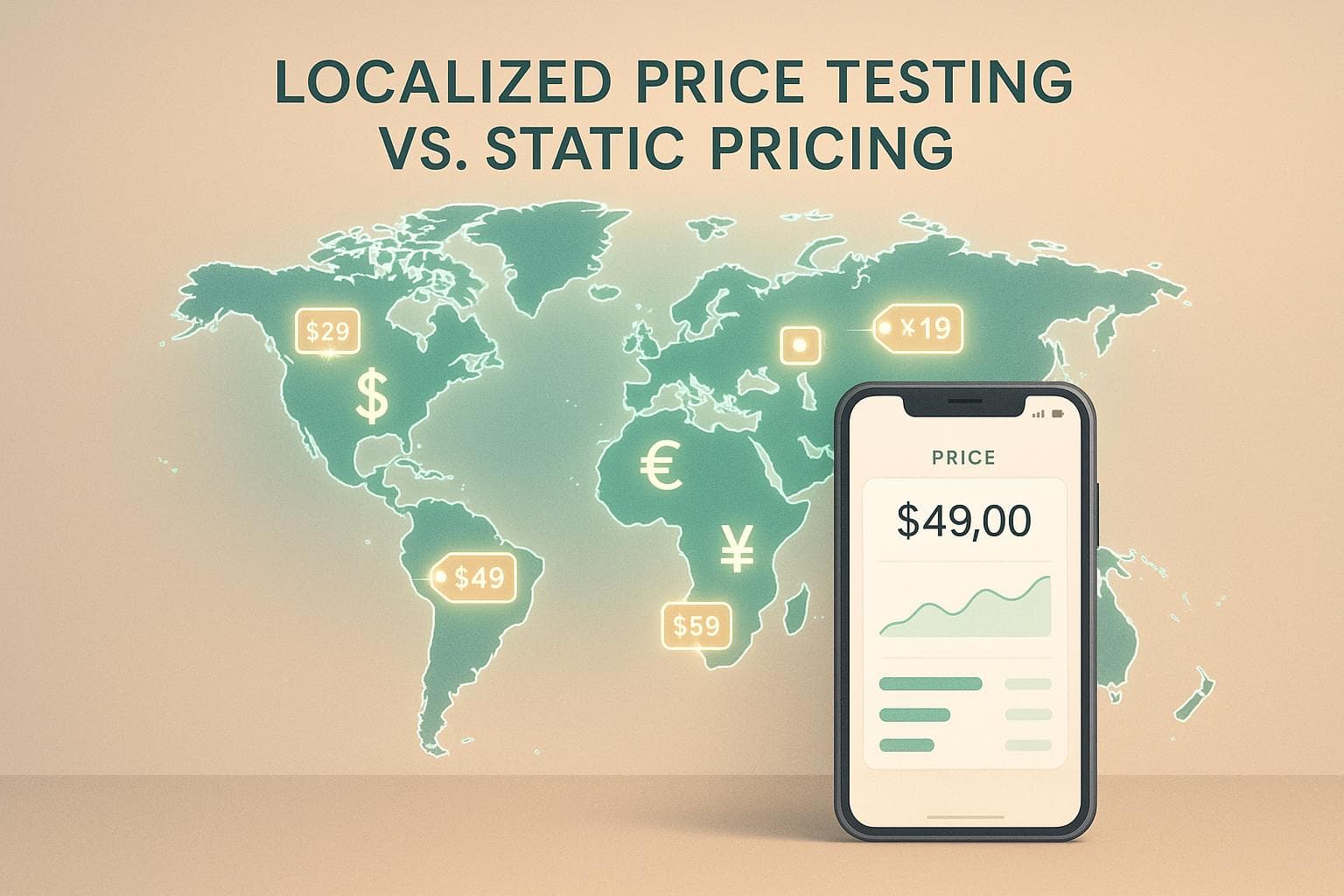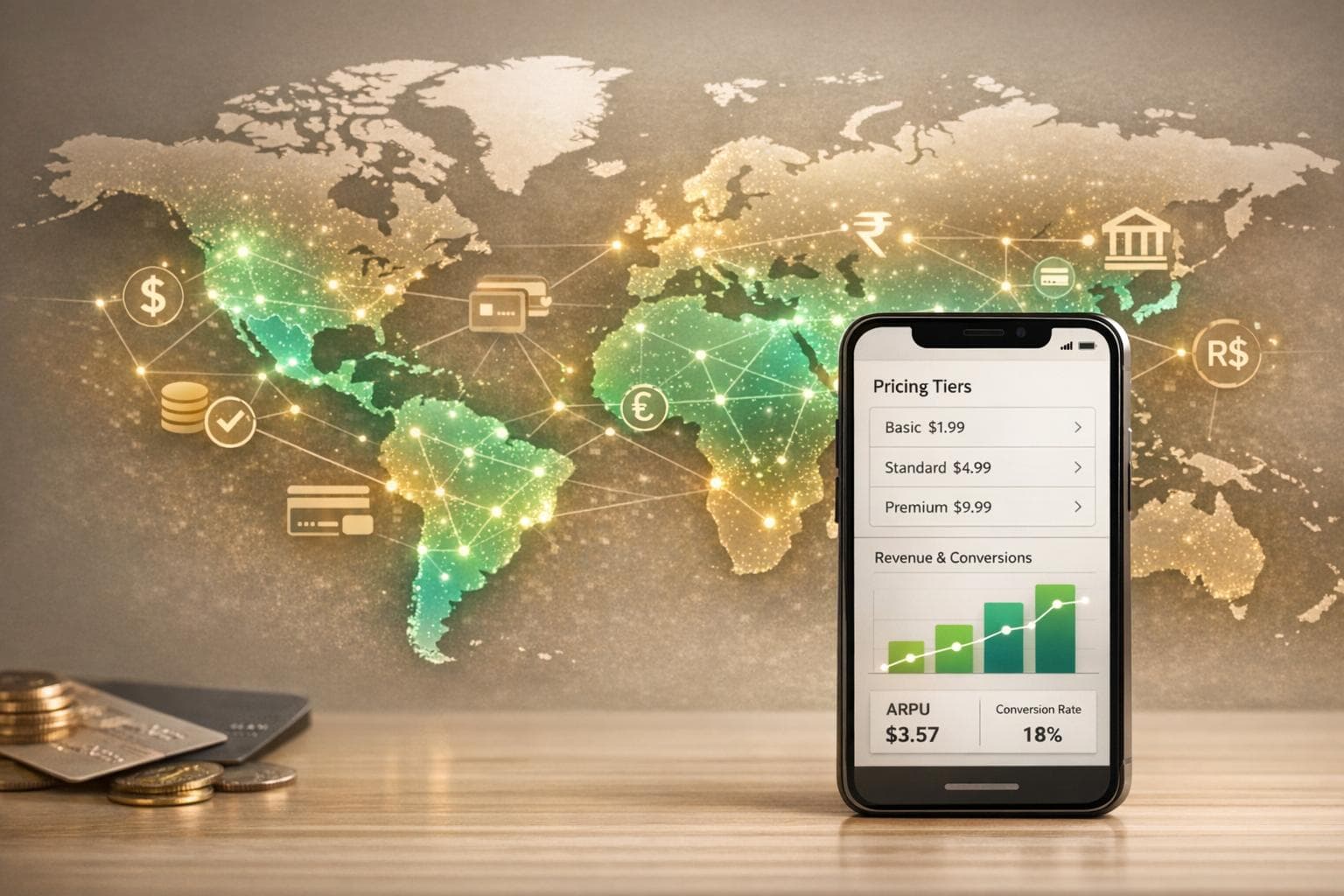
Emerging markets like India, Brazil, and Indonesia offer huge growth opportunities for app developers, but pricing strategies designed for wealthier economies often fail here. To succeed, you need to set prices that reflect local incomes, payment behaviors, and economic conditions. Here’s what works:
- Localized Pricing: Adjust prices based on local purchasing power, not just currency conversion. A $9.99 subscription in the U.S. might be $1.99 in India.
- Micro-Transactions: Smaller, affordable options like $0.99 daily passes or weekly subscriptions perform better than high-cost monthly plans.
- Alternative Payments: Many users rely on methods like UPI, carrier billing, or e-wallets due to low credit card usage.
- Data-Driven Adjustments: Use metrics like Purchasing Power Parity (PPP), conversion rates, and churn to optimize pricing.
- Tiered Plans: Offer a low-cost entry tier to attract price-sensitive users while keeping premium options.
Apps that embrace these strategies - like Netflix’s $2.70 mobile plan in India or Spotify’s $1.40 subscription - often see revenue growth of 20–40% in emerging markets. Tools like Mirava simplify managing regional pricing, ensuring your strategy stays profitable and competitive.
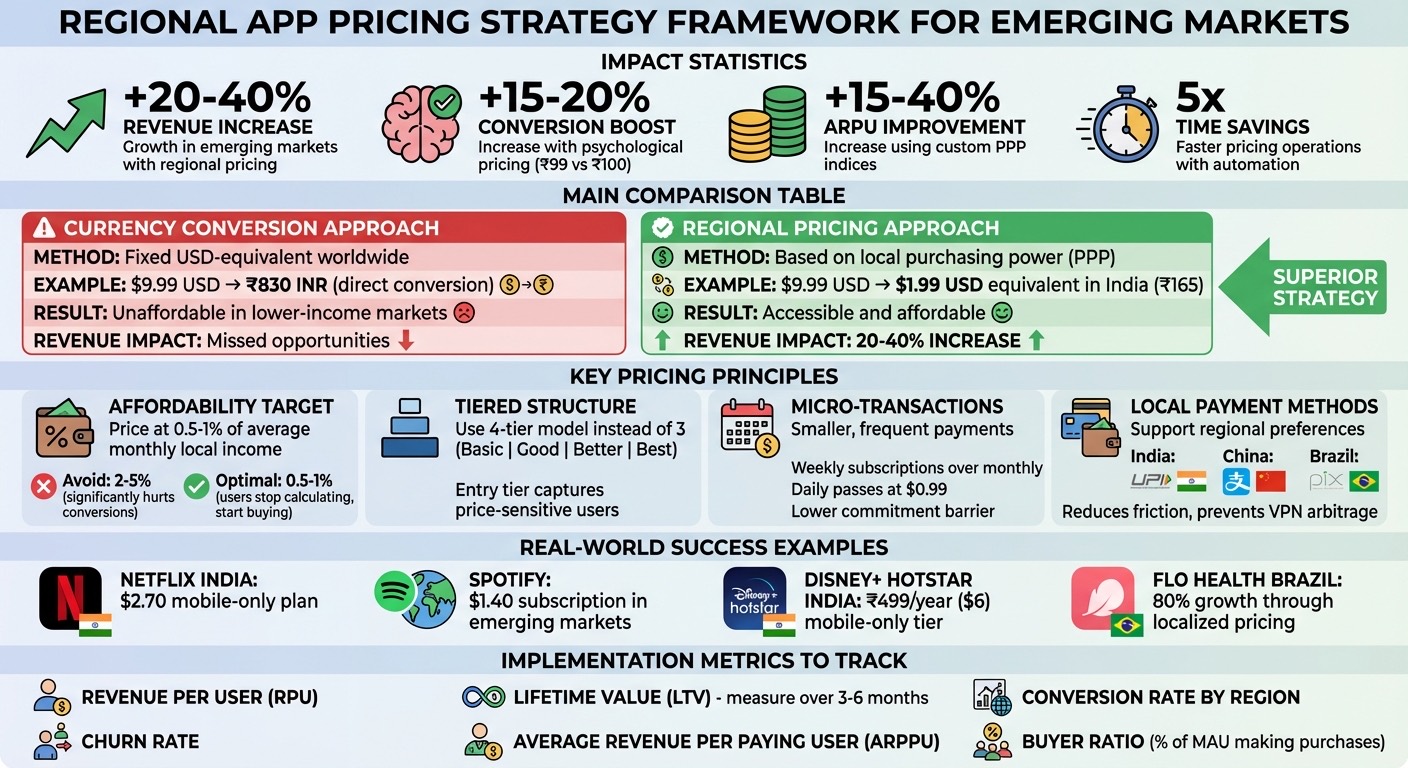
Regional App Pricing Strategy Framework for Emerging Markets
Price Localization Fundamentals
What Is Price Localization?
Price localization is about more than just converting a U.S. dollar price into another currency. It’s a thoughtful approach to setting app prices based on local purchasing power, economic conditions, and cultural expectations. Unlike Apple's localized pricing system and Google's equivalent, which primarily rely on exchange rates and taxes, true price localization considers the value a product holds for customers in different regions. As growth specialist Daphne Tideman puts it:
"A system that's focused entirely on business mechanics, with no regard for customer value, was never going to succeed long-term." [1]
The distinction between simple currency conversion and regional pricing is crucial. Currency conversion applies a fixed USD-equivalent price worldwide, which can make an app unaffordable in lower-income markets. Regional pricing, on the other hand, adjusts based on local income levels and perceived value, often leading to better accessibility and increased revenue potential. For example, adopting regional pricing could boost revenue by 20–40% [5].
Take an English-learning app as an example. It might be priced higher in France or Spain, where English proficiency is seen as a valuable professional skill, than in the U.S. This approach highlights how regional pricing aligns with local economic realities and customer expectations.
Understanding User Willingness to Pay
What feels affordable in one country might be out of reach in another. For instance, a $9.99 subscription may work well for U.S. customers but could be a financial stretch in many emerging markets. This is where Purchasing Power Parity (PPP) becomes a useful tool. It helps developers determine what a U.S. price would feel like in local terms, ensuring prices align with what users in different regions can afford.
The benefits of tailoring prices to local affordability are clear. Studies show that adjusting pricing at the country level can lead to a 20–40% increase in revenue outside the U.S. [5]. By making prices more accessible, you not only capture a wider audience but also boost revenue through higher sales volume.
However, pricing isn’t just about affordability. Developers must also consider fees and taxes when setting prices to ensure profitability.
Platform Fees and Taxes
When crafting a pricing strategy, it’s essential to calculate what you’ll actually keep after platform fees and taxes. App store commissions can take a significant cut, and taxes like VAT or GST vary greatly by country. For instance, overlooking a 15% VAT could seriously impact your profit margins [3].
This issue is especially pressing in emerging markets, where lower price points are common. If an app is priced at $2.99 in Brazil, developers must account for a 30% platform fee and local taxes to ensure the app remains profitable.
Additionally, offering local payment methods - like UPI in India, Alipay in China, or Pix in Brazil - can help reduce purchase barriers and improve conversion rates. However, these payment processors often come with their own fees [3][6]. To safeguard profits, it’s important to establish a price floor that accounts for these costs, particularly in regions with lower purchasing power. This ties directly into the strategies for ongoing optimization discussed later [5].
Data-Driven Pricing Framework
Segmenting Markets by Purchasing Power
Most major app platforms use a one-size-fits-all pricing strategy across more than 150 countries, which often results in missed revenue opportunities [5]. A smarter approach involves segmenting markets based on economic realities. Metrics like Purchasing Power Parity (PPP) and GDP per capita can help uncover what users in different regions can actually afford. For instance, Apple suggests a 21% price reduction for India, though more refined strategies might adjust prices by as much as 50–80% [1].
You can also use Local Purchasing Power (LPP), which compares an average wage earner's buying capacity to a benchmark like New York City. This method highlights regional differences, even within large countries. Differences in conversion rates can also signal pricing mismatches [1]. Additionally, competitor benchmarking - such as using mobile app pricing tools to create a custom index of 10 relevant global and local apps - provides valuable insights into regional pricing norms.
These methods help you calculate precise regional price multipliers.
Setting Regional Price Multipliers
Once you've segmented your markets, the next step is calculating regional price adjustments. Start by using the PPP conversion factor from trusted sources like the World Bank or OECD. For example, if your app costs $9.99 in the U.S. and India's PPP factor is 0.25, a good starting price for India would be around ₹249 [3]. However, PPP alone isn't enough. You also need to set a price floor to cover platform fees and local taxes.
Another effective strategy is to use a four-tier pricing model - basic, good, better, best - instead of the usual three-tier approach. This works particularly well in emerging markets, catering to both budget-conscious users and premium-seeking customers [2]. For testing, try three price variants in each region: one based on PPP, another 20% higher, and one 20% lower. Aim for at least 1,000 users per variant and a 95% confidence level before finalizing changes. Avoid testing minor price differences (e.g., $39 vs. $43); bold shifts like $39 vs. $69 provide clearer insights into price elasticity [1].
Measuring Key Performance Metrics
After setting regional price multipliers, it's crucial to track key metrics to evaluate and refine your strategy. Metrics like Revenue Per User (RPU) and Lifetime Value (LTV) are essential, though LTV often requires 3–6 months for accurate measurement.
Keep an eye on conversion rates, churn rates, and refund rates together. For example, high engagement but low conversion might indicate a pricing misalignment with market expectations [1]. Other useful metrics include Average Revenue Per Paying User (ARPPU) and Buyer Ratio, which measures the percentage of monthly active users making purchases. These metrics can reveal whether you’re optimizing revenue from existing customers or need to focus on attracting more paying users [7].
Be cautious of the novelty effect, where initial enthusiasm fades over time. Testing for at least two to four weeks helps capture more reliable user behavior [3][7]. Finally, in markets with volatile currencies, regularly updating your pricing ensures you stay in sync with shifting economic conditions [7].
Regional Pricing Strategies
Let’s dive into practical strategies for tailoring pricing to regional markets, building on the fundamentals and data-driven framework we’ve already discussed.
Designing Entry-Level Pricing
In emerging markets, a low-cost entry tier can open the door to a much larger audience. The typical three-tier pricing model - Good, Better, Best - often leaves out price-sensitive users. Instead, consider a four-tier structure: Basic, Good, Better, and Best. The "Basic" tier should be priced minimally to attract users with tighter budgets [2].
Another effective approach is offering micro-subscriptions, such as weekly plans. These smaller packages lower the commitment barrier and keep the upfront cost manageable, even if the daily rate is slightly higher. For example, Impulse, a brain training app, removed its annual subscription option in Brazil and focused on weekly and lifetime plans to better align with local spending habits [1].
Mobile-only tiers are another smart way to lower entry barriers without undercutting premium plans. Disney+ Hotstar in India, for instance, introduced a mobile-only plan priced at ₹499 per year (about $6). This approach captures budget-conscious users while preserving higher-tier options for those seeking multi-device access.
"When your app costs 2-5% of someone's monthly income, they simply won't convert. But price it at 0.5-1% of local income? Suddenly, users stop calculating 'is this worth it?' and start thinking 'can I afford this?'" - Zoë Castillo, Mirava [8]
A good rule of thumb is to price your app so it represents 0.5-1% of the average local monthly income. Pricing above this range - closer to 2-5% - can significantly hurt conversion rates [8]. Additionally, small adjustments like using ₹99 instead of ₹100 can boost conversions by 15-20% [8].
Managing Currency Volatility
Emerging markets often deal with unstable currency values, which can quickly make your pricing uncompetitive or even unprofitable. One option is to manually update exchange rates, such as using Google Play’s tools [9]. However, this can be time-consuming and reactive.
A better solution is automated PPP syncing. By using tools that adjust prices based on Purchasing Power Parity, you can ensure your pricing stays aligned with what users can realistically afford, even as economic conditions shift [3]. This approach is more dynamic and helps maintain balance between affordability and profitability.
To safeguard your margins, set a profit floor that accounts for platform fees, taxes, and base costs. This prevents extreme currency devaluation from eating into your earnings [5]. Apps that implement smart regional pricing strategies often see revenue increases of 35-50% [8].
"Currency localization is optics. Regional pricing is strategy." - Zoë Castillo, Mirava [8]
Keep an eye on metrics like Revenue Per User (RPU) and Lifetime Value (LTV) for each region. If you notice a drop in conversion rates or a rise in refund requests, it’s a sign that your pricing may no longer align with local economic realities [8][3].
These adjustments also set the stage for adapting to local payment preferences, which we’ll cover next.
Adapting to Local Payment Behaviors
Pricing isn’t the only factor that matters - how users pay is equally important. In many emerging markets, so-called "alternative" payment methods like eWallets, QR codes, and real-time transfers are actually the primary ways people make transactions [10]. Ignoring these preferences can create unnecessary friction and hurt conversions.
For instance, weekly subscriptions align well with how many users in these markets manage their finances. Smaller, frequent payments feel less risky, especially for first-time subscribers [1].
Requiring local payment methods can also validate residency and prevent VPN-based price arbitrage. For example, mandating UPI in India or Alipay in China ensures that only legitimate local users can access region-specific pricing [8].
A real-world example: Flo Health experienced substantial growth by tailoring its pricing and payment options to local conditions in Brazil. By significantly lowering prices and catering to local purchasing power, they achieved 80% growth in non-English-speaking markets, with Brazil becoming their third-largest market globally [1].
To further reduce friction, offer customer support in the local language. This builds trust and makes users more comfortable completing transactions [6]. Combined with thoughtful regional pricing, these adjustments can increase app revenue by 25-40% across all markets [8].
Together, these strategies form a comprehensive approach to optimizing app pricing for emerging markets.
sbb-itb-43fe43a
Scaling and Automating Pricing with Mirava
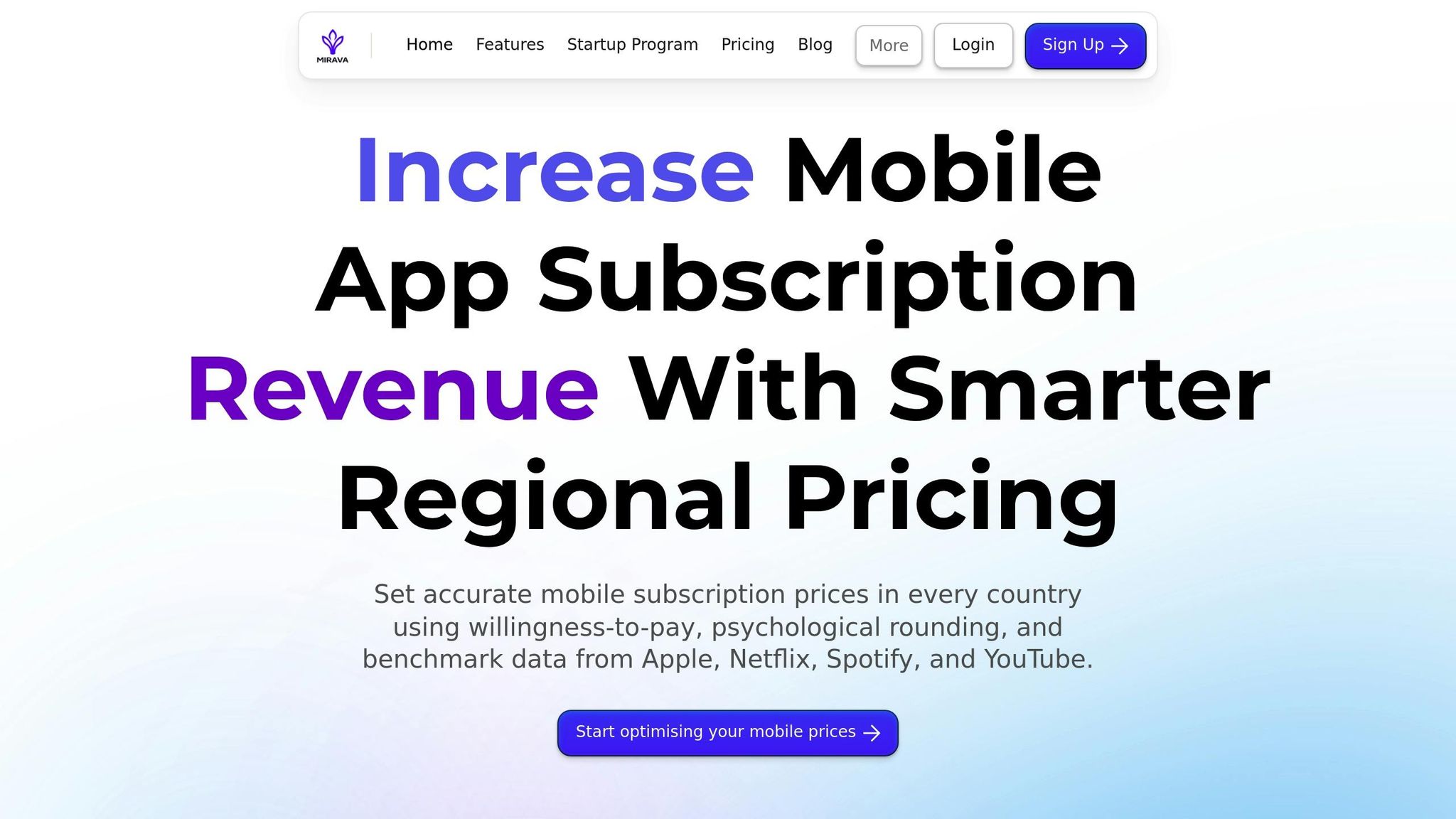
Expanding on the regional pricing strategies mentioned earlier, Mirava takes the complexity out of scaling and automating your pricing efforts. Managing regional pricing manually across multiple countries can quickly become overwhelming. Add the need to update prices separately on iOS, Android, and web platforms, and the workload - and risk of errors - skyrockets. Mirava simplifies this by centralizing pricing management, allowing you to control everything from a single dashboard while syncing updates seamlessly across App Store and Google Play.
Simplifying Pricing Updates Across Platforms
Mirava’s batch update feature is a game-changer. It enables you to adjust prices across more than 170 countries with just one click. No more logging into multiple platforms - define your pricing strategy once, and Mirava ensures it’s applied everywhere. For example, a fitness app developer using Mirava reduced their pricing update time from two weeks to just two hours across 50 countries. This swift reaction to currency fluctuations in Latin America led to a 20% boost in conversions [12][15].
Mirava integrates directly with Apple and Google APIs, ensuring compliance with app store policies. Updates typically go live within 24–48 hours [11]. The platform also takes platform fees into account automatically, helping you maintain your net revenue. Plus, it applies psychological pricing adjustments tailored to local buying behaviors, rounding prices to familiar endings like .99, .00, or .95 [11].
Leveraging Mirava's PPP and Custom Indices
Mirava uses Purchasing Power Parity (PPP) indices to align prices with local economic realities. For instance, a $9.99 subscription in the U.S. might be priced at $1.99 in India, reflecting what users in that market can reasonably afford [12][14]. Beyond PPP, you can create custom indices by combining it with regional ARPU (Average Revenue Per User) data. This approach often increases ARPU by 15–40% compared to standard localization methods [13][14].
The platform also incorporates a Willingness-To-Pay (WTP) algorithm, which uses demand signals to refine pricing multipliers. For instance, it might apply a 0.3x multiplier for Latin America versus a 1.0x multiplier for the U.S. Mirava even maps these calculated prices to the nearest app store price tiers automatically [11][12].
Building a Continuous Optimization Process
Once you have accurate pricing indices, the next step is ongoing optimization. Pricing isn’t a one-and-done decision; it requires constant fine-tuning. Mirava supports this with analytics dashboards, and our guide to testing regional pricing covers how to validate a change through your paywall layer. These tools let you monitor key metrics like conversion rates, ARPU, churn, and LTV by region. Price changes apply on your approval, or within rules-based caps you set [14][15].
Take the case of an education app in India. They tested a $0.99 introductory monthly price and, after 30 days, adjusted it to $1.49. This small change resulted in a 30% increase in retention and steady revenue growth [12][16]. With Mirava, pricing becomes a systematic, data-driven process rather than a guessing game. Most users report revenue increases of 15–40%, while pricing operations run up to five times faster compared to manual methods [11].
Conclusion
Key Lessons
Successfully pricing products in emerging markets begins with understanding local economic conditions. Using Purchasing Power Parity (PPP) data is a smart first step, but refining it through mobile app pricing experiments with over 1,000 users per variant helps strike the right balance between maximizing volume and profit [3][7]. This structured approach can lead to a 150–300% revenue increase in new markets within 6–12 months [3].
"Every global app should take the time to consider the right time to start price localization. This is such a major opportunity for you to maximize your revenue... without having to build a single additional feature."
- Daphne Tideman, Growth Specialist [1]
Adopting regional pricing strategies can increase revenue by 22–35% while boosting lifetime value by 25–40%. This happens because localized pricing reduces churn and improves how fair customers perceive your pricing to be [8]. The key is to approach pricing decisions strategically and ensure they’re measurable. Start by optimizing your primary market and use it as a reference for setting regional multipliers. For high-revenue markets, monitor currency fluctuations weekly, as platform-default pricing updates are often delayed during economic changes [4]. And don’t forget: when adjusting base prices on Google Play, back up your manual overrides - those changes can wipe out all your optimizations unexpectedly [4].
These strategies set the stage for implementing tools like Mirava to streamline and optimize regional pricing.
How Mirava Simplifies Regional Pricing
Mirava takes the complexity out of regional pricing, making execution easier and more effective. Managing pricing manually across 175+ countries and multiple platforms often leads to errors and missed opportunities. Mirava’s visual dashboards allow you to track performance by region, make data-driven adjustments, and automate compliance and pricing calculations.
Teams that switch to automated regional pricing with Mirava can better align prices with local purchasing power, helping to lift conversions in emerging markets like Southeast Asia.
"Regional pricing isn't a discount tactic - it's a revenue strategy built on empathy and data."
- Zoë Castillo, Mirava [8]
With Mirava handling the intricate details, you can concentrate on creating exceptional products while your pricing strategy works harder in every market.
FAQs
How can app developers set the right price for users in emerging markets?
To find the right price for users in emerging markets, developers should turn to purchasing power parity (PPP) data and A/B testing. Start by setting a base price in USD, then use trusted PPP multipliers - like those from the World Bank - to calculate prices for different regions. A good rule of thumb is to aim for a price that’s about 0.5% to 1% of the average user’s monthly income, as anything higher might discourage conversions.
Once you’ve calculated these prices, validate them with A/B testing. Compare the PPP-based price to a straightforward currency conversion price. Tools like the Play Console can help you track key metrics, such as conversion rates, retention, and lifetime value, over a meaningful test period. Use the results to refine your pricing strategy and settle on what works best.
It’s also important to monitor local economic conditions, including inflation and currency changes, and adjust your pricing and testing accordingly. This ensures that your pricing stays relevant, encourages more users to adopt your product, and supports steady revenue growth.
What makes micro-transactions effective in emerging markets?
Micro-transactions work exceptionally well in emerging markets because they let developers adjust prices to match local buying power. Instead of demanding a hefty upfront payment, they offer affordable, pay-as-you-go options. This makes apps more accessible, attracting more users and increasing both downloads and conversions. For audiences mindful of costs, this approach eliminates financial barriers.
Another advantage is the consistent and ongoing revenue stream micro-transactions generate. Developers can earn steadily from active users over time, which helps maintain operations and fund updates. Plus, their low price point often leads to impulse buys - users are more inclined to spend on small, inexpensive items, which can significantly boost overall revenue and lifetime value.
By blending affordability, increased access, and recurring income, micro-transactions enable developers to grow their revenue while keeping their apps budget-friendly for price-conscious users in these regions.
Why is it important to offer local payment methods for apps in emerging markets?
Adapting to local payment methods is crucial for thriving in emerging markets, where traditional credit cards aren't always the go-to option. In areas like Africa, Asia, and Latin America, many people prefer e-wallets, mobile money platforms, real-time bank transfers, or even cash to complete transactions. Overlooking these preferences could result in abandoned carts and missed revenue opportunities.
By incorporating payment methods that locals already trust - such as widely-used regional e-wallets or mobile money services - you can minimize barriers, increase conversion rates, and keep users coming back. Aligning your app with the financial habits of these markets not only makes subscribing, shopping, and interacting with your app more seamless but also opens doors to the revenue potential of these rapidly growing economies.