
When running a subscription business globally, currency fluctuations can distort key metrics like Monthly Recurring Revenue (MRR) and Average Revenue Per User (ARPU). A weakening local currency can reduce the USD value of subscriptions, even if prices and customer behavior remain unchanged. This can lead to:
- MRR Instability: Exchange rate changes make revenue appear inconsistent.
- Retention Misreads: Stable renewals may look like downgrades when converted to USD.
- Higher Churn Risk: Delayed price adjustments can make subscriptions unaffordable in weaker economies.
- Time Burdens: Manual pricing adjustments are slow and error-prone.
Tools like Mirava handle this through price localization, recommending per-market prices built from real subscription transaction data, the Mirava Index, instead of chasing exchange rates. You approve each change yourself, or set rules and caps that keep updates inside bounds you define. For apps with a global customer base, that turns pricing upkeep from a recurring fire drill into a quick review.
Corporate Finance Explained | The Financial Strategies of Subscription-Based Businesses
1. Manual Regional Pricing Adjustments
Many developers manage regional pricing by manually setting prices for each market. Typically, this involves establishing a base price in USD and adjusting it for local currencies like EUR, GBP, or BRL. While this method gives developers full control, it comes with some major drawbacks that can disrupt subscription metrics. Let’s take a closer look at how these manual adjustments can skew revenue data.
Revenue Stability (MRR & ARPU)
Manually set prices mean that exchange rate fluctuations directly impact your Monthly Recurring Revenue (MRR) and Average Revenue Per User (ARPU). Even if customer behavior doesn’t change, end-of-period currency conversions can make your MRR appear unstable. This creates ongoing noise in your revenue metrics, making it harder to get a clear picture of performance. Many platforms have documented this issue[4]. Without frequent updates to reflect exchange rate changes, your revenue data becomes inconsistent and less reliable.
Retention & Churn Impact
Delayed price adjustments can also lead to increased churn. When a local currency weakens - say, if the Euro takes a sharp dip - the actual cost of a subscription rises for customers, even if the local price hasn’t been updated[5]. By the time you manually lower prices to account for the change, some customers may have already canceled their subscriptions. SaaS Capital suggests calculating retention MRR based on the exchange rate at the time of contract signing or renewal, rather than the current rate, to avoid volatility that distorts retention metrics[3]. Otherwise, exchange rate fluctuations can create artificial churn, masking genuine customer behavior and complicating analysis.
Time Efficiency
Manual pricing updates can be incredibly time-consuming. Growth teams often describe the process as overwhelming because it involves juggling spreadsheets and complex pricing rules. On top of that, app store price changes typically take 24–48 hours to be approved, making it nearly impossible to respond quickly to sudden currency shifts. Automated pricing tools, on the other hand, can roll out the same updates far faster, letting teams launch country-specific pricing in under an hour instead of wrestling with spreadsheets for days.
Compliance & Scalability
As your app expands globally, managing manual pricing becomes increasingly unsustainable. You’ll need to ensure that regional prices align with app store tier requirements, local tax laws (like VAT or GST), and psychological pricing norms. Failure to update prices consistently across platforms like iOS and Android can lead to discrepancies that confuse customers and may even violate platform policies. Keeping a detailed audit trail in spreadsheets is essential for financial reporting, but as your reach grows, this method becomes error-prone and difficult to maintain.
Moving from a single global price to optimized, localized pricing often unlocks meaningful gains in global revenue. However, achieving this requires either significant manual effort or leveraging automated tools that ensure compliance, synchronization, and scalability. These challenges highlight why automated pricing solutions are becoming indispensable - a topic we’ll explore next.
2. Automated Pricing Tools like Mirava

Pricing platforms such as Mirava tackle the challenges of manual pricing by recommending per-market prices from real transaction data, then applying the updates you approve or that fall inside rules and caps you set. Unlike manual spreadsheet rounds - which often lag behind market changes - a standing review cadence keeps pricing accurate and up to date. This means your monthly recurring revenue (MRR) stays steadier, even when currencies like the Euro or Brazilian Real fluctuate against the U.S. dollar. These tools help maintain your revenue goals across all markets without constant manual intervention.
Revenue Stability (MRR & ARPU)
Manual pricing often creates inconsistencies in revenue metrics due to delayed adjustments for exchange rate changes. Mirava addresses this by stabilizing MRR and average revenue per user (ARPU) through its centralized dashboard, where teams can set foreign exchange (FX) rates and apply custom multipliers. Using a Willingness-To-Pay (WTP) algorithm, the platform adjusts regional price tiers based on local purchasing power and demand. This keeps ARPU within targeted ranges, even in unpredictable markets, reducing artificial FX-related churn. The result? Revenue trends become more predictable, which is invaluable for forecasting and investor reporting. A stable revenue base also supports better retention metrics.
Retention & Churn Impact
By aligning local prices with what customers can reasonably pay, automated pricing helps reduce avoidable churn. In emerging markets, high prices caused by weak local currencies or lower incomes often lead to increased churn and downgrades. Mirava addresses this by keeping prices affordable while still meeting ARPU and margin targets. This approach not only improves gross revenue retention (GRR) but also boosts net revenue retention (NRR), strengthening the overall health of subscription-based businesses.
Time Efficiency
Updating prices manually can be a time-consuming process, often taking hours or even days. Mirava simplifies this by replacing clunky spreadsheets with a centralized dashboard that can push updates directly to platforms like the Apple App Store and Google Play Store. Supporting pricing management in over 170 countries, Mirava makes the process substantially faster compared to manual methods. Many teams avoid touching regional pricing simply because doing it by hand feels like too much work - automation removes that friction, letting them test new strategies without wrestling with spreadsheets or App Store rules.
Price updates are reflected on app stores within 24–48 hours, providing the speed and reliability necessary for global growth.
Compliance & Scalability
As your app grows internationally, pricing compliance becomes increasingly complex. Automated pricing platforms like Mirava account for region-specific tax rules and app store fee structures in their calculations. They also adapt to evolving tax regulations and commission changes, ensuring that pricing remains consistent and compliant across all markets. Store credentials are stored encrypted and isolated to your account, allowing U.S.-based teams to oversee hundreds of localized prices from a single dashboard. This eliminates the need for region-specific pricing analysts while accommodating local FX rates, purchasing power, and competitive factors.
sbb-itb-43fe43a
Pros and Cons
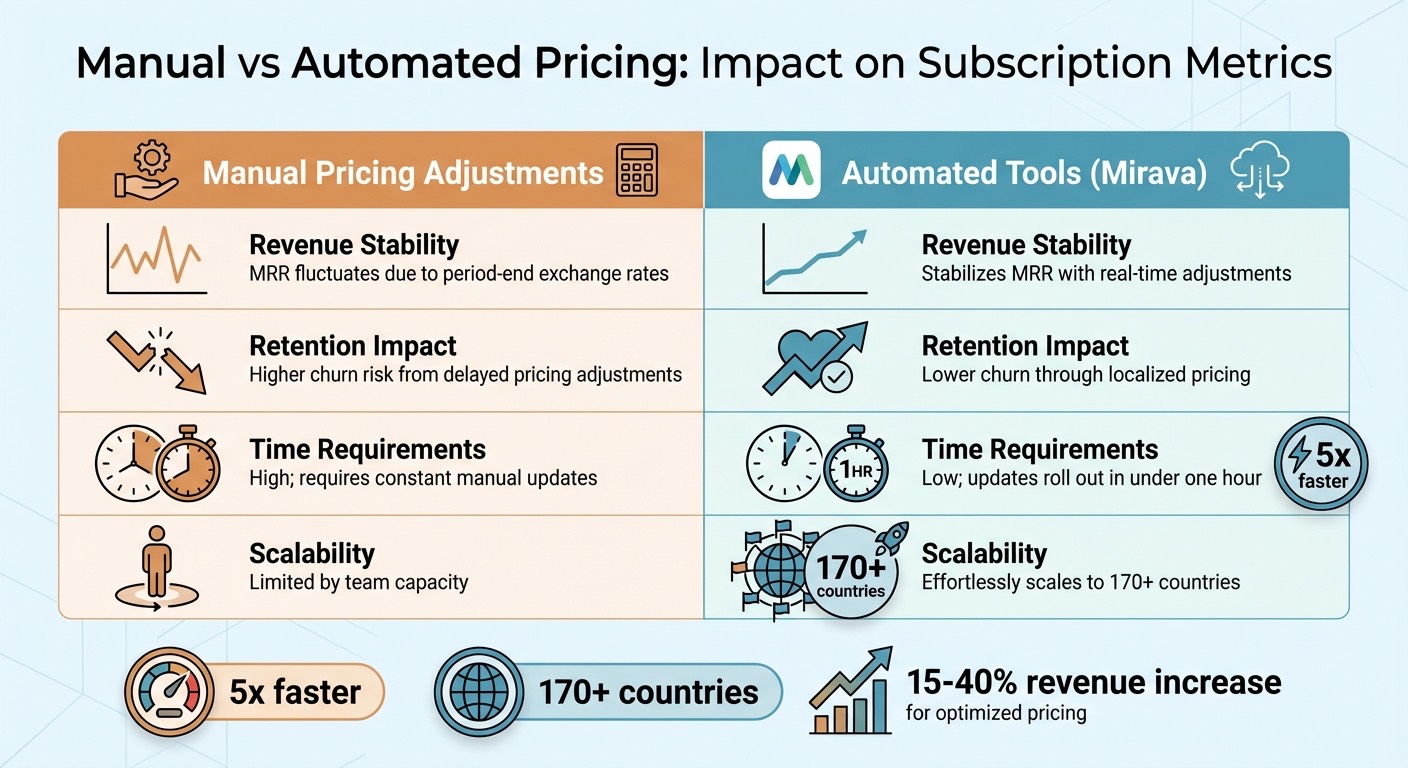
Manual vs Automated Pricing: Impact on Subscription Metrics
Deciding between manual pricing adjustments and automated tools like Mirava boils down to weighing control against efficiency, stability, and scalability. Each approach has its strengths and trade-offs, and understanding these can help you make the right choice for your business.
Manual pricing gives you complete control over how prices are adjusted. You can fine-tune prices based on specific market insights or strategies. However, this level of control comes with challenges. For one, manual pricing leaves your monthly recurring revenue (MRR) at the mercy of exchange rate fluctuations, especially at the end of financial periods, making forecasting a headache [2]. Retention can also take a hit - if you’re slow to react to currency drops, customers in emerging markets might find your app suddenly too expensive, leading to increased churn [5]. On top of that, manual adjustments demand constant attention and effort, which becomes unmanageable as you expand into more markets.
Automated tools like Mirava, on the other hand, prioritize efficiency and stability. Recommendations come from real transaction data, and updates go live on your approval or inside rules-based caps you define, keeping pricing aligned with what customers in different regions can afford and steadying MRR through currency swings. Time investment is significantly reduced - approved updates can roll out in under an hour, making operations dramatically faster than manual methods. Scalability is another key advantage, as you can manage pricing across 170+ countries from a single dashboard without needing to expand your team.
Here’s a side-by-side comparison to highlight the differences:
| Aspect | Manual Pricing Adjustments | Automated Tools (Mirava) |
|---|---|---|
| Revenue Stability | MRR fluctuates due to period-end exchange rates [2] | Steadier MRR through approved, localized updates [2] |
| Retention Impact | Higher churn risk from delayed pricing adjustments [5] | Lower churn through localized pricing [5] |
| Time Requirements | High; requires constant manual updates [2] | Low; updates roll out in under one hour |
| Scalability | Limited by team capacity [6] | Effortlessly scales to 170+ countries |
Conclusion
Deciding between manual and automated pricing depends largely on your business’s size and available resources. While manual pricing provides a sense of control, it leaves your monthly recurring revenue (MRR) vulnerable to exchange rate swings and slows your ability to respond to market changes. Apps with a significant share of non-U.S. revenue or multi-regional pricing models often face delays and inefficiencies when relying on manual adjustments [2]. This highlights how automated pricing can better handle currency fluctuations and safeguard revenue streams.
On the other hand, automated tools like Mirava offer a more dynamic solution. They continuously adjust prices to reflect local purchasing power, helping to stabilize revenue metrics like gross revenue retention (GRR) and net revenue retention (NRR). This not only protects revenue but also helps reduce churn. For U.S.-based teams reporting in USD, automation simplifies dashboards and reduces unexpected revenue variances.
As discussed, automation plays a key role in optimizing subscription metrics during periods of currency instability. By cutting pricing updates from days to under an hour, automated systems allow teams to focus on growth and product innovation. For growing apps, this efficiency becomes even more impactful. Managing global pricing from a single dashboard transforms pricing from a reactive process into a proactive strategy, giving businesses a critical edge in scaling effectively.
FAQs
How do currency fluctuations affect subscription revenue and user metrics?
Currency fluctuations can have a noticeable impact on subscription revenue and key metrics like Monthly Recurring Revenue (MRR) and Average Revenue Per User (ARPU). For instance, if a local currency weakens against the US dollar, the value of subscriptions from that region decreases when converted to USD, which can drag down overall revenue. On the flip side, a stronger local currency can boost revenue. These shifts can also influence user behavior - pricing inconsistencies caused by currency changes might lead to dissatisfaction or even cancellations.
One way to navigate these challenges is by implementing region-specific pricing strategies that take currency fluctuations into account. This approach helps stabilize revenue while maintaining user trust. Tools like Mirava simplify the process by optimizing pricing to align with local market conditions, ensuring subscriptions remain fair and competitive while helping businesses protect their bottom line.
What are the advantages of using automated pricing tools like Mirava instead of adjusting prices manually?
Automated pricing tools, such as Mirava, streamline the challenge of managing regional pricing by turning real transaction data into per-market recommendations you approve or bound with rules and caps. These tools help keep your prices competitive by factoring in variables like currency shifts and local market conditions.
With pricing automation, you can save valuable time, reduce manual mistakes, and respond swiftly to market changes. This approach not only boosts revenue potential but also ensures your pricing strategies reflect local market dynamics, delivering a smooth and tailored experience for your customers.
How can businesses manage global subscription pricing while staying compliant and scalable?
To handle global subscription pricing efficiently, businesses can use tools like Mirava to simplify the process. Mirava ensures regional pricing stays consistent across app stores and payment platforms by accounting for factors like currency changes, local purchasing power, and market dynamics.
By automating these updates and aligning prices with real-time data, businesses can stay compliant with regional regulations while expanding their global reach. This approach not only makes pricing management easier but also supports better revenue growth and improved customer retention.