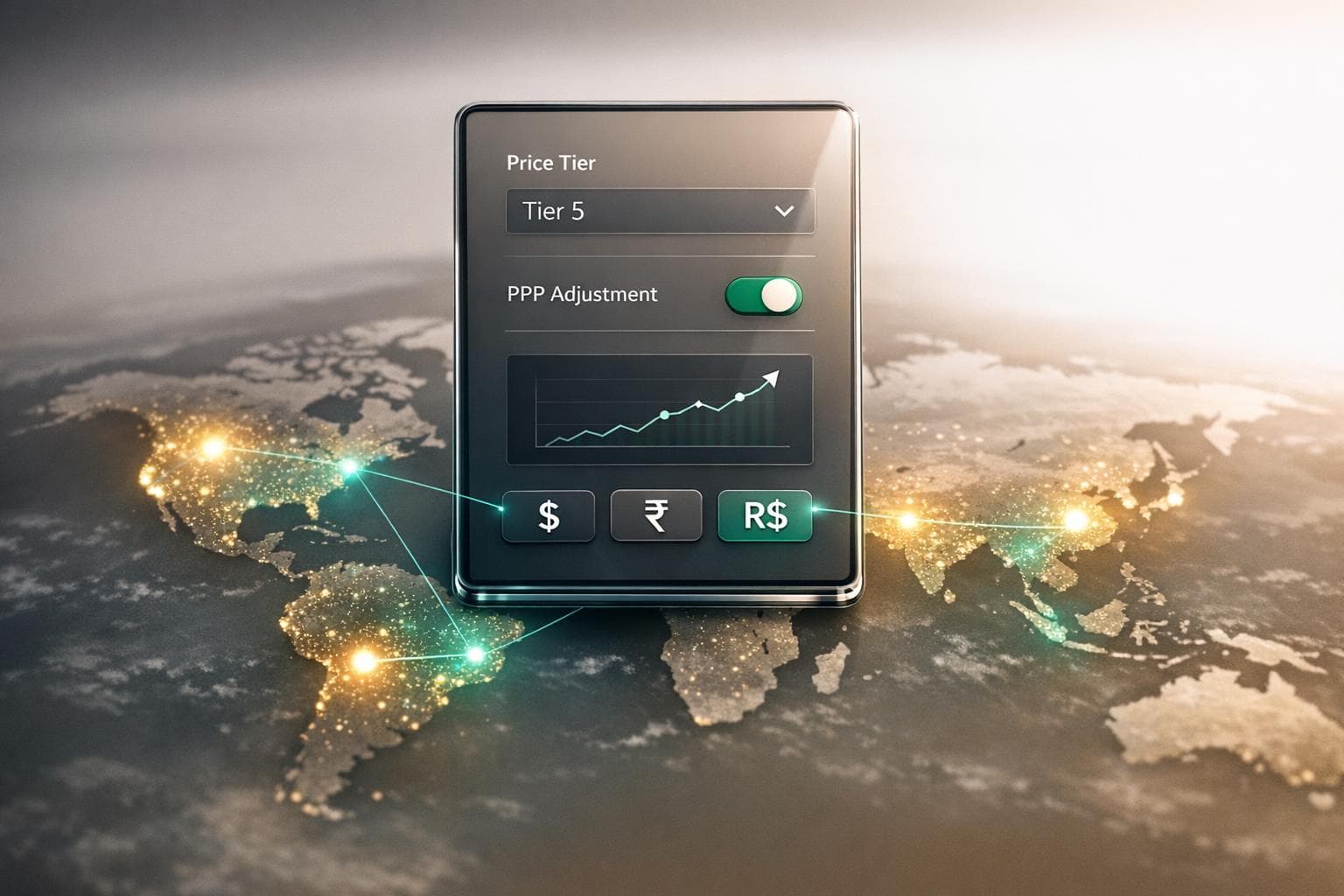
Balancing price sensitivity and revenue growth is a challenge for app developers. Price too low, and you're leaving money on the table. Price too high, and you risk losing users. Here's what you need to know:
- Price Sensitivity: Measures how users react to price changes. Lower prices can boost conversions but may attract users who churn quickly.
- Revenue Growth: Focuses on increasing income through higher prices, more subscribers, or both. This often results in fewer users but higher lifetime value (LTV) per user.
- Localized Pricing Works: Aligning prices with local purchasing power, rather than charging one global price, tends to lift conversions and revenue in cost-sensitive markets without adding traffic. Willingness-To-Pay (WTP) models help find the price each market will actually bear.
- Tools Matter: Automated tools like Mirava simplify managing regional pricing across 170+ countries, enabling faster updates and better alignment with local markets.
The takeaway? A data-driven approach that balances these two strategies, especially with regional pricing, can maximize both user acquisition and long-term profitability.
How to price your subscription app globally - Featuring Jacob Rushfinn
1. Price Sensitivity
Price sensitivity measures how users react to changes in pricing. Price it too high, and you risk losing potential customers. Price it too low, and you could attract users who churn quickly while leaving money on the table.
Impact on Conversion Rates
How users respond to pricing can vary widely by region. Many apps that set prices by simple currency conversion find their emerging-market pricing is misaligned with what local users can afford, which depresses conversions and drives early churn. Moving to country-specific pricing that reflects local purchasing power typically takes a fraction of the time teams expect and removes a common reason users abandon checkout.
This underscores the importance of aligning pricing with local purchasing power. For instance, in highly price-sensitive regions, a low-price, high-volume model like CamCard’s $0.99 pricing can be highly effective. On the flip side, premium apps like Crestron succeed with high-price, low-volume strategies in markets where users are less price-sensitive [2]. These insights allow developers to fine-tune their revenue strategies based on regional behavior.
Revenue Optimization Strategies
To avoid undervaluing your app, understanding price elasticity is key. Tools like the Van Westendorp model, which asks users about four price points ("too cheap", "bargain", "expensive", and "too expensive"), can help identify the sweet spot for pricing without resorting to guesswork. Similarly, A/B testing by region or user groups allows you to measure how pricing changes affect conversions before rolling out adjustments widely [4][5]. These methods are essential for adapting to local market conditions.
Regional Pricing Adaptability
Markets differ greatly in terms of purchasing power and competition, so a one-size-fits-all pricing strategy rarely works. Apps that implement well-tuned localized pricing tend to grow revenue in markets that a single global price would otherwise underserve or overcharge. Using actual willingness-to-pay data and psychological pricing (like $4.99 or $9.99) helps create prices that feel natural and appealing to local users.
Mirava makes it easier to manage pricing across 170+ countries, allowing developers to set adaptive rules, adjust for currency fluctuations, or apply custom multipliers, so pricing stays consistent and responsive as conditions change.
2. Revenue Growth
Growing revenue for mobile apps isn't just about attracting more users - it’s about making the most of monetization models and pricing strategies to maximize lifetime value (LTV) while balancing short-term earnings with long-term profitability. For instance, subscription-based apps can achieve higher LTV when users remain actively engaged, whereas one-time purchases may bring in quick cash but often lack ongoing revenue potential.
Revenue Optimization Strategies
To maintain steady revenue growth, developers can fine-tune pricing through targeted experiments. A/B testing different subscription plans or price points can reveal how much users are actually willing to pay. This structured approach helps identify opportunities to tweak pricing and improve revenue outcomes.
Another effective tactic is segmenting pricing based on user behavior. For example, casual users might prefer a more affordable plan, while heavy users could find value in premium subscriptions. Keeping an eye on LTV in relation to acquisition costs ensures that growth remains sustainable. These strategies also need to be adjusted for regional differences to fully tap into diverse markets.
Regional Pricing Adaptability
Region-specific pricing plays a crucial role in driving revenue, as purchasing power and competition vary greatly across markets. A one-size-fits-all pricing strategy often falls short. Adopting localized pricing can make a big difference: moving from a single global price to automated, country-specific pricing makes it realistic to keep prices aligned with what each market is willing to pay, which is where Willingness-To-Pay (WTP) models earn their keep.
Scalability for Developers
Managing pricing across multiple countries manually is a logistical nightmare - it’s slow, error-prone, and drains resources. Automated tools like Mirava simplify this process by enabling regional pricing updates across 170+ countries from a single dashboard. This not only saves time but also ensures developers can focus on creating outstanding apps while staying on top of pricing adjustments that drive both immediate and long-term revenue growth.
sbb-itb-43fe43a
Advantages and Disadvantages
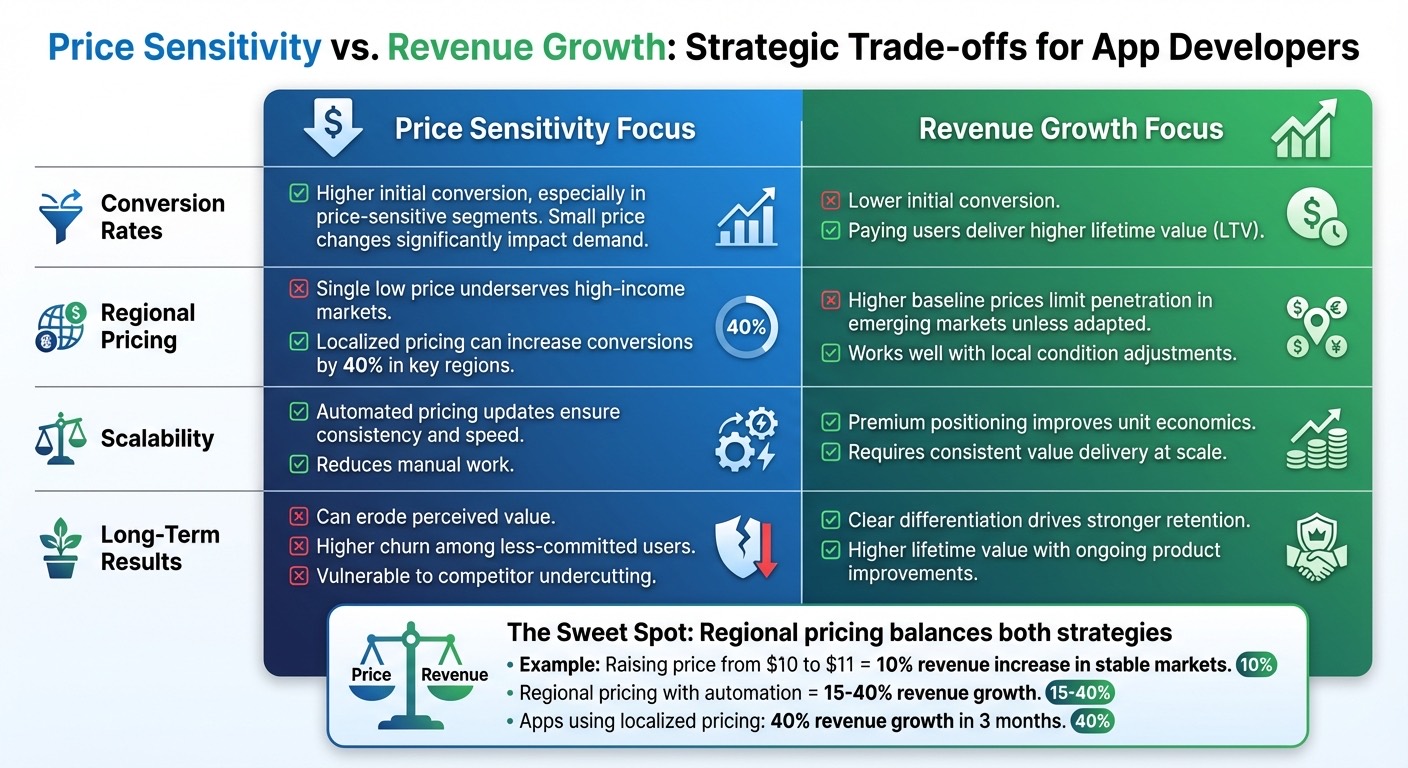
Price Sensitivity vs Revenue Growth: Strategy Comparison for App Developers
Let’s take a closer look at how price sensitivity and revenue growth stack up against each other. These two strategies aren’t mutually exclusive; instead, it’s about understanding what each brings to the table and where they might fall short. Both approaches influence conversion rates, regional pricing, scalability, and long-term outcomes in distinct ways.
Focusing on price sensitivity involves setting lower prices to attract a larger user base. This strategy often leads to higher initial conversion rates, especially in competitive markets where customers are price-conscious. However, there’s a trade-off: lower prices mean reduced revenue per user and could harm your app’s perceived value. Additionally, this approach may attract users who are more likely to churn and less likely to stay engaged long-term.
On the flip side, prioritizing revenue growth by adopting higher prices or positioning as a premium product changes the equation. While initial conversion rates may drop, the users who do convert tend to bring higher lifetime value. The challenge here lies in clearly communicating your product’s value - without a strong differentiation, users may hesitate to pay the higher price.
| Aspect | Price Sensitivity Focus | Revenue Growth Focus |
|---|---|---|
| Conversion Rates | Higher initial conversion, especially in price-sensitive segments; small price changes can significantly impact demand[2] | Lower initial conversion, but paying users tend to deliver higher lifetime value[3] |
| Regional Pricing | A single low price may underserve higher-income markets; localized pricing can lift conversions in markets where a flat price feels too high | Higher baseline prices might limit penetration in emerging markets unless adapted for local conditions[2] |
| Scalability | Automated pricing updates ensure consistency and speed, reducing manual work | Premium positioning requires consistent value delivery at scale, which can improve unit economics[3] |
| Long-Term Results | Can erode perceived value and lead to higher churn among less-committed users, leaving room for competitors to undercut[2] | Clear differentiation and ongoing product improvements can drive stronger retention and lifetime value[3] |
Developers who succeed often find ways to balance these strategies, especially when it comes to regional pricing. For instance, raising a price from $10 to $11 in a stable market can result in a 10% revenue increase[2]. However, that same adjustment might hurt conversions in a highly price-sensitive market. Smart regional pricing, supported by automation, can create a strategy that boosts both growth and conversions - an essential takeaway as we wrap up this analysis.
Conclusion
The discussion above highlights how thoughtful pricing strategies bring together regional considerations and growth goals. Striking the right balance between price sensitivity and revenue growth isn’t about choosing one over the other - it’s about understanding how they complement each other to support long-term success. When pricing reflects user value, engagement, retention, and acquisition costs[6][3], it safeguards against issues like reduced value perception, higher churn rates, and revenue losses.
The central insight? Regional pricing is where balance is achieved. A single global price point will inevitably leave some markets underserved while overcharging others. This equilibrium, emphasized throughout the analysis, is critical for sustainable app monetization. Developers who rely on data-driven insights - like user engagement metrics, retention trends, competitive benchmarks, and direct user feedback - are better positioned to craft pricing strategies that resonate across diverse markets[6].
Mirava embodies these principles, simplifying regional pricing adjustments with precision. Its use of Willingness-To-Pay (WTP) algorithms and psychological rounding enables tailored pricing for over 170 countries, so prices reflect what each market is willing to pay rather than a single global number.
A/B testing tailored to regional audiences has become a standard practice[4]. Platforms like Mirava make this process faster by managing bulk regional updates from one place while ensuring compliance with App Store and Google Play policies. Whether you’re managing two apps on the free plan or scaling up with the Premium plan at $79 per quarter, Mirava equips you with the tools to balance price sensitivity and growth, all while eliminating the hassle of manual pricing updates.
FAQs
How do regional pricing strategies help boost app revenue?
Regional pricing strategies are a smart way to increase app revenue by adjusting prices to align with local market factors like currency exchange rates, purchasing power, and overall economic conditions. This approach makes pricing feel fair and reasonable to users across different regions, which can lead to higher conversion rates and happier customers.
Using tools like Purchasing Power Parity (PPP) and automated price adjustments, developers can fine-tune pricing tiers efficiently without the need for constant manual updates. Not only does this save valuable time, but it can also help grow global revenue by capturing demand in markets a flat price would otherwise underserve.
How can I efficiently manage app pricing across different countries?
Mirava makes it easier to handle app pricing across different countries by providing a single, unified platform for iOS and Android applications. By leveraging market-specific insights - like currency changes and local purchasing power - it helps developers set regionally competitive prices. Its automated updates and user-friendly interface streamline the process, making price adjustments fast and straightforward. This not only saves valuable time but also helps boost revenue potential.
Why is it important for app developers to balance pricing and revenue growth?
Finding the sweet spot between pricing and revenue growth is crucial for app developers navigating competitive markets. Pricing your app in a way that reflects local market conditions helps ensure that users feel they're getting fair value while allowing you to maximize earnings.
To achieve this, consider factors like local purchasing power, currency exchange rates, and what competitors are charging. Overpricing risks scaring off potential users, while underpricing could mean missed revenue opportunities. Striking this balance can lead to higher conversions and set the stage for steady, long-term growth for your app.