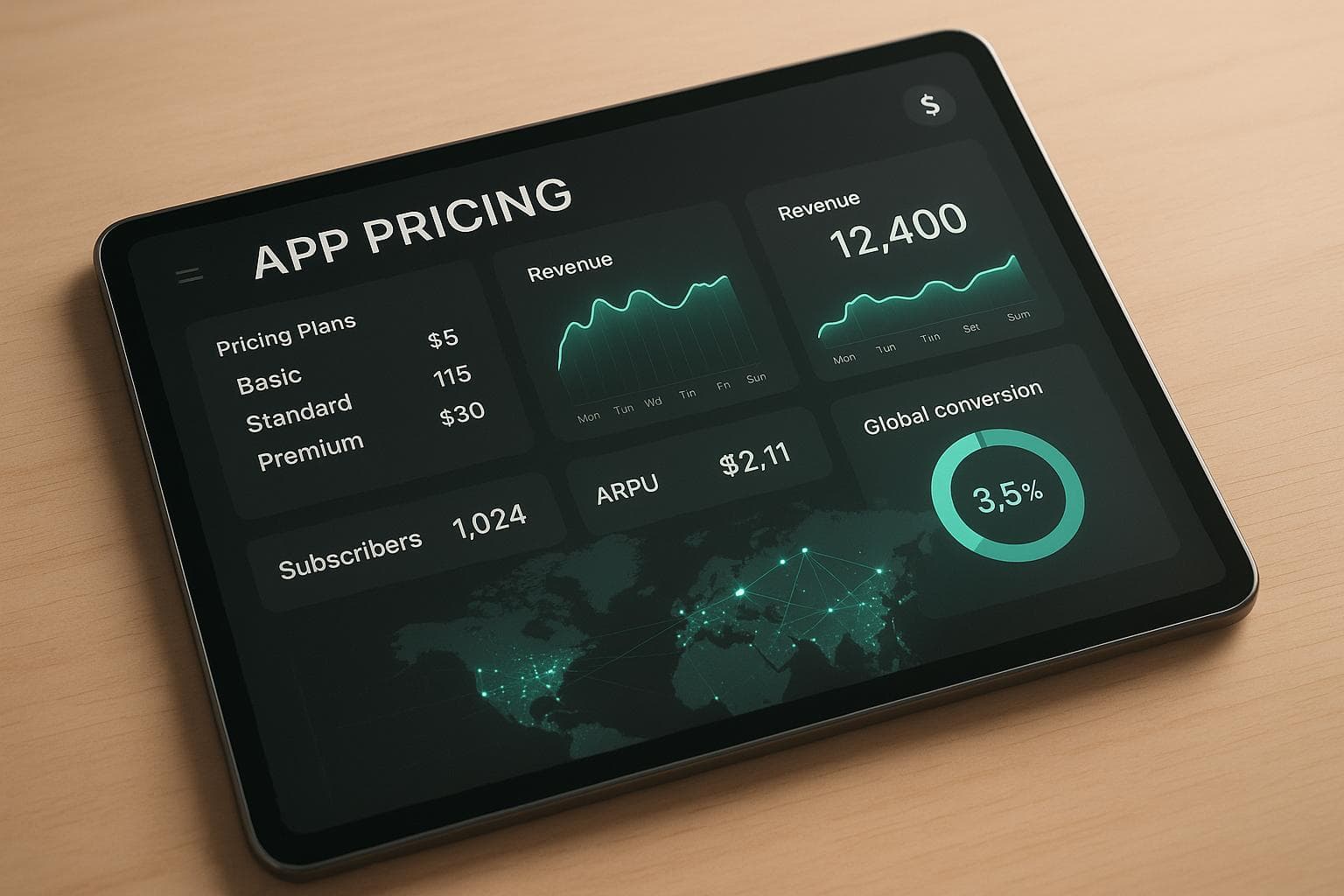
User behavior-driven pricing tailors app pricing to how users interact with features, offering discounts, trials, or premium plans based on engagement. This approach replaces static pricing (e.g., $9.99/month) with dynamic offers tied to user actions, such as completing milestones or frequent app usage. By aligning pricing with perceived value, apps can boost revenue, conversions, and retention. For example, apps using behavior-based pricing have reported up to a 40% increase in conversions and 15–40% revenue growth globally. Tools like Mirava simplify implementing this strategy by combining behavior analytics with regional pricing adjustments.
Key Benefits:
- Higher conversions: Timely offers after user milestones.
- Increased revenue: Power users pay more; casual users opt for lower tiers.
- Improved retention: Discounts or downgrades for churn-risk users.
This pricing strategy works best with clean analytics, A/B testing, and tools to manage regional and behavioral pricing seamlessly. Start by tracking key user behaviors, segmenting users (e.g., new, loyal, at-risk), and testing personalized offers. Regularly measure results and refine pricing to align with user value and market conditions.
How to price your subscription app globally - Featuring Jacob Rushfinn
How User Behavior-Driven Pricing Works
This section dives into how user actions can shape pricing strategies to boost revenue.
At its core, behavior-driven pricing is about observing what users actually do in your app and using those actions to guide pricing decisions. Instead of relying on a one-size-fits-all price, you analyze user behaviors - like how often they open the app, which features they use, whether they complete onboarding, or how they react when encountering a paywall. These behaviors give clues about the value users see in your app and their willingness to pay. By linking engagement patterns to revenue trends, you can offer tailored prices or promotions at just the right moment.
Let’s explore the key data points that make this approach work.
Understanding User Behavior Data
Tracking the right events is the backbone of behavior-based pricing. Here are four essential categories of data to focus on:
- Engagement: Look at session frequency, session length, and how deeply users interact with specific features.
- Funnel progression: Monitor the user journey from app install to signup, onboarding completion, trial initiation, paywall views, and eventual purchase.
- Monetization behaviors: Keep tabs on trial signups, plan upgrades or downgrades, and cancellations.
- Friction signals: Pay attention to signs of frustration, like repeated errors, visits to help sections, or excessive tapping in frustration ("rage taps").
For example, a daily active user who completes onboarding and explores premium features shows strong interest. However, interest doesn’t always translate to payment - someone might enjoy your app but hesitate to pay $7.99/month if they’re unsure of the long-term value or concerned about cost. That’s why tracking pricing responses is critical. Does the user start a trial when shown a $4.99 offer? Do they abandon the paywall at $9.99 but convert at $6.99? These insights reveal not just interest but actual readiness to pay at specific price points.
Armed with this data, you can start mapping user actions to value, which is the next step.
Connecting Behavior to Value and Willingness to Pay
Once you’ve gathered behavioral data, the goal is to link user actions to the value they derive from your app. Identify "value events" - key milestones that historically lead to higher retention and revenue. These could include completing a set number of workouts, exporting several documents, or inviting a teammate. By running cohort analyses, you can compare users who hit these milestones with those who don’t, observing differences in conversion rates, average revenue per user (ARPU), and churn.
For instance, power users who hit these milestones often tolerate higher prices and prefer annual plans (like $79.99/year), while casual users lean toward lower monthly rates (like $4.99/month) or extended free trials.
Behavioral economics also comes into play. Using anchoring, you might showcase a higher-priced "Pro" plan (e.g., $19.99/month) to make a "Standard" plan at $9.99/month seem more appealing. The decoy effect works by adding a slightly cheaper but less appealing option to nudge users toward your preferred tier. These strategies are most effective when tailored to specific user segments - for example, showing a $19.99 anchor to a highly engaged power user can work well, but presenting it to a first-time visitor might backfire.
Data and Tools You Need
To implement behavior-driven pricing, you’ll need a solid analytics and experimentation setup. Start by tracking key user actions - like logins, feature usage, paywall interactions, trial activations, and subscription purchases - using tools such as RevenueCat, Amplitude, Mixpanel, or Firebase Analytics. Ensure your data is clean and standardized, logging prices in USD (e.g., $9.99), using the MM/DD/YYYY date format, and including timestamps with explicit time zones to avoid confusion for U.S.-based teams.
A/B testing is also crucial for refining your pricing strategy. For example, test whether a $4.99 offer converts better than a $6.99 option among users who complete onboarding quickly. Additionally, a regional pricing tool like Mirava can help adjust prices for local markets, accounting for currency differences, purchasing power, and competition. Mirava can automatically display region-specific prices (e.g., $9.99 for U.S. users and localized equivalents elsewhere), while your behavior-based logic determines which tier, discount, or trial length to offer each group. This setup lets you optimize revenue while keeping your infrastructure manageable, so you can focus on improving your product.
User Behavior Pricing Strategies
Use these strategies to segment users, adjust pricing dynamically, and time offers effectively to boost revenue. By aligning pricing with user behavior, you can make more precise adjustments that resonate with your audience.
Segmenting Users by Behavior for Pricing
Start by categorizing users based on their lifecycle stages:
- New users (0–3 days)
- Activated users (completed a core action)
- Engaged users (5–10 sessions per week)
- Loyal users (active for 90+ days)
- At-risk users (50% drop in activity)
- Churned users (inactive or canceled)
Additionally, segment users by payment history: those who’ve never paid, made a one-time purchase, are active subscribers, or have a high lifetime value (LTV).
For new users, offer a low-barrier introductory deal immediately after they experience their first "aha moment." For engaged but unpaid users, especially those who repeatedly view the paywall, consider a limited-time discount or a free premium weekend to showcase paid features. Loyal users can be rewarded with exclusive offers like annual plans at their current rates, even if public prices increase, or family plans with attractive per-seat pricing. For at-risk users - those with declining activity or cancellation attempts - trigger a retention offer such as a discounted plan, a pause feature, or a limited-time reduced rate. When reactivating churned users (e.g., those returning after 30+ days), welcome them back with incentives like 50% off their first month to reignite interest.
Once these segments are established, you can implement dynamic pricing tailored to individual user actions.
Dynamic and Personalized Pricing
Dynamic pricing focuses on tailoring offers based on user behavior without altering the base price. This approach ensures fairness and clarity. For example, if a user views the paywall three or more times within a week without purchasing, you could unlock a 10% discount for their first year. Similarly, users who complete onboarding quickly and reach a key milestone might see a higher-priced annual plan for power users, while casual users are offered more affordable monthly options.
Tie these offers directly to user actions. If someone repeatedly revisits the paywall after using key features, prompt them with an offer like: "Unlock unlimited access for $4.99/month." High-usage users, such as those exporting reports frequently, could be offered a premium "Pro" plan at $14.99/month with added features like expanded exports and priority support, while casual users stick to a $4.99 "Basic" plan. For users inactive for over 30 days, re-engagement offers like a free premium week can help rekindle interest.
Maintain consistent list prices and use clear labels like "New customer offer," "Loyalty discount," or "Black Friday deal" to explain why pricing varies. This transparency helps users understand that offers are tied to timing or behavior, not arbitrary changes.
These dynamic pricing strategies work best when paired with targeted trials and promotions.
Trial, Discount, and Promotion Strategies
Building on dynamic pricing, tailor trials and promotions to drive conversions and retain users. Match trial lengths to the time it takes for users to reach a key milestone: a 7-day trial for quick adoption or 14–30 days for features requiring more time. Monitor trial cohorts and use in-app nudges to adjust trial lengths for better conversion rates and lifetime value.
Consider behavior-based trials. For example, users who quickly complete onboarding and engage with core features could be offered a shorter trial with a discounted introductory month. Meanwhile, users who take longer to engage might benefit from an extended trial paired with helpful educational content.
For the U.S. market, align promotions with major events like Black Friday, Cyber Monday, Christmas, New Year's, or back-to-school season. Focus on warm prospects, such as frequent paywall viewers, active trial users, or recently churned subscribers, by offering steep discounts on annual plans. During the Christmas-to-New Year period, campaigns like "New Year, New You" can combine discounts with motivational content. Always apply promotions in the user’s local time zone and clearly communicate start and end dates using U.S. formats (e.g., "Offer ends November 27, 2025, at 11:59 PM PT").
Treat every pricing offer as an experiment. Use control and variant groups to measure key metrics like conversion rates, retention, and revenue (e.g., ARPU and LTV). This ensures that behavior-based offers increase overall revenue rather than just shifting purchase timing.
sbb-itb-43fe43a
Combining Regional and Behavioral Pricing
Regional pricing sets a baseline for each country, reflecting local purchasing power, currency, and market norms. For instance, a subscription might cost $7.99/month in the U.S. but only $2.49/month in Southeast Asia. On the other hand, behavior-driven pricing adjusts offers based on individual user patterns - like engagement, feature usage, churn risk, or responses to promotions. Together, these strategies create pricing that feels fair, aligning with both a user’s region and their actual usage habits. This combination can boost conversion rates, average revenue per user (ARPU), and lifetime value (LTV) by tailoring prices to meet both regional and individual expectations.
How Regional Pricing Aligns with Behavior-Based Strategies
Regional pricing, guided by metrics like Purchasing Power Parity (PPP), helps determine what users in different countries perceive as affordable or expensive. When layered with behavior-driven strategies, this approach ensures pricing is finely tuned. For example, if U.S. users are comfortable with a $9.99/month subscription but Indian users respond better to $2.99/month, behavior-based rules - like offering a 20% discount to heavy users at renewal - should apply to those localized prices rather than a single global rate. This prevents discounts from being ineffective in low-income regions or leaving revenue on the table in high-income markets.
Key regional behavior signals to monitor include session frequency, feature usage, trial completion rates, paywall interactions, time to first purchase, churn events, and responses to past promotions. For instance, U.S. users who engage with three premium features in a week might convert well on a full-price annual plan. Meanwhile, the same behavior in a lower-PPP market could lead to better results with a more affordable monthly plan or even a micro-subscription. A productivity app might price itself at $7.99/month in the U.S. and $2.49/month in Southeast Asia, while offering a longer free trial in regions where users take more time to activate - like 14 days in the U.S. versus 21 days in India. For users who frequently engage but ignore the paywall, personalized offers - such as "first 3 months at 50% off" - can be tailored to fit each region’s baseline price.
Using Mirava for Behavior-Aware Regional Pricing
Mirava simplifies the process of managing regional pricing across platforms by combining behavior-based segmentation with optimized regional baselines. This ensures that discounts and offers - like 20% off for at-risk subscribers - are automatically adjusted to match each region’s pricing, rather than relying on a one-size-fits-all global rate.
Mirava integrates seamlessly with analytics platforms, allowing you to segment users by both behavior (like engagement or churn risk) and country. For example, you can define test groups, such as high-engagement users in the U.S. versus Brazil, and use Mirava to implement updated regional prices or discount strategies for these groups through App Store and Google Play configurations. As experiment results come in - tracking metrics like conversion rates, ARPU, and churn - you can quickly adjust regional baselines. For instance, you might raise prices slightly in high-PPP markets where conversion remains strong or lower entry-level plans in regions where price sensitivity is evident.
This continuous feedback loop between behavioral analytics and Mirava’s regional price management allows for ongoing, data-driven revenue optimization while staying fully compliant with app store policies. By integrating regional pricing with user behavior insights, Mirava helps businesses create smarter, more effective pricing strategies tailored to both local markets and individual user needs.
Implementation and Best Practices
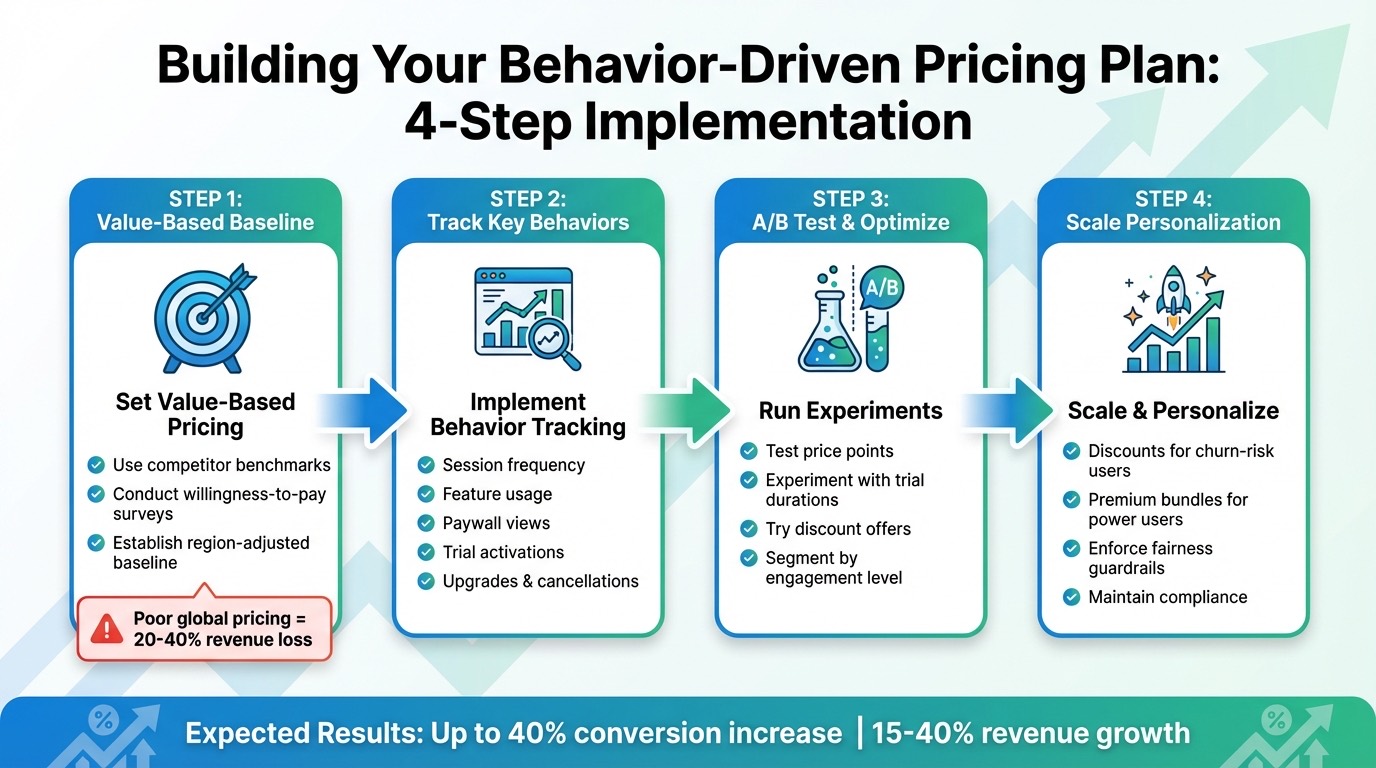
4-Step Implementation Process for User Behavior-Driven Pricing
Building Your Behavior-Driven Pricing Plan
To create a strong behavior-driven pricing strategy, start by setting a region-adjusted baseline to prevent revenue losses. When apps fail to account for regional differences in willingness to pay, poor default global pricing can leave a meaningful share of potential revenue on the table.
Once your baseline is secure, follow a four-step rollout process:
- Step 1: Begin with straightforward, value-based pricing. Use competitor benchmarks and basic willingness-to-pay surveys to guide your initial setup.
- Step 2: Equip your app to track key user behaviors, such as session frequency, feature usage, paywall views, trial activations, upgrades, and cancellations.
- Step 3: Conduct A/B tests to fine-tune pricing strategies. Experiment with price points, trial durations, and discount offers by dividing users into behavior-based groups (e.g., high-engagement vs. low-engagement users).
- Step 4: Scale personalized offers. For example, provide discounts to users at risk of churning or create premium bundles for your most engaged users. At the same time, enforce guardrails to ensure fairness and compliance.
Always display prices in USD with standard formatting (e.g., $4.99). When integrating behavior-based adjustments with regional pricing, tools like Mirava can help manage base prices optimized for different regions across iOS and Android. Once regional pricing is set, apply behavior-driven rules - such as offering a 20% discount to highly engaged users - as a percentage of the local base price. This ensures consistency across all platforms.
With your pricing strategy in place, the next step is to evaluate its performance thoroughly.
Measuring Results
To gauge the effectiveness of your pricing changes, focus on key metrics like conversion rates, ARPU (average revenue per user), LTV (lifetime value), and churn. Break these metrics down by platform, region, and behavior segment to identify where pricing adjustments are most impactful. Use dashboards that combine behavior analytics with revenue data to track weekly performance for experiments and monthly trends for user cohorts.
Incorporate holdout control groups - 5–20% of eligible users who remain on your original pricing - to measure incremental revenue lift. Randomize users into control and treatment groups for at least one billing cycle. Compare performance across key segments, such as ARPU for high-engagement versus low-engagement users, to avoid misleading averages. Additionally, monitor non-revenue metrics like NPS (Net Promoter Score), refund rates, and customer support inquiries to ensure that revenue gains don’t come at the cost of user satisfaction.
By closely analyzing these results, you can refine your pricing strategy while staying aligned with ethical and compliance standards.
Compliance, Ethics, and Transparency
Both Apple and Google mandate transparent pricing practices. The price users see at checkout must match what they’re charged, including for renewals. For U.S. users, clearly outline subscription terms in USD, detailing the price per billing period, free trial duration, auto-renewal terms, and cancellation instructions, as required by platform guidelines. Avoid tactics like hidden fees, misleading countdown timers, or overly complicated cancellation processes. For example, communicate limited-time offers clearly: "$4.99/month for 3 months, then $7.99/month."
Personalization should focus on product usage and value-driven behaviors, such as feature engagement or milestones achieved, rather than sensitive user attributes. Avoid creating extreme price gaps for similar users within the same region. Instead, consider strategies like timing adjustments, bundling, or offering discounts. Limit the frequency of pricing or offer changes to maintain predictability - no more than one major change per month is a good rule of thumb. After implementing pricing updates, monitor user feedback, NPS, and reviews to quickly identify and address any negative reactions.
Finally, ensure that your pricing practices comply with App Store and Google Play rules regarding in-app promotions, subscription price changes, and offer codes. Make sure your analytics tools align with your privacy policy and platform regulations. Obtain user consent for personalized experiences and provide an opt-out option. Striking a balance between optimization, fairness, and transparency strengthens user trust while maximizing revenue potential.
Conclusion
Pricing based on user behavior consistently outshines flat pricing models because it ties what users pay to the actual value they experience. By understanding how users engage with your app, you can create pricing tiers that not only increase revenue but also improve retention and customer lifetime value. For U.S.-based apps with a global audience, combining this approach with regional pricing - adjusted for local purchasing power and currency differences - can deliver even stronger results.
The key is to treat pricing as an ongoing strategy rather than a one-and-done decision. Start by setting up basic analytics to track critical events like feature usage, paywall interactions, and churn triggers. Segment your users into groups, such as highly engaged users versus casual ones, and run A/B tests to experiment with pricing tiers and trial lengths. Apps that have adopted systematic pricing experiments have seen double-digit revenue growth, turning small adjustments into meaningful monthly gains.
When scaling globally, it's essential to integrate behavioral insights with localized pricing strategies. Relying solely on regional pricing without understanding user behavior can leave revenue untapped, while behavior-driven pricing without regional adjustments risks alienating key markets. Tools like Mirava help bridge this gap by aligning behavioral data with competitive local rates. Once you’ve identified your most valuable user segments and their willingness to pay, Mirava automates the process of adapting your U.S. pricing to fit regional markets.
Some teams worry that behavior-driven pricing may feel overly complex or unfair to users, but most of the necessary data - such as session counts, feature usage, and conversion rates - is already being collected by analytics tools. In reality, pricing that offers premium plans for heavy users and budget-friendly options for casual ones is often perceived as fair. Starting with just one or two key metrics and a simple pricing experiment can lay the groundwork, and automation tools like Mirava make the process faster and easier by eliminating tedious manual work.
Ultimately, the most effective pricing strategy is grounded in value and validated by data. Prices should reflect the actual value users derive, as revealed through their behavior, and should be revisited regularly rather than set in stone. Schedule quarterly reviews to refine pricing tiers and regional adjustments based on updated behavior metrics. By following a continuous cycle - monitoring user behavior, testing pricing hypotheses, measuring results, and scaling successful changes - you can transform pricing into a powerful growth tool that delivers long-term results.
FAQs
How does user behavior data enhance app pricing strategies?
Understanding how users respond to different price points can reveal a lot about their preferences and behaviors. By diving into data like purchasing patterns and regional trends, developers can adjust pricing to better match local buying power and market dynamics.
This approach, grounded in real user data, helps create pricing that's competitive, fair, and tailored to a wide range of audiences. The result? Smarter pricing decisions that save time and drive higher profitability.
What are the best tools for setting user behavior-based pricing?
To put user behavior-based pricing into action, you’ll need tools that simplify the process and deliver precise insights. Some of the most useful ones include data-driven purchasing power parity (PPP) strategies, automatic pricing tier adjustments, and smooth integration with platforms like app stores and payment systems. These tools make it easier to align your pricing with market factors like currency fluctuations and local purchasing power, all while saving time and boosting revenue potential.
How does regional pricing work alongside behavior-based pricing?
Regional pricing complements behavior-based pricing by tailoring app prices to local market conditions, such as currency exchange rates, purchasing power, and economic factors. This approach helps ensure that pricing feels reasonable and accessible to users across various regions.
When regional pricing is combined with insights into user behavior, developers can craft pricing strategies that are both competitive and personalized. This not only enhances user satisfaction but also improves conversion rates, ultimately unlocking more revenue opportunities in different markets.