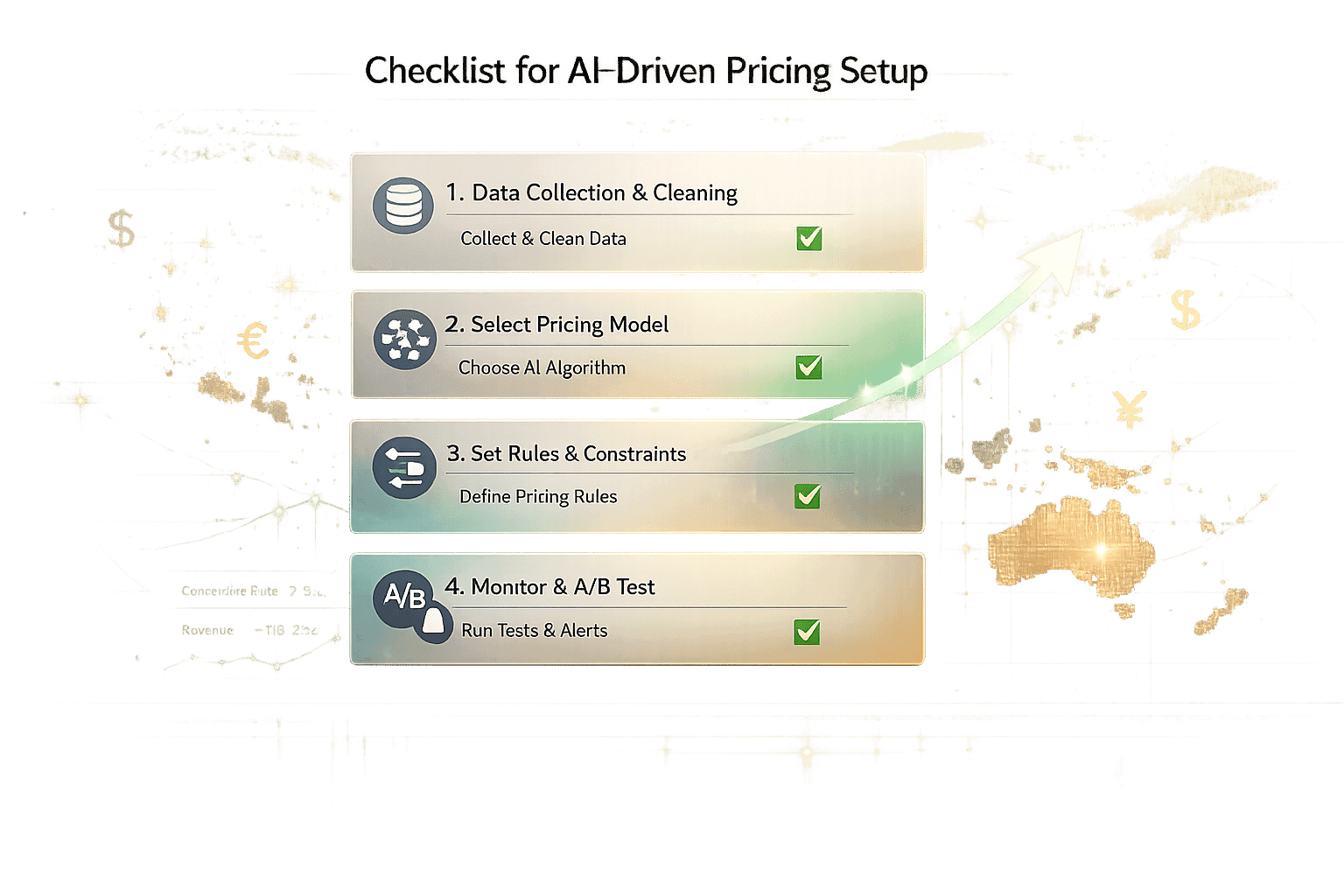
AI-driven pricing is transforming how businesses optimize their revenue by using machine learning to analyze data like customer behavior, competitor prices, and market trends. This approach replaces manual pricing and outdated rule-based systems, offering real-time adjustments tailored to global markets. Businesses adopting AI pricing have reported revenue increases of up to 50% and improved customer lifetime value by 25–40%.
Key Steps for AI-Driven Pricing Success:
- Collect and Prepare Data: Gather accurate data from internal systems, customer insights, costs, and competitor intelligence. Clean and validate it to avoid errors.
- Define Pricing Strategy: Choose a pricing model (e.g., subscription, tiered, or freemium) and set clear revenue and customer goals.
- Implement AI Pricing Rules: Use triggers for real-time price adjustments and set regional or currency-specific pricing.
- Monitor and Adjust: Continuously track key metrics like ARPU, churn rates, and price realization. Run A/B tests on seasonal pricing to refine strategies.
Why It Matters: AI pricing can boost revenue, improve margins, and adapt to market changes faster than traditional methods. Tools like Mirava simplify global pricing adjustments, ensuring businesses stay competitive.
Follow this checklist to streamline pricing, reduce errors, and maximize growth.
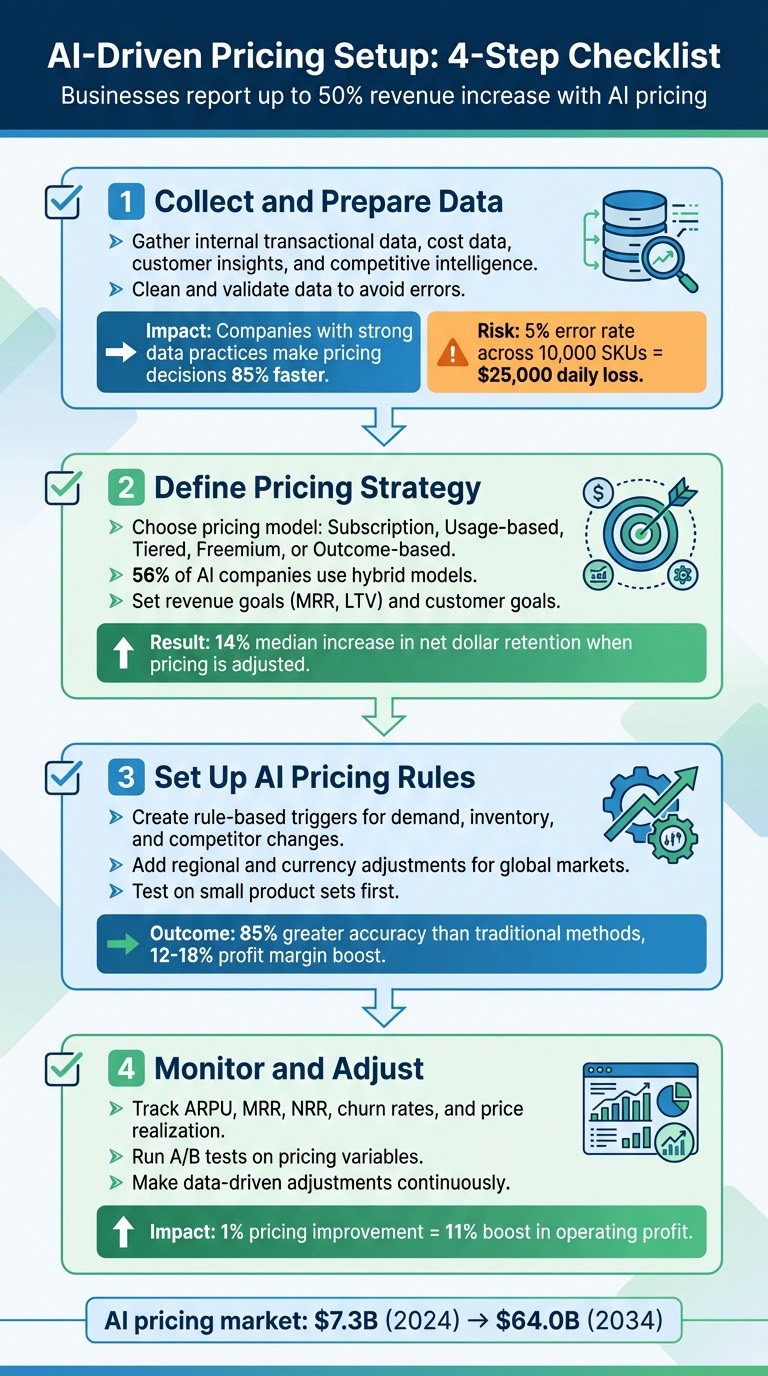
4-Step AI-Driven Pricing Implementation Checklist
Step 1: Collect and Prepare Your Data
The foundation of any AI-driven pricing strategy lies in the quality of your data. Simply put, the system can only be as effective as the information it processes. As Avy Punwasee, Partner at Revenue Management Labs, explains: "Even the smartest AI agent will fail without good data. If your inputs are fragmented, inconsistent or incomplete, your outputs will be too" [10]. In other words, poor data leads to poor results, making it essential to focus on accurate and thorough data collection and preparation.
The impact of data quality on revenue is no small matter. Over half of companies report that 25% or more of their revenue is negatively affected by data issues [9]. To put this into perspective, imagine running a mobile app with 10,000 SKUs. If competitor data has just a 5% error rate, and each error results in a $0.50 margin mistake, the daily loss could add up to $25,000 [4]. On the flip side, companies with strong data practices make pricing decisions 85% faster than their competitors, and advanced pricing data initiatives can boost margins by 2–7% within a year [7].
Identify Your Data Sources
There are four key types of data you'll need to gather:
- Internal transactional data: This includes historical pricing, sales volumes, revenue records, and the performance of discounts or promotions [6][7].
- Cost data: Both fixed costs (like salaries) and variable costs (such as shipping or supply chain expenses) fall into this category [6][8].
- Customer insights: These reveal factors like willingness-to-pay, price elasticity, and buying behaviors [7][8].
- Competitive intelligence: This tracks competitor pricing, discount strategies, and market positioning [6][7].
Start by pulling internal data from your CRM and ERP systems to get a complete picture of historical pricing, sales trends, and costs [6]. For competitor data, web scraping tools can provide real-time updates on pricing and market trends [7]. If you're in the B2B space, encourage your sales teams to report pricing insights they gather during negotiations [7]. You can also enhance your dataset with third-party providers offering industry-specific reports, databases, and economic indices [6][7]. Regardless of the source, take the time to validate and ensure the accuracy of every piece of data.
Clean and Validate Your Data
Once you've collected your data, the next step is to process and refine it. Start by addressing gaps, such as missing sales records or incomplete product attributes. Standardize formats - like currencies and date formats - across all systems, and eliminate outliers, such as an accidental $1.00 sale on a premium product [5][6]. One global retailer, for instance, managed to reduce pricing errors by 76% by implementing automated validation rules to flag improbable price points [7].
Automated consistency checks and reliability scoring can help identify errors early on [7]. Cross-referencing data from multiple sources - like web scraping, field reports, and third-party databases - adds another layer of accuracy [7][4]. Establish clear standards for data accuracy, completeness, and timeliness, and assign a dedicated team member to maintain the integrity of your datasets [5][7]. As Diana Micevic, Principal Product Manager at Vendavo, wisely puts it: "Your data is your foundation" [5].
sbb-itb-43fe43a
Step 2: Define Your Pricing Strategy
Once you've gathered your data, the next move is deciding how to charge your customers. A well-thought-out pricing strategy is essential to align AI-driven optimization with your goals for revenue and customer growth. Even the most advanced AI won't perform as expected without a clear plan.
Currently, 73% of AI companies are experimenting with their pricing models [15], and 92% of those charging for AI usage have adjusted their pricing based on customer behavior and costs [2]. These numbers highlight the importance of having a strategy that can evolve over time. Once you’ve defined your approach, focus on ensuring your pricing reflects your product’s value.
Select Your Pricing Model
Your pricing model should fit your product’s nature, your business objectives, and what your customers expect. Here are some popular options:
- Subscription pricing: Ideal for apps providing ongoing value, like productivity tools or content platforms. Customers pay a fixed monthly or annual fee, offering predictable revenue and fostering loyalty. However, if your product doesn’t deliver consistent value, churn rates could rise.
- Usage-based pricing: Also known as pay-as-you-go, this model charges customers based on usage, such as API calls or compute time. It’s seen as fair and lowers the entry barrier for new users. But revenue can fluctuate, and unexpected usage spikes might shock customers. To address this, consider adding usage caps, alerts, or prepaid bundles [1][2].
- Tiered pricing: This approach offers different features or usage limits at various price points (e.g., Basic, Pro, Enterprise). It caters to diverse customer needs and enables upselling. A straightforward "Good‐Better‐Best" structure often works effectively [15].
- Freemium: Offers a free basic version while advanced features are behind a paywall. This model can attract a large user base by letting people try the product first. The challenge is ensuring the free tier doesn’t give away so much that users don’t feel compelled to upgrade.
- Outcome-based pricing: Charges are tied to measurable results. For example, Intercom's AI support agent "Fin" charges based on successfully resolved customer tickets [2][13]. This model aligns cost with delivered value but can bring variability to your revenue.
In practice, 56% of AI companies use a hybrid model, combining a subscription base with usage-based overages [2]. For instance, Browserbase employs tiered plans that include a set amount of usage, with clear rates for overages [2].
When deciding on a model, consider factors like customer expectations (how similar products are priced), your growth priorities (e.g., acquisition vs. profitability), and unit economics (ensuring your pricing covers costs like API calls and GPU usage) [11][14][3].
Set Your Revenue and Customer Goals
Your pricing strategy must strike a balance between meeting revenue goals and delivering clear value to customers. Start by setting measurable targets - whether it’s achieving a specific MRR (monthly recurring revenue), improving LTV (lifetime value), or driving rapid user growth. Then, identify a value metric that reflects the benefit your product provides, such as increased sales or time saved.
For example, if your app helps e-commerce businesses boost sales, your value metric might be "increased sales", while your charge metric could be "number of listings processed."
To support your pricing, calculate the ROI your product delivers. Use industry benchmarks to determine the time or efficiency savings your AI offers [12]. For instance, if your app automates a task that used to take 10 hours a week at $50/hour, it’s delivering $500 in weekly value - making a $100/month subscription a compelling offer.
Price elasticity is another key consideration. AI can help you analyze how demand changes across customer segments and price points [17]. For example, a small business might respond well to a $29/month plan, while enterprise customers could pay $299/month for added features like advanced support or compliance tools.
Keep your pricing flexible. Customer behavior and market conditions change, so review your strategy regularly. In 2022, software businesses that adjusted their pricing saw a 14% median increase in net dollar retention [16]. Consider evaluating your pricing quarterly, using AI insights to spot opportunities for refinement.
If you’re targeting global markets, platforms like Mirava can help tailor your pricing to regional factors, ensuring it reflects local purchasing power and currency fluctuations. A one-size-fits-all approach risks leaving money on the table or alienating key markets. Adjusting for regional differences is crucial for maximizing your reach and revenue.
Step 3: Set Up AI Pricing Rules
Now that you've got your data and strategy sorted, it’s time to put automation into action. The goal? Set up dynamic pricing rules that respond to market changes while keeping your margins intact.
Smart AI pricing rules combine internal data (like sales trends and inventory stats) with external factors (such as competitor prices, local events, or even weather shifts) [12][22]. And there’s a lot at stake - AI in ecommerce is projected to jump from $7.3 billion in 2024 to $64.0 billion by 2034 [1]. Businesses that master this balance between automation and control will lead the way.
Create Rule-Based Triggers
At the heart of automated pricing are rule-based triggers. These are specific conditions that tell your system when and how to adjust prices. Think of scenarios like sudden demand spikes, low inventory, competitor price cuts, or operational limits [19][1].
Here’s how companies are making it work:
Olfin Car, a top car reseller in the Czech Republic, uses a pricing engine that blends manufacturer supply data with competitor pricing. This setup enables near real-time price adjustments, which led to a 760% sales boost [25].
Another example is Rohlik, a European e-grocery company. They use machine-learning models to offer real-time discounts based on stock levels, historical demand, and the shelf life of perishables. This approach helped them hit a $1 billion valuation while slashing waste [25].
When setting up triggers, include guardrails like minimum and maximum price limits to safeguard profitability [1][20][21]. These limits ensure that even during rapid adjustments, your prices remain sustainable.
AI can also tailor pricing based on customer behavior. For instance, you can identify patterns like how often someone shops, their sensitivity to discounts, or their likelihood of leaving without purchasing. This lets you offer targeted deals, such as a 15% discount for shoppers who’ve abandoned their cart twice in a month or special loyalty pricing for long-term subscribers [1].
Start small. Test dynamic pricing on a few high-traffic products or in one geographic region before scaling up [1][21]. Use control groups to measure effectiveness, and always have a manual override in place for sensitive situations or unexpected system glitches [1][20].
Once your triggers are working smoothly, take your pricing strategy a step further by factoring in regional differences and currency dynamics.
Add Regional and Currency Adjustments
If you’re selling globally, regional pricing is a must. A flat pricing model risks alienating customers in lower-income regions or missing out on higher profits in wealthier markets. AI can fine-tune prices or discounts by region, using data like historical sales and real-time win rates [18].
Take this example:
In 2025, Duetto, a revenue management platform, integrated event data from PredictHQ. This allowed hotels to adjust room rates ahead of demand surges caused by local events - concerts, festivals, marathons - rather than reacting to booking trends. The result? More accurate demand forecasts and proactive pricing adjustments across their global properties [22].
AI can also integrate third-party event data to predict regional demand spikes. For instance, if a major conference is scheduled in Austin, Texas, your system should automatically adjust prices in that area before the influx of visitors [22].
Currency fluctuations are another critical factor. Define price floors and maximum discounts for each currency to protect your margins during volatile periods [18]. If win rates start dropping in a specific region, it could signal that local purchasing power has shifted, or that currency changes have made your product less competitive [18].
Platforms like Mirava simplify regional pricing by automating adjustments based on purchasing power parity (PPP) and local conditions. Supporting over 175 countries, Mirava lets you update prices in bulk while previewing revenue impacts. This is especially useful for mobile app developers managing pricing across iOS, Android, and web platforms simultaneously.
Before scaling globally, test AI-driven pricing in one region for 90 days. This trial period will help you refine the model’s accuracy [18]. Regularly retrain your AI - daily or weekly updates ensure it stays aligned with evolving market trends [20]. With AI-powered pricing, you can achieve 85% greater accuracy than traditional methods and potentially boost profit margins by 12–18% [23].
Step 4: Monitor and Adjust Your Pricing
AI-driven pricing isn't a "set it and forget it" solution. The real power lies in ongoing monitoring and fine-tuning. Without keeping an eye on the right metrics, you risk losing sight of whether your pricing strategy is driving growth or cutting into profits. It's worth noting that even a small 1% improvement in pricing can lead to an 11% boost in operating profit[28]. Businesses that regularly test and refine their pricing often enjoy much faster revenue growth.
Track Performance Metrics
To evaluate how well your pricing strategy is working, focus on key metrics that tie pricing to outcomes. Metrics like ARPU (Average Revenue Per User), MRR (Monthly Recurring Revenue), NRR (Net Revenue Retention), and churn rates can reveal a lot about pricing effectiveness. Another critical metric is Price Realization, which compares the price you're actually charging to the price you intended to charge. This can highlight whether discounts or regional pricing adjustments are eating into your margins.
NRR is especially important because it combines churn with expansion revenue, giving you a clear picture of customer loyalty and growth. Additionally, tracking both Customer Churn and Revenue Churn separately, along with trial-to-paid conversion rates and win/loss rates, can help you understand if your pricing is turning potential customers away. For a deeper look at profitability, metrics like Pocket Margin (the net price after accounting for discounts and costs-to-serve) can provide insights into how profitable each deal truly is. Using a dashboard to monitor these indicators can make it easier to spot trends and opportunities.
This data lays the groundwork for targeted pricing experiments.
Run A/B Tests on Pricing
Testing is the best way to confirm assumptions and figure out what truly impacts performance. Focus on one variable at a time - such as price points, billing cycles, or trial lengths - to clearly see the effect of each change. Use control groups to account for outside influences like seasonality or market-wide promotions, and set clear success criteria before you start (e.g., a variant might succeed if it boosts conversion rates by 15% without decreasing ARPU). Make sure your sample sizes and test durations meet standard benchmarks, like a 95% confidence level with enough users.
"Customers who convert on lower prices often have higher churn and lower expansion revenue." – Patrick Campbell, CEO, ProfitWell[28]
This highlights why disciplined testing is crucial for long-term revenue growth.
When testing new price points, grandfather existing users to avoid disrupting their experience. Instead, experiment with new prospects. Location-based testing can also be helpful, as some regions may support higher prices without hurting conversion rates.
For mobile app developers, platforms like Mirava shorten the slowest part of a pricing test: getting the new price live across iOS, Android, and web. App store price changes typically take 24 to 48 hours to propagate globally, so a centralized tool to push updates saves time on every iteration. Mirava also offers Purchasing Power Parity (PPP) algorithms and psychological rounding, making localized price points easier to set with less manual work.
Make Data-Driven Adjustments
Once you've validated your pricing changes through testing, use the results to refine your overall strategy. For example, if win rates drop in a specific region, it might indicate that local market conditions require a different approach. Automated anomaly detection can help flag low-margin transactions early, allowing you to address issues before they escalate. Another effective approach is constrained optimization, where you aim to maximize revenue while sticking to key gross profit thresholds.
Timely pricing insights are essential. A 5% pricing error across 10,000 SKUs can lead to substantial daily losses[4]. Consider these examples: In late 2023, a major Chinese online retailer used an AI-powered pricing model for its top 30 feeding bottle SKUs, resulting in an 11% revenue increase while maintaining a 10% gross margin[24]. Similarly, a leading U.S. online home furnishings retailer piloted a dynamic pricing system for a month across 10,000 products, achieving a 15% jump in revenue and a 10% profit increase[24].
Think of pricing as an ongoing process of hypothesis, testing, and adjustment. Companies that take a systematic approach to pricing optimization grow 25% faster, with typical revenue gains ranging from 3% to 15%[28].
Final Checklist
Before rolling out your AI-driven pricing system, make sure the essentials are in place. Start by verifying the accuracy, completeness, and timeliness of your data - this includes historical sales, customer behavior, inventory levels, and competitor pricing. Even a small error can have big consequences. For instance, a retailer managing 10,000 SKUs could face over $9 million in hidden annual losses with just a 5% inaccuracy in pricing data[4].
Once your data is solid, double-check that your pricing strategy aligns with your business objectives and KPIs. This ensures your approach supports your broader goals. Keep in mind, 92% of companies selling AI products have adjusted their pricing after launch[2], so be prepared to iterate as needed.
Next, validate your AI triggers. Test them thoroughly, ensuring regional adjustments and currency conversions are working as expected. A good way to do this is by running a pilot with 50–100 deals over a 4–8 week period to test your assumptions[18]. If you're working with mobile apps, tools like Mirava can simplify the process by enabling instant price updates across iOS, Android, and web platforms.
After rule validation, focus on continuous monitoring to maintain pricing effectiveness. Regularly review performance metrics like price realization, pocket margin, and leakage[26]. Use automated anomaly detection to catch unusual transactions early, and keep refining your strategy with ongoing A/B testing. As Umbrex puts it:
"Pricing is never 'finished.' Markets move, competitors change tactics, and your own portfolio evolves."[26]
FAQs
What data do I need before using AI-driven pricing?
To make the most of AI-driven pricing, it's crucial to work with accurate, high-quality data. This includes details like historical sales figures, insights into what customers are willing to pay, competitor pricing strategies, market trends, and key cost factors. When this data is actionable and reliable, it lays the groundwork for dependable pricing recommendations.
How do I keep AI pricing from hurting margins or trust?
To prevent AI-driven pricing from damaging margins or eroding trust, prioritize accurate data and careful oversight. Faulty or incomplete data can lead to incorrect pricing decisions, so it's crucial to maintain data quality and review inputs consistently.
Implement safeguards such as guardrails and manual checks to avoid drastic or unreasonable price shifts. Stay transparent with your customers, steer clear of overly complicated algorithms, and ensure a balance between automation and human judgment. This approach helps safeguard profits while fostering trust.
Which pricing metrics should I monitor every week?
Keeping an eye on key pricing metrics every week is essential to make sure your strategies are working as planned. Pay close attention to revenue performance, pricing execution, and market conditions. These areas will show you how well your pricing supports your business goals and fits with current market trends. Regularly reviewing these metrics allows you to adjust quickly and fine-tune your approach for better outcomes.