The holiday season is a golden opportunity for subscription apps, especially around Christmas and New Year. Here's what the data shows for 2024–2025:
- Discount Trends: Average discounts have decreased from 29.1% in 2024 to 26.2% in 2025, focusing more on profitability than aggressive user acquisition.
- Revenue Insights: Weekly subscriptions now make up nearly 50% of all plans, with a 10% growth in 2025. Apps offering trials see up to 64% higher lifetime value (LTV).
- Regional Pricing Differences: U.S. weekly subscriptions average $8.10, while Europe averages $8.30. Dutch users pay 62% more than the U.S. baseline; Turkish users pay 3.5× less. Understanding how localized pricing works is essential for managing these global variations.
- Promotional Strategies: Multi-phase pricing, personalized offers, and targeted upgrades are driving better results than blanket discounts.
- AI Influence: Generative AI is reshaping discovery, with traffic from AI sources growing 520% year-over-year.
Key Takeaway: Focus on precise pricing, regional adjustments, and personalized promotions to maximize holiday revenue while balancing profitability.
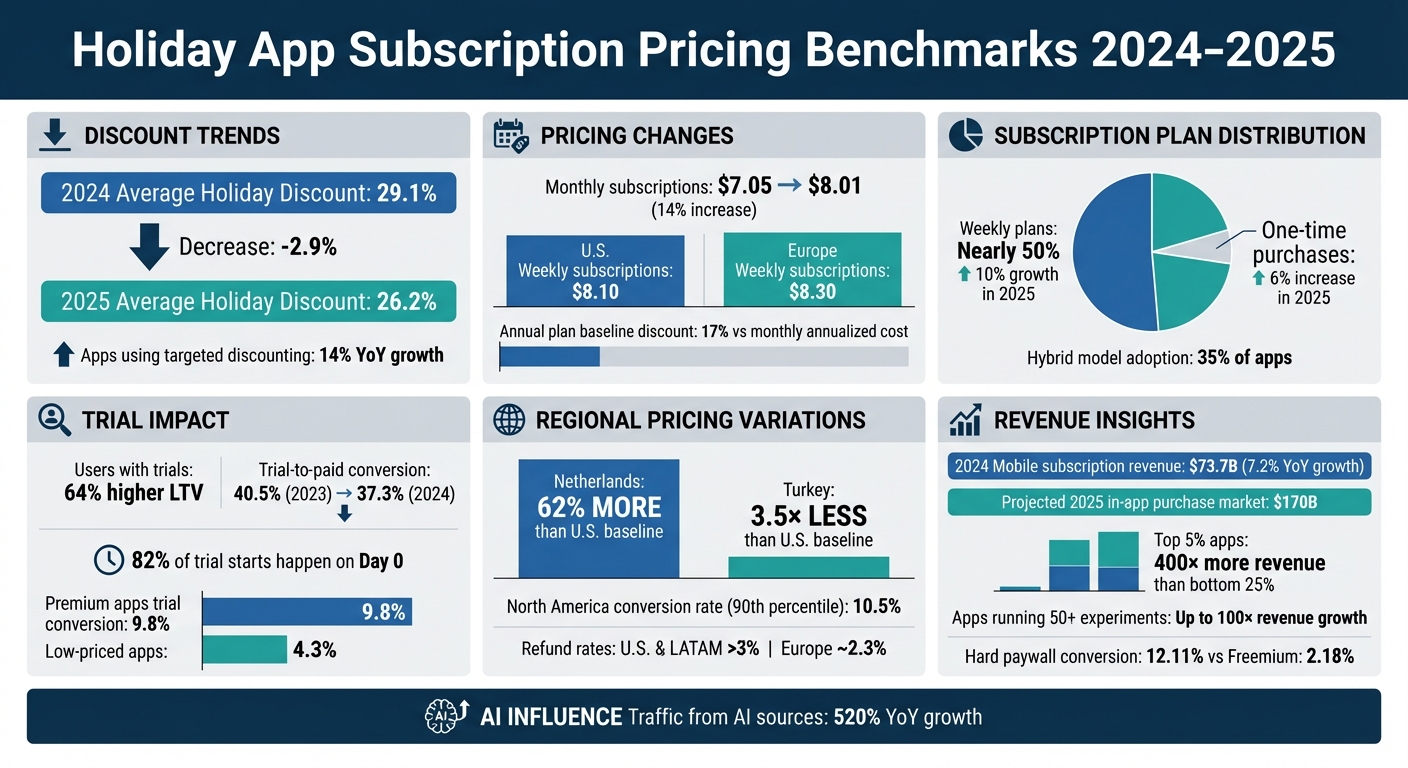
Holiday App Subscription Pricing Benchmarks 2024-2025: Key Statistics and Regional Differences
Discount Trends for Holiday Subscriptions
Changes in Holiday Discount Rates
Subscription developers are pulling back on aggressive holiday discounts. The average holiday subscription discount dropped from 29.1% in 2024 to 26.2% in 2025, signaling a shift in focus. This strategy leans more toward profitability rather than chasing user acquisition at all costs, which aligns with recent conversion trends[3].
Interestingly, brands that adopted targeted discounting strategies experienced a 14% year-over-year growth, outperforming those relying on steep price cuts[3]. At the same time, iOS and Android subscription prices have risen significantly. Monthly subscription rates increased by 14%, moving from $7.05 to $8.01 on average. Weekly plans also saw a jump, reaching $8.10 in the U.S. and $8.30 in Europe[1][3].
For annual plans, the typical baseline discount hovers around 17% when compared to the annualized cost of monthly subscriptions[3].
Reid DeRamus, Founder of Caddie, cautions: "If you discount the annual plan too much, you may sacrifice revenue from folks who would have likely paid more"[3].
These pricing shifts highlight the importance of finding the right balance between offering discounts and maintaining profitability.
Balancing Discounts and Profitability
The data shows that bigger discounts don’t always deliver better results. Developers are discovering that smaller, well-targeted discounts can lead to stronger revenue growth when paired with a good user experience.
Trial-to-paid conversion rates have dipped, falling from 40.5% in 2023 to 37.3% in 2024. This suggests that consumers are becoming more discerning and strategic when it comes to discounts[3].
Jacob Eiting, CEO and Co-Founder of RevenueCat, reflects: "2023 was a year of renormalization and reacceleration where we saw the businesses who survived the post-covid era really begin to thrive"[3].
Making pricing decisions based on data is becoming essential. Users who begin with a trial tend to have a lifetime value that’s up to 64% higher than those who don’t[1]. Additionally, apps with higher pricing tiers see better trial conversion rates - 9.8% for premium-priced apps compared to 4.3% for lower-priced ones. This suggests that premium positioning attracts more engaged and committed users[2].
Holiday Promotional Strategies for App Subscriptions
Top Promotional Tactics
Developers are shifting toward Offer Phases - staged, paywall-visible holiday sales like those seen during Black Friday - instead of relying solely on traditional discount codes. These offers automatically appear on your paywall, making them easy to scale for a large number of users. Meanwhile, Promo Codes - targeted promotional codes - work best for influencer collaborations or exclusive, limited-quantity deals[7].
A multi-phase pricing strategy is especially effective during the holiday season. For example, offer a one-month free trial followed by a discounted introductory price before transitioning users to your standard plan. This approach gives potential subscribers enough time to see the app's value while creating urgency around the limited-time holiday deal[7].
Tailor your offers based on user status. For example:
- New Customer Acquisition: Attract first-time users with enticing holiday deals.
- Upgrade Offers: Encourage existing users to move to higher-tier plans.
- Re-engagement Offers: Target churned subscribers with win-back promotions during high-traffic holiday periods[6][7].
Another trend to consider is the rise of weekly subscription plans, which have grown by 10% and now make up nearly half of all subscriptions[1]. Adding flexible, short-term options to your holiday promotions can attract users hesitant to commit to annual plans. Data suggests that paywalls offering three plans - weekly, monthly, and annual - often drive the highest lifetime value across various app categories[1][4].
These tactics lay a strong foundation for incorporating personalized strategies to maximize holiday subscription performance.
Personalized Offers and New Subscription Tiers
Beyond discounts, personalized offers can significantly boost user engagement. Since 82% of trial starts happen on the same day a user installs an app[2], it's crucial to connect with users immediately. Many top-performing apps use onboarding quizzes to tailor the experience and recommend the most relevant subscription tier right from the start.
"Optimizing onboarding flows to maximize trial start rates is a huge source of leverage for many subscription apps." - Phil Carter, Founder and CEO, Elemental Growth[2]
The holiday season is also a great time to introduce new subscription tiers. Currently, 35% of apps use a hybrid model, blending subscriptions with one-time consumables or lifetime purchases[2]. This approach appeals to users who want holiday deals but aren't ready to commit to recurring payments. In fact, one-time purchases saw a 6% increase in 2025, indicating a growing interest in upfront value[1].
For high-priced apps, the median download-to-trial conversion rate is 9.8%, compared to just 4.3% for lower-priced apps[2]. Introducing premium options during holiday promotions can attract users willing to pay more, resulting in greater long-term value.
Lastly, leverage Offering Metadata to seamlessly switch between standard and holiday-themed paywalls without needing code changes[7]. This allows for quick testing of different designs and messages, helping you adapt as the season unfolds and find what resonates most with your audience. This is also the ideal time to test regional pricing to ensure your holiday offers are optimized for every market.
Regional and Platform Pricing Benchmarks
Regional Differences in Holiday Pricing
Subscription prices show significant variation across regions, sometimes differing by 2–3×. For instance, Dutch users pay 62% more than the U.S. baseline for weekly subscriptions, while Turkish users pay nearly 3.5× less [1]. During the 2024–2025 holiday season, average weekly prices in Europe rose by 12.2% to $8.30, compared to a 12.5% increase in the U.S., where weekly subscriptions averaged $8.10. Monthly subscriptions also reflected this disparity, averaging $15.20 in the U.S. versus $13.30 in Europe [1]. In Latin America, pricing is far from uniform - subscriptions in Argentina and Uruguay are notably higher than in other parts of the region [5].
North America stands out with a 10.5% download-to-paid conversion rate at the 90th percentile. However, refund rates tell a different story, exceeding 3% in both the U.S. and Latin America, compared to approximately 2.3% in Europe [1][2].
"Most apps just set a universal price, use Apple's default localization, or guess with random multipliers... This index fixes that. It shows exactly how much users pay in 60+ countries compared to the US baseline."
– Vitaly Davydov, CEO and Co-Founder, Adapty [5]
These pricing differences highlight the need to consider regional nuances when analyzing mobile and web subscription trends.
Mobile vs. Web Subscription Benchmarks
Looking at device-specific trends, mobile and web subscriptions paint distinct pictures. Mobile app subscription revenue reached $73.7 billion in 2024, marking a 7.2% year-over-year growth [1]. Weekly subscriptions dominate in-app purchases, accounting for nearly half of all subscriptions and growing by 10% in 2025 [1]. Productivity and Utility apps perform especially well on mobile, with lifetime values of $53.20 and $58.40, respectively [1]. Gaming apps lean heavily on weekly plans, with 78% of subscriptions in this format, while Health & Fitness and Travel apps favor yearly subscriptions, with 67% and 65% adoption, respectively [2].
The paywall model also plays a key role in conversion rates. Apps with hard paywalls show a median conversion rate of 12.11%, significantly outpacing freemium models, which achieve just 2.18% [2].
Using Mirava for Regional Pricing Optimization
Addressing the challenges of regional and platform pricing requires automation, especially during the busy holiday season. Managing pricing across 175+ countries manually is simply not feasible. This is where Mirava steps in. The platform automates regional pricing adjustments by factoring in purchasing power parity and local market conditions, ensuring competitive holiday offers without the need for constant manual updates. Mirava also allows you to preview the impact of pricing changes on revenue and conversions, making it easier to test and refine holiday pricing strategies for different regions.
With batch updates, you can adjust hundreds of prices with a single click. Mirava simplifies the entire process by setting up regional pricing, offering A/B testing support, and streamlining team approvals. This makes it a valuable tool for developers managing multiple apps or entering new markets during the holiday season. By using real payment data, Mirava aligns pricing with local willingness to pay, eliminating the guesswork. Its PPP and Mirava Blend indices are tailored specifically for app subscriptions, ensuring that every pricing decision is backed by data and optimized for conversions when it matters most.
sbb-itb-43fe43a
Performance Metrics and Revenue Insights
Holiday Revenue Trends
As we dive deeper into the connection between pricing strategies and revenue growth, holiday revenue trends highlight just how impactful optimized pricing can be. Looking ahead to the 2024–2025 holiday season, the in-app purchase market is projected to hit an impressive $170 billion by the end of 2025. However, this growth is not evenly distributed across all categories [1]. For instance, weekly subscription plans saw a 10% increase in 2025 and now make up nearly half of all subscriptions. Meanwhile, one-time purchases rose by 6%, signaling a growing preference for upfront value [1].
The revenue divide between top-performing apps and the rest of the market continues to widen. Apps in the top 5% generate over 400 times more revenue after their first year compared to those in the bottom 25% [8]. This stark difference emphasizes the critical role of conversion and retention optimization. Simply chasing new installs is no longer enough to drive substantial growth [1].
"The gap is growing: apps that optimize pricing and onboarding continue to scale. Everyone else falls behind to monetize."
– Aleksandr Samoilenko, Content Marketing Manager at Adapty [1]
Trial-based strategies have proven to be especially powerful during the holidays. Users who begin with a trial have a lifetime value (LTV) up to 64% higher than those who don’t [1]. The importance of onboarding on Day 0 is clear, as 82% of trial starts occur immediately after download [8]. In 2024, 1.7% of downloads converted into paying subscribers within their first 30 days [3]. North America stood out, achieving an LTV of $0.35 within 14 days - four times the global average [3]. These numbers highlight the importance of continuously experimenting with pricing models to stay competitive.
Data-Driven Decision Making for 2025
The 2024–2025 holiday season has provided a wealth of data that underscores the importance of regional and platform-specific pricing strategies. As we look to 2025, it’s clear that growth is increasingly tied to improving conversion and retention rates rather than simply attracting new users [1]. Apps that conducted over 50 experiments on subscription durations and trial offerings saw revenue growth of up to 100 times [1].
Flexibility in pricing is now a dominant trend. Weekly subscription plans have become the leading choice in categories like Productivity and Utilities, accounting for more than 50% of revenue in these segments [1]. On the other hand, annual plans continue to perform well in goal-oriented categories like Health & Fitness and Education. Hybrid monetization models are also gaining momentum, with 35% of apps now combining subscriptions with consumables or lifetime purchase options to cater to a broader range of users [8]. These insights offer a clear roadmap for developers aiming to fine-tune their strategies and capitalize on proven methods for success during the holidays.
How to price your subscription app globally - Featuring Jacob Rushfinn
Conclusion
The key to successful holiday pricing lies in smart promotions, tailored offers, and localized strategies. Building customer loyalty through free trials - boosting lifetime value (LTV) by as much as 64% - is far more effective than relying on heavy discounts, which often result in short-term sign-ups without long-term engagement[1].
Rather than applying generic discounts, bundled deals and personalized promotions deliver better results. These approaches align naturally with localized pricing models, which have become increasingly important. With 35% of apps now combining subscriptions with consumables or lifetime purchase options[2], developers can cater to diverse user preferences while preserving the value of their core offerings.
Regional pricing optimization plays a crucial role in maximizing revenue. Purchasing power varies widely across countries, with users in some regions willing to pay significantly more - or less - than others. For instance, users in the Netherlands spend 62% more on weekly plans, while those in Turkey pay nearly 3.5 times less[1]. Tools like Mirava enable developers to set competitive prices in over 175 countries, including localized pricing for Google Play, using real market data to strike the perfect balance - capturing high-value opportunities while maintaining affordability in lower-income regions.
The data makes one thing clear: apps that invest in robust, data-driven pricing strategies see the biggest rewards. Running frequent pricing experiments - some apps conduct 50 or more - has been shown to grow revenue by up to 100 times[1]. Monitoring metrics like retention and refund rates helps refine these strategies, ensuring they drive long-term profitability. Ultimately, the gap between top-performing apps and the rest of the market continues to grow, with optimized pricing standing out as a critical factor in that success.
FAQs
How can app developers offer holiday discounts without compromising profitability?
To maintain a balance between holiday discounts and profitability, focus on short-term, well-planned offers that create urgency without undermining your app's value. Some effective strategies include offering a 7-day introductory price, a limited-time percentage discount, or bundled holiday packages. Tailor these deals to specific groups, like new users or those who’ve canceled subscriptions, and keep a close eye on metrics such as conversion rates, post-promotion churn, and lifetime value (LTV) to ensure your discounts remain viable.
Leverage benchmark data to fine-tune your discount strategy. For instance, modest discounts in the range of 10–15% on annual plans often lead to better retention and revenue over time compared to steep cuts on monthly subscriptions. Additionally, consider regional pricing adjustments to account for varying purchasing power. This approach makes discounts more appealing in price-sensitive areas while safeguarding profitability in higher-income regions.
Lastly, prioritize testing and iteration. Use A/B testing to experiment with different discount durations, percentages, and audience segments, then refine your strategy based on real-time results. By keeping discount periods short, targeting the right audience, and making decisions backed by data, developers can drive holiday sales while protecting long-term revenue streams.
How does regional pricing help increase subscription revenue?
Regional pricing tailors subscription costs to align with the local purchasing power of different markets. This strategy makes your app more accessible to a diverse range of users. By setting fair and competitive prices, you can draw in a larger audience, minimize price sensitivity, and boost conversion rates.
Beyond driving revenue, regional pricing can also help address piracy issues and ensure your app stays affordable for users across the globe, enhancing their overall experience.
How is generative AI changing app discovery and subscription growth?
Generative AI is reshaping the way users find apps and how apps grow their subscription base. App stores now use AI-powered recommendation systems that analyze personalized data to spotlight apps, often giving those with AI-enhanced features an edge in visibility. On top of that, AI tools are enabling developers to roll out new features more quickly, which is raising the stakes in an already competitive app market.
When it comes to subscription performance, AI-driven apps tend to stand out. These apps frequently report higher revenue per install compared to their traditional counterparts. But while AI can improve app discovery and revenue opportunities, long-term success still hinges on delivering real value and keeping users engaged.
To fully capitalize on AI in this fast-paced market, getting regional pricing right is critical. Platforms like Mirava make this easier by allowing developers to set data-driven prices tailored to specific markets. This ensures AI-enhanced apps can maximize revenue potential while avoiding the pitfalls of pricing too high or too low.