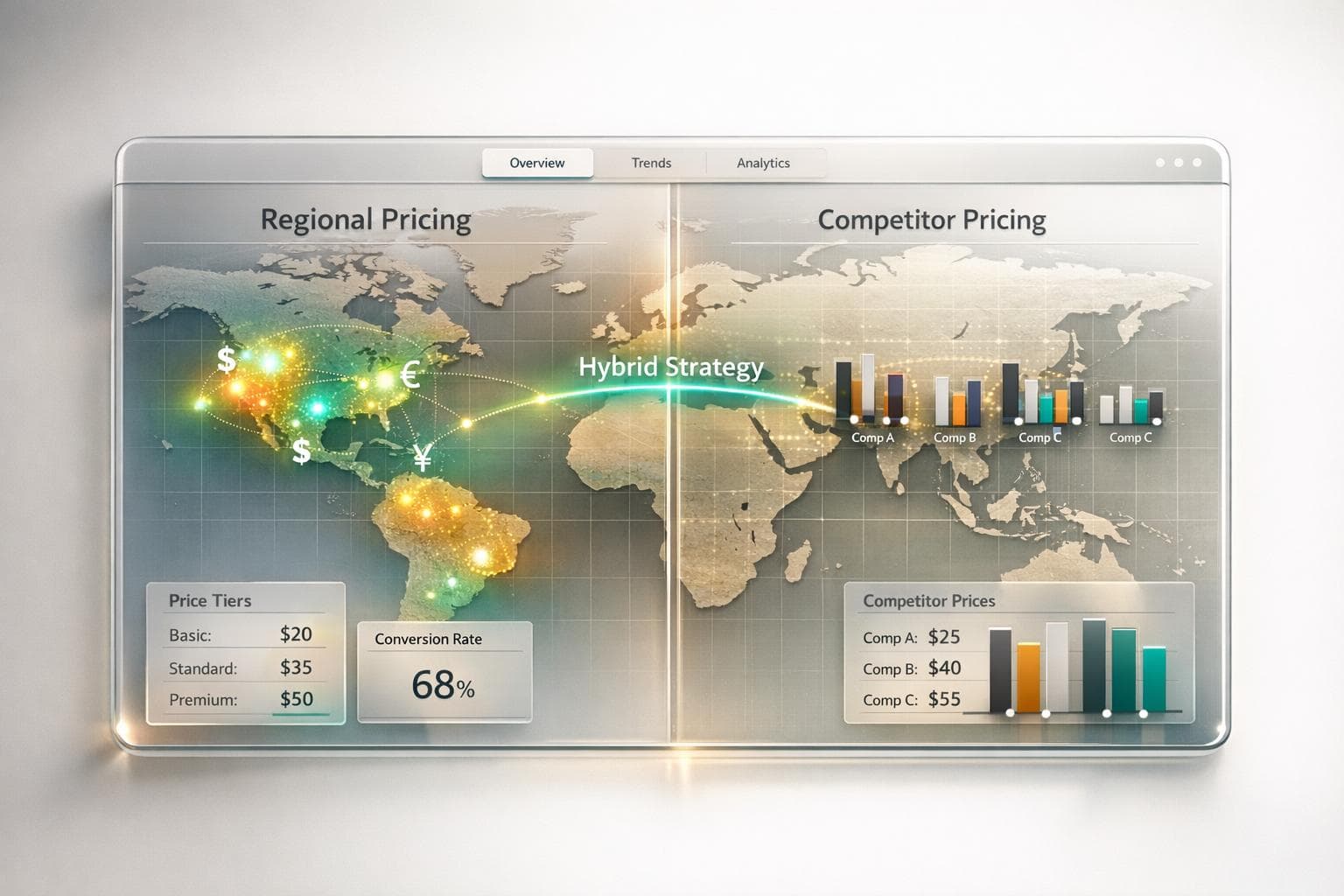
Dynamic pricing powered by AI is transforming how businesses set prices. By analyzing data like demand, competitor rates, and customer behavior, AI helps businesses find optimal price points, leading to revenue growth and improved profit margins. Companies using AI-driven pricing have reported up to 25% revenue increases and 11% profit gains. Tools like Mirava simplify global pricing for mobile apps, offering insights for over 170 countries and integrating seamlessly with platforms like RevenueCat and Adapty.
Key Benefits:
- Higher Revenue: AI identifies the best prices to maximize sales and profits.
- Instant Adjustments: Prices update in real-time based on market changes.
- Personalized Pricing: Tailored prices based on customer behavior.
- Automated Management: Reduces manual effort with streamlined workflows.
- Market Expansion: Optimizes pricing for regional purchasing power.
- Quick Market Response: Adapts to trends and competitor actions rapidly.
- New Market Access: Aligns prices with local economic conditions for global growth.
AI pricing tools are reshaping industries, from mobile apps to airlines, enabling businesses to stay competitive while driving profitability.
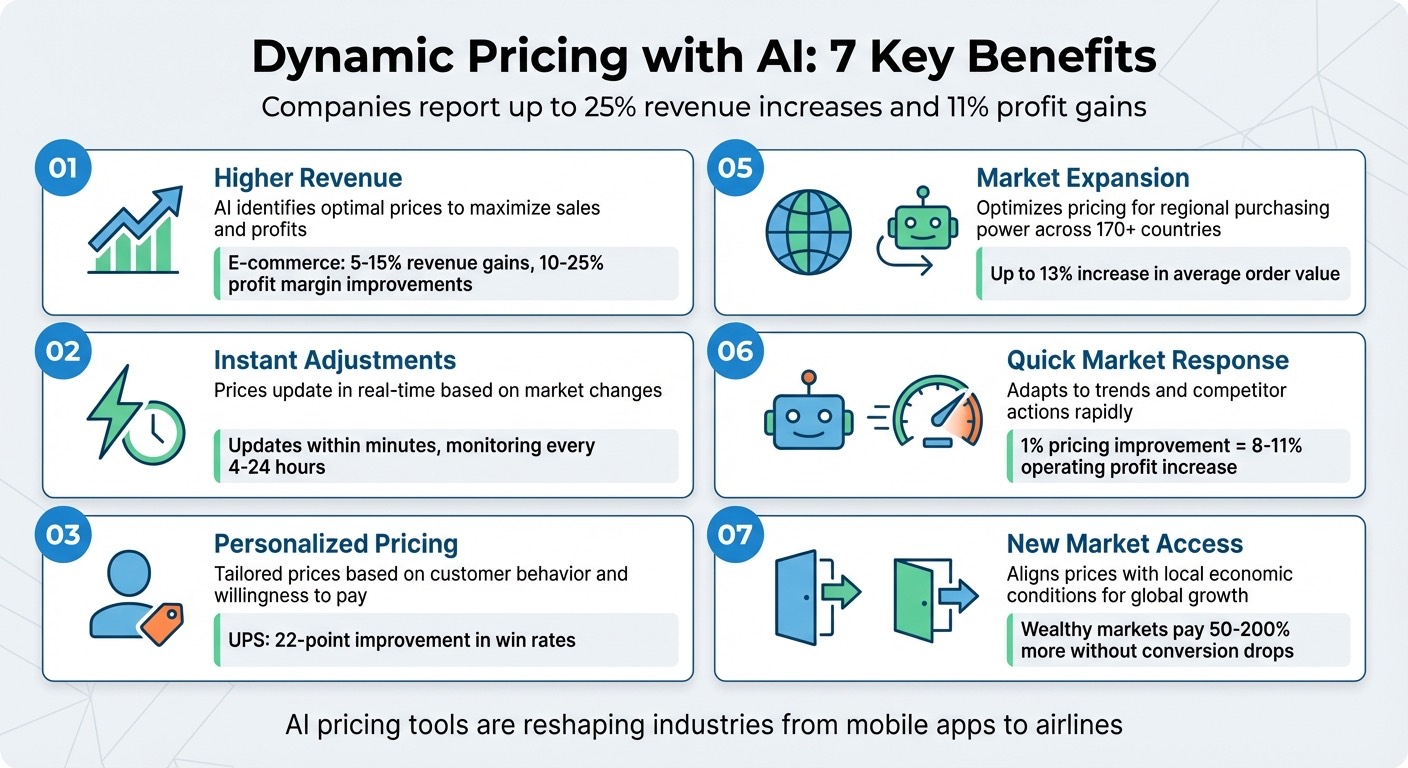
7 Key Benefits of AI-Powered Dynamic Pricing for Businesses
AI and Dynamic Pricing Strategies for Modern Commerce | Uplatz
sbb-itb-43fe43a
1. Higher Revenue Through Optimized Pricing
AI takes the guesswork out of pricing by identifying the sweet spot where sales volume and profit margins combine for maximum revenue. Instead of relying on traditional cost-plus pricing - which simply adds a fixed margin to costs - AI evaluates price elasticity to determine what customers are actually willing to pay. This approach captures value that manual methods often miss, directly increasing profits and improving operational efficiency.
The numbers speak for themselves. E-commerce businesses adopting dynamic pricing typically see revenue gains of 5% to 15% and profit margin improvements ranging from 10% to 25% [4]. Similarly, hotels leveraging AI-driven pricing report a 15% boost in revenue and a 20% improvement in forecast accuracy [2].
A real-world example is Zendesk, which transitioned from seat-based pricing to a value-based model, significantly increasing revenue per customer interaction [2]. This shift highlights how AI-powered pricing strategies can reshape revenue models across various industries.
AI also enhances pricing across the entire product lifecycle. By integrating with inventory data, AI can dynamically adjust prices based on stock levels. For instance, it raises prices on scarce items to capitalize on demand or reduces prices on slow-moving inventory to clear space and maintain cash flow [1].
For mobile app developers managing subscriptions in over 170 countries, platforms like Mirava offer region-specific pricing insights. By analyzing purchasing behavior from services like Netflix, Spotify, Apple, and YouTube, Mirava provides upstream pricing intelligence. This data seamlessly integrates with billing platforms such as RevenueCat, Adapty, Purchasely, and Superwall, enabling a complete pricing-to-payment workflow that maximizes revenue across global markets.
2. Instant Price Adjustments
AI-driven pricing systems bring speed and precision to the table, responding to market changes in real time without the need for manual intervention. These systems continuously process data from various sources, including competitor websites, inventory levels, customer purchasing patterns, and even external factors like weather or trending topics on social media. This allows prices to adjust automatically - often within minutes - keeping businesses agile and boosting revenue potential.
A key advantage is their ability to sync with live inventory updates. When stock levels fluctuate, these systems can immediately recalibrate prices to align with demand. Automated competitor monitoring is another powerful feature, checking rival prices every 4 to 24 hours and feeding fresh data into pricing algorithms to maintain competitiveness [4].
To avoid harmful pricing strategies, these tools also include safeguards like pre-set minimum and maximum price limits. Businesses can define thresholds to protect profit margins, cap maximum prices, and control how much prices can fluctuate within a specific timeframe [1] [4].
For app developers managing global app pricing strategies, platforms like Mirava simplify the process. By integrating effortlessly with tools such as RevenueCat, Adapty, Purchasely, and Superwall, these systems ensure real-time pricing adjustments that maximize revenue potential.
3. Personalized Pricing for Different Customers
AI transforms one-size-fits-all pricing into a tailored approach by analyzing customer behavior. Machine learning examines factors like browsing habits, purchase frequency, and sensitivity to discounts to estimate each customer's willingness to pay. By identifying price sensitivity across segments and forecasting Customer Lifetime Value (CLV), businesses can fine-tune discounts and pricing strategies. This method not only maximizes value from high-intent customers but also encourages conversions in a way that balances short-term sales with long-term profitability. These insights align seamlessly with earlier discussions on dynamic pricing and revenue management.
"We're using AI for personalized promotions and dynamic pricing. Our recommendation engines suggest products based on customer behavior, which lifts basket size and conversion rates." - Dr. Malina Ngai, Group CEO, AS Watson Group [2]
Take UPS as an example. Their AI-powered "Deal Manager" platform optimizes B2B contract negotiations by analyzing historical data and customer segments. The tool recommends ideal pricing, leading to a 22-percentage-point improvement in win rates in the U.S., all while maintaining profit margins [2].
For mobile app developers handling subscriptions across global markets, tools like Mirava provide pricing intelligence by evaluating willingness-to-pay data from over 170 countries. Drawing insights from platforms like Netflix, Spotify, Apple, and YouTube, Mirava helps determine optimal regional pricing. This intelligence integrates with subscription platforms such as RevenueCat, Adapty, Purchasely, and Superwall, which handle billing and paywalls. The outcome? Higher conversion rates and increased average order values, as customers recognize pricing as fair and transparent [6].
4. Automated Pricing Management
Handling pricing manually is a major hurdle for businesses. When you’re dealing with hundreds or even thousands of products across multiple regions, relying on spreadsheets and manual updates becomes unmanageable fast. AI steps in to streamline this process, automating the entire pricing workflow - from tracking competitors' prices to updating rates across all sales channels. By letting technology handle price updates, businesses can deliver the tailored and timely benefits mentioned earlier without the usual headaches.
Take airBaltic as an example. In 2024, the airline adopted an AI-driven dynamic pricing system that used reinforcement learning models to fine-tune seat assignment fees. Within just two months, they saw a 6% boost in seat reservation revenue per passenger while cutting down on manual pricing work [2]. This kind of success demonstrates how smoothly AI systems can integrate into existing operations.
Modern AI-powered pricing tools rely on APIs to make real-time updates to thousands of SKUs. This ensures consistent pricing across platforms like Amazon, Walmart, and direct e-commerce sites, helping businesses avoid penalties like losing the "buy box." For mobile app developers, automated pricing simplifies subscription updates across over 170 countries. Tools like Mirava handle bulk updates, regional price adjustments, and even price rounding, syncing seamlessly with platforms like RevenueCat, Adapty, Purchasely, and Superwall.
The time savings are game-changing. Many teams avoid touching regional pricing simply because doing it by hand feels like too much work - automation lets them test new strategies without worrying about spreadsheets or App Store rules.
This shift to automation doesn’t just save time - it opens the door for businesses to explore pricing strategies that would’ve been too complex or time-consuming to manage manually. Yet, despite these advancements, 71% of companies still rely on scattered, ad-hoc methods to track competitor pricing [2]. This reliance on outdated processes could mean leaving significant revenue opportunities on the table, as teams remain bogged down by manual tasks.
5. Easy Expansion Across Markets
Expanding pricing strategies internationally comes with its own set of hurdles. A pricing model that works seamlessly in the U.S. might fall flat in markets like Brazil, India, or Norway. The challenge lies in understanding real purchasing behavior in each region, which goes far beyond simple currency conversion. This is where AI-powered pricing platforms step in, streamlining the process by tailoring prices to local market dynamics.
For mobile app developers, this approach can be a game-changer. Instead of manually tweaking prices for over 170 countries, platforms like Mirava leverage proprietary pricing indexes. These indexes are informed by data from major players like Netflix, Spotify, Apple, and YouTube, helping to determine region-specific pricing that aligns with local willingness-to-pay. The platform also simplifies bulk updates, adjusts for regional price-ending preferences (e.g., .99 in the U.S. versus .00 in other markets), and integrates seamlessly with tools like RevenueCat, Adapty, Purchasely, and Superwall for billing and paywall management. Automated regional optimization, alongside features like instant price adjustments and personalized pricing, is essential for unlocking new market potential.
The impact of AI-driven pricing speaks for itself. It can boost average order value by up to 13% during peak periods and increase repeat buyer conversion rates by 5% [6]. On a broader scale, dynamic AI pricing has been shown to raise turnover by up to 3% and improve profit margins by as much as 10% through real-time, market-specific adjustments [6].
Surfacing the biggest pricing differences next to a developer's top markets is often a wake-up call - the kind of regional insight the app stores rarely show natively.
6. Quick Response to Market Changes
Markets are in constant motion, and staying ahead requires agility. AI-driven dynamic pricing systems excel at this by continuously monitoring factors like competitor pricing, inventory levels, sales trends, and even external triggers such as weather or social media activity. When these conditions change, AI adjusts prices within minutes, offering a speed advantage that’s crucial in today’s competitive landscape.
The financial impact of fine-tuned pricing is substantial. Studies show that even a modest 1% improvement in pricing can lead to an 8% to 11% increase in operating profit [4][5]. AI eliminates the lag of manual processes by systematically gathering competitor data every 4 to 24 hours and applying price changes instantly across all sales channels.
Real-world examples highlight the potential. UPS implemented an AI-powered "Deal Manager" for B2B contract negotiations, which analyzed past transactions to recommend optimal pricing. This tool led to a 22 percentage point increase in win rates in the U.S. market [2].
AI systems go beyond merely responding to competitors. They adapt to contextual triggers, such as increasing umbrella prices during unexpected rain, discounting slow-moving inventory, or capitalizing on viral demand spikes from platforms like TikTok. This level of responsiveness is increasingly vital as retailers prepare for "AI shopping agents" - automated bots that scan the web at machine speed to find the best deals for consumers [1].
To ensure these systems operate effectively without unintended consequences, it’s important to set clear boundaries. Define minimum price floors to maintain profit margins and maximum price ceilings to avoid accusations of price gouging. These guardrails help prevent harmful price wars and protect brand reputation [1][4].
7. Better Access to New Markets
AI goes beyond just adjusting prices - it opens doors to new markets by aligning costs with local economic conditions. Expanding into different regions demands pricing that suits the purchasing power of local consumers. Instead of sticking to a single global price, AI-driven dynamic pricing helps craft region-specific strategies that match what customers in those areas can realistically pay.
Understanding economic differences between regions is essential when creating tailored pricing. The disparity can be striking. Users in wealthier countries like Switzerland, Norway, Singapore, and Denmark are often willing to pay considerably more than a standard USD price without seeing a drop in conversion rates. On the other hand, a subscription that works well in the U.S. might be out of reach for users in countries like India, Turkey, Brazil, or Indonesia. Companies like Apple Music, YouTube Premium, Netflix, and Spotify have already adopted localized pricing, allowing them to reach more users and grow their markets.
AI tools evaluate several critical factors, such as Purchasing Power Parity (PPP) to ensure prices align with local incomes, local subscription benchmarks to set competitive rates, and price elasticity to gauge how different markets respond to changes in pricing. These algorithms even consider regional preferences for psychological pricing - like using .99 endings or rounded numbers - to enhance perceived value and appeal. This targeted approach to pricing helps mobile apps penetrate markets more effectively.
For developers managing pricing across over 170 countries, platforms like Mirava simplify this process. These tools calculate region-specific prices based on actual purchasing behavior in digital markets, with updates typically appearing on app stores within 24–48 hours [3].
This strategy achieves two key goals: it allows for lower prices in emerging markets, making products accessible to users who might otherwise be priced out, while higher prices in wealthier regions offset these adjustments. The result is a balanced global revenue model that supports growth across diverse markets.
Platform Comparison
To fully leverage the benefits of dynamic pricing, it's essential to understand how specialized platforms work together to streamline global subscription management.
A thriving subscription business depends on two key layers: pricing intelligence and subscription infrastructure. Mirava operates in the pricing intelligence space, determining optimal prices across 170+ countries by integrating purchasing power parity (PPP), willingness-to-pay algorithms, and psychological rounding tailored to local buying habits [3]. Once Mirava sets these region-specific prices, platforms like RevenueCat, Adapty, Purchasely, and Superwall handle the implementation - managing paywalls, transactions, and billing processes.
Mirava’s pricing recommendations enable lower rates in emerging markets to attract users while supporting premium pricing in wealthier regions. Subscription platforms such as RevenueCat and Adapty then apply these pricing structures seamlessly, ensuring smooth subscription management.
| Platform | Primary Function | Key Features | Pricing |
|---|---|---|---|
| Mirava | Pricing Intelligence | Regional pricing recommendations, willingness-to-pay analysis, psychological rounding, bulk updates in 170+ countries | Free, $49/app/month (Premium), Custom (Enterprise) |
| RevenueCat | Subscription Infrastructure | Billing management, in-app purchases, receipt validation, analytics | Free, $120/month (Launch), $250/month (Grow) |
| Adapty | Subscription Management | Paywall optimization, A/B testing, subscription lifecycle tracking | Free, $149/month (Growth), Custom (Enterprise) |
When used together, these platforms create a powerful ecosystem for subscription growth. Teams that previously avoided regional pricing because it felt like too much manual work can use this layered setup to test new strategies without worrying about spreadsheets or App Store rules.
The financial impact of this layered approach is clear: just a 1% improvement in price optimization can increase operating profit by 8–11% [4][5]. This synergy equips app developers with the tools they need to build scalable and profitable subscription models.
Conclusion
AI-driven dynamic pricing plays a crucial role in driving sustainable growth for mobile app monetization. By leveraging advanced pricing strategies, businesses can see revenue increases of up to 25% and operating profit improvements of as much as 11% [1][2][4].
For success, pricing intelligence must seamlessly integrate with subscription infrastructure. Tools like Mirava excel in pricing intelligence by analyzing purchasing power parity across more than 170 countries, incorporating psychological pricing techniques, and identifying optimal price points based on real user purchasing behavior. Meanwhile, platforms such as RevenueCat, Adapty, Purchasely, and Superwall handle billing and paywall management. Together, these systems enable global scalability and ensure precise pricing implementation.
Dynamic pricing becomes even more vital for apps with high GPU compute costs. Aligning revenue with these operational expenses is essential to maintaining profitability over the long term [9].
FAQs
What data does AI need to set dynamic prices?
AI relies on various data points to craft effective pricing strategies. These include customer behavior patterns, competitor pricing, market trends, demand elasticity, and seasonal fluctuations. It also considers inventory levels and how much customers are willing to pay. By analyzing these factors, AI can recommend pricing strategies that align with market dynamics and consumer preferences.
How do you prevent AI pricing from causing price gouging or price wars?
To avoid AI-driven pricing leading to extreme price hikes or aggressive price undercutting, implementing safeguards is essential. Setting clear price boundaries helps control fluctuations, maintaining a balance that avoids unfair practices. Tools like Mirava leverage regional pricing insights to fine-tune local pricing strategies, minimizing the likelihood of unethical pricing behaviors. Additionally, incorporating ethical guidelines, ensuring human oversight, and actively monitoring market trends keep AI pricing systems responsible and aligned with market stability.
How does Mirava work with RevenueCat, Adapty, Purchasely, or Superwall?
Mirava serves as the upstream pricing intelligence layer, analyzing real purchasing behavior to determine the best regional pricing strategies. Tools like RevenueCat, Adapty, Purchasely, and Superwall work alongside Mirava by handling billing, paywalls, and entitlements. This combination simplifies the process of fine-tuning pricing and managing subscriptions effectively.