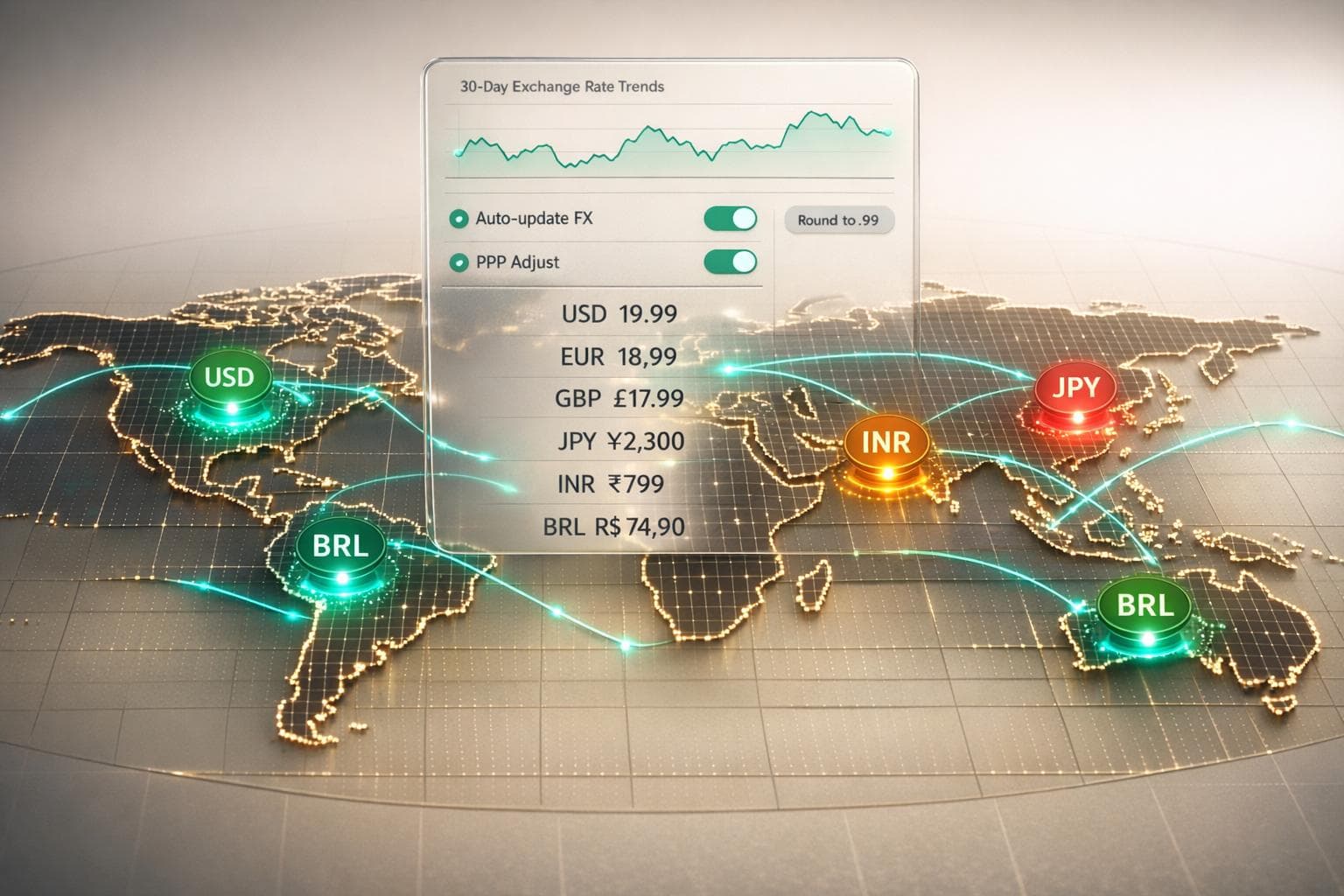
Localized pricing is more than just converting currencies - it’s about aligning app prices with the economic realities and purchasing behaviors of different regions. This approach can significantly boost revenue, improve conversions, and expand your global footprint. Apps like Duolingo and Flo have seen success by tailoring prices to local markets, with adjustments of up to 50–80% lower in price-sensitive areas like India and Brazil.
Key strategies include:
- Currency Conversion: A basic starting point but often too simplistic, leading to mismatched pricing.
- Market-Based Pricing: Adjusts for local purchasing power and psychological pricing limits, driving better conversions.
- Automation Tools: Platforms like Mirava analyze regional purchasing behavior and optimize pricing, integrating seamlessly with tools like RevenueCat and Adapty for implementation.
To succeed, configure regional pricing in app stores, test pricing changes with A/B experiments, and track metrics like Revenue Per User (RPU) and Customer Lifetime Value (LTV). Combine pricing adjustments with localized app content and regional payment methods to create a user experience that feels tailored and fair across markets.
How to price your subscription app globally - Featuring Jacob Rushfinn
sbb-itb-43fe43a
Localized Pricing Strategies
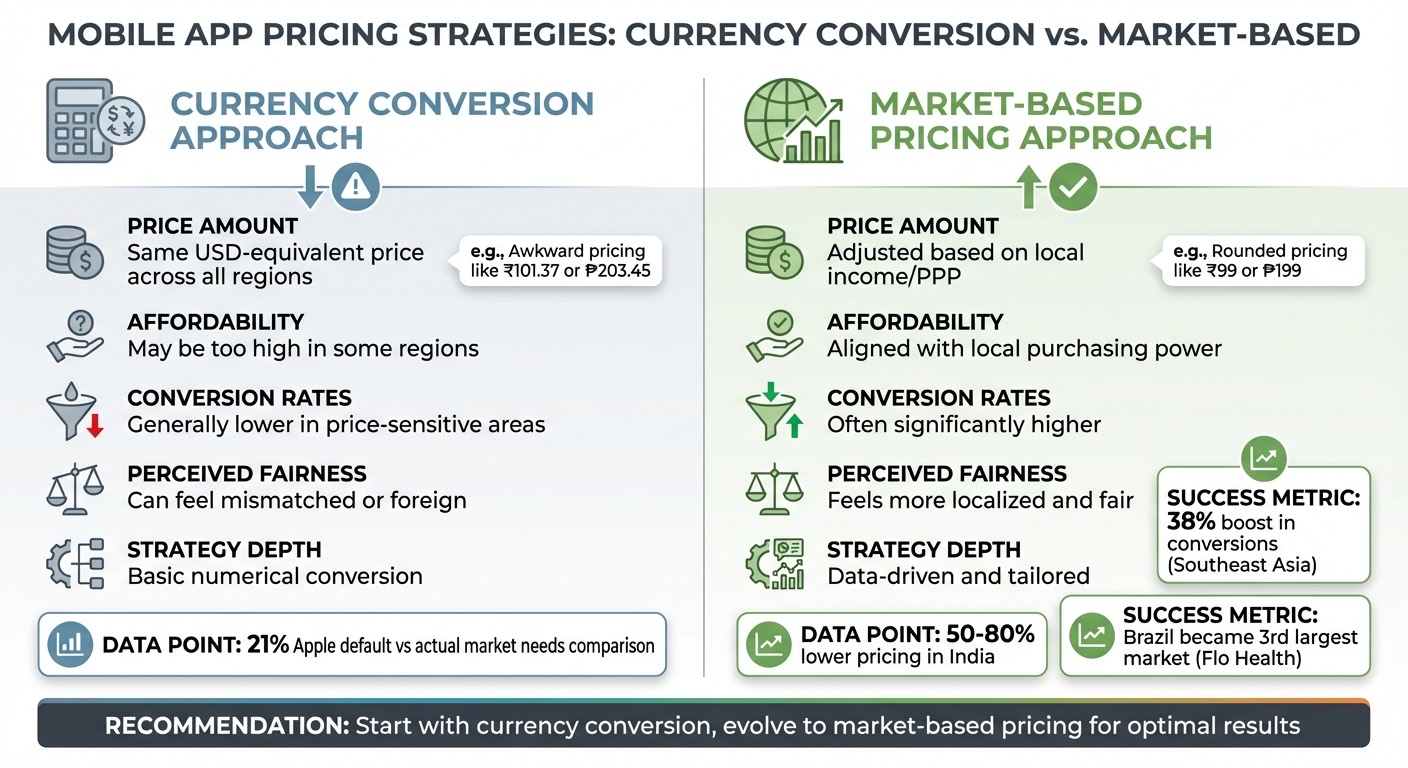
Currency Conversion vs Market-Based Pricing for Mobile Apps
Currency Conversion Approach
Currency conversion is a straightforward tactic - it takes your base price, often set in USD, and translates it into local currency using the latest exchange rates. Both Apple and Google offer this as a default feature in their app store settings, automatically generating localized prices. While this method is convenient, it oversimplifies pricing, reducing it to a mathematical exercise rather than a strategic decision.
One major downside of this approach is its disregard for local purchasing power. For instance, a converted price might result in awkward, non-rounded numbers like ₹101.37 or ₱203.45, which can appear odd or unappealing to users. Clean, rounded figures like ₹99 or ₱199 often resonate better in these markets.
This method can serve as a starting point for international pricing. However, if your app’s conversion rate in India is five times lower than in the U.S., it’s a clear sign that pricing needs to be revisited. While currency conversion offers ease, it lacks the nuance required to adapt to local market conditions effectively.
Market-Based Pricing Approach
Market-based pricing takes a more thoughtful route, adjusting prices to reflect local purchasing power and demand rather than relying solely on exchange rates. This strategy acknowledges that the perceived value of a product varies widely across regions. For example, a $9.99 subscription might feel reasonable in one market but prohibitively expensive in another.
Using purchasing power parity (PPP) as a foundation, this approach helps ensure that pricing feels consistent across different economies. Apple, for instance, suggests pricing in India 21% lower than in the U.S., but many apps fine-tune this further, often going 50–80% lower to match local realities [1]. Similarly, while Apple recommends a 26% increase for the UK, many apps successfully price about 10% lower than the U.S. equivalent [1].
A great example of market-based pricing in action comes from Flo Health. The period-tracking app experimented with significantly lowering subscription costs in Brazil to align with local conditions. This adjustment turned Brazil into their third-largest market, remaining profitable due to lower advertising acquisition costs, according to co-founder Dmitri Gurski [1]. In the same vein, tailoring prices to regional affordability in price-sensitive markets like Southeast Asia tends to lift conversions without raising acquisition spend.
This approach also considers how users perceive value. For instance, Duolingo’s revenue from "rest-of-world" markets grew by 45% in 2022, partly because the professional value of learning English in countries like Spain and France is higher than the casual use case often seen in the U.S. [1].
Implementing market-based pricing can be more complex than simple currency conversion. Developers often create competitor indexes of both global and local apps, apply psychological pricing techniques (e.g., rounding to ₹99 instead of ₹102), and adapt subscription offerings - opting for weekly or monthly plans in lower-income regions instead of annual ones [1]. Tools like Mirava simplify this process by analyzing regional purchasing behaviors from platforms like Netflix, Spotify, Apple, and YouTube. Mirava then integrates these insights with tools such as RevenueCat and Adapty to update prices and manage billing and paywalls seamlessly.
| Feature | Currency Conversion | Market-Based Pricing |
|---|---|---|
| Price Amount | Same USD-equivalent price | Adjusted based on local income/PPP |
| Affordability | May be too high in some regions | Aligned with local purchasing power |
| Conversion Rates | Generally lower in price-sensitive areas | Often significantly higher |
| Perceived Fairness | Can feel mismatched or foreign | Feels more localized and fair |
| Strategy Depth | Basic numerical conversion | Data-driven and tailored |
Setting Up Regional Pricing in App Stores
How to Configure Regional Pricing in App Store Consoles
Apple and Google provide different approaches for setting up regional pricing within their app stores. On the Apple App Store, you start by designating a "Base Country or Region", which serves as the foundation for pricing across 174 storefronts and 43 currencies [4]. Apple offers over 800 predefined price tiers, with prices ranging up to $10,000. These tiers automatically adjust to local currencies, factoring in exchange rates and taxes. If needed, developers can request an additional 100 higher price tiers [4].
Google Play, on the other hand, has moved away from pricing templates. Pricing is now set individually for each product. You define a default price in your local currency, and Google calculates region-specific prices using current exchange rates and local pricing trends [6]. For bulk adjustments on Android, the onetimeproducts service is available [6].
A notable difference between the two platforms is how they handle taxes. Apple includes taxes by default in its pricing [5], whereas Google Play gives you the option to include taxes in the default price or add them separately [6]. For example, Apple suggests pricing in India at 21% lower than in the U.S., but many developers manually set prices 50–80% lower to better match local purchasing power. Despite this, around 40% of brands still rely on Apple's default localization settings [1].
| Feature | Apple App Store | Google Play Store |
|---|---|---|
| Pricing Basis | 800+ Predefined Tiers [4] | Custom values per country [6] |
| Base Selection | Requires "Base Country/Region" [4] | "Default Price" in local currency [6] |
| Tax Inclusion | Included by default [5] | Optional (can be included or added separately) [6] |
| Bulk Management | Managed via Price Schedule [4] | onetimeproducts service (Templates deprecated Oct 2025) [6] |
Once you've configured regional pricing manually, automation tools can simplify future updates.
Using Pricing Tools for Automation
After setting up manual pricing, automation platforms can take over to streamline regional price management across more than 170 countries. These tools work upstream of subscription infrastructure, determining optimal prices while leaving billing, paywall, and entitlement management to tools like RevenueCat, Adapty, and Purchasely [1].
For instance, Mirava leverages purchasing behavior data - drawing insights from platforms like Netflix, Spotify, Apple, and YouTube - to calculate prices that align with local demand. This approach goes beyond relying solely on GDP or purchasing power parity (PPP) [7]. Mirava also applies psychological pricing techniques, such as rounding ₹102.33 to ₹99, and integrates directly with both App Store and Google Play consoles [7]. Once Mirava calculates the optimal pricing, tools like RevenueCat and Adapty handle the implementation at the billing and paywall levels [1].
Importantly, regional pricing updates are made directly in the app store consoles, eliminating the need for a new app version or binary update [8]. It's a good practice to verify pricing through VPN checks [1]. Additionally, testing significant price differences - like $39 versus $69 - can help you gather statistically meaningful results more quickly [1].
Additional Localization Strategies
Adapting App Content for Local Markets
Tailoring your app's content to resonate with local audiences goes hand-in-hand with pricing adjustments. When content feels relevant and familiar, it enhances user engagement and strengthens market appeal. For example, Duolingo fine-tunes its app for markets like Spain and France by highlighting the professional benefits of English proficiency, catering to local career aspirations [1]. Similarly, Flo saw significant growth in non-English-speaking regions by combining localized pricing with targeted marketing content [1].
A practical first step is localizing your app store metadata - titles, descriptions, and screenshots. This low-cost approach helps you test a market's responsiveness [11]. Beyond translation, consider tweaking the onboarding experience to spotlight region-specific benefits before users encounter the paywall [10]. In areas with limited purchasing power, offering flexible options like weekly plans or "lite" versions instead of annual subscriptions can align better with local spending habits [1][10].
Localized pricing is not a one-time discount or a currency conversion trick. It is a strategy to align affordability and perceived value per market so your subscription pricing feels normal and converts consistently.
To complement localized content, integrating region-specific payment methods is another key step in creating a seamless user experience.
Supporting Regional Payment Methods
Simplifying the checkout process with local payment options can significantly reduce friction and improve conversions. For instance, Photomyne, an app with over 45 million downloads, leveraged Paddle to offer payment localization across 136 territories and more than 29 currencies. According to CMO Mickey Atir, this streamlined checkout process led to higher conversion rates [13].
In fact, incorporating local payment methods can elevate checkout conversion rates from 4.3% to 6.5%, representing a 51% relative increase [13]. Currency-specific acceptance rates also highlight the importance of localization; in India, transactions in Indian Rupees (INR) had a 55.03% acceptance rate, compared to 42.59% for Euros (EUR) [13]. Focus on the most relevant payment options for each region, such as PayPay in Japan or UPI in India. Additionally, ensure the checkout interface is translated and formatted for local conventions, including right-to-left support for languages like Hebrew or Arabic [12][13].
Mirava takes the lead in calculating optimal pricing based on purchasing data from platforms like Netflix, Spotify, Apple, and YouTube. From there, tools like RevenueCat, Adapty, and Purchasely handle the billing and payment logistics, allowing you to concentrate on refining your pricing strategy [1]. This division of tasks ensures a smoother implementation while keeping your focus on market-specific growth opportunities.
Measuring and Improving Localization Results
Key Metrics to Track
When evaluating localized pricing, Revenue Per User (RPU) by region is your most critical metric. It shows whether regional pricing adjustments are improving profitability, not just increasing downloads. Pair this with your download-to-purchase conversion rate - if downloads in India result in conversion rates five times lower than in the US, your pricing strategy likely needs adjustment [1].
Keep an eye on Customer Lifetime Value (LTV) and retention rates at 7, 30, and 90 days to assess long-term engagement. Regional churn rates and refund rates are also essential to monitor. High refund rates often indicate a disconnect between perceived value and pricing, rather than dissatisfaction with the product itself. These metrics collectively reveal how well your pricing aligns with user expectations.
“[Look at] how many free users are coming in. If your conversion rate in India is five times lower than in Canada, Australia, or US, well, there's some mismatch, right?"
- Jacob Rushfinn, Founder, Rushfinn Consulting [1]
Mirava supports pricing decisions by offering previews of revenue and conversion impacts before changes are implemented. This allows you to forecast outcomes across more than 170 countries. Once the prices are live, tools like RevenueCat, Adapty, and Purchasely help track billing metrics and user behavior, ensuring your strategy delivers the intended results.
With these metrics in place, leverage A/B testing to refine your pricing and maximize its effectiveness.
A/B Testing and Ongoing Optimization
A/B testing is essential for understanding price elasticity. Test clear price differences (e.g., $39 vs. $69) to measure user sensitivity to pricing [1]. In price-sensitive regions, a well-judged price cut can grow conversions and the paying user base by enough to more than offset the lower per-user price, which is exactly the tradeoff A/B testing helps you measure before rolling a change out widely.
During testing, maintain a control group of 5–10% of users on the original pricing to assess the long-term effects on LTV and retention. Roll out the winning prices gradually - start with 10% of users, then expand to 50%, and finally 100%. This phased approach helps identify and address any unexpected issues before full deployment. Keep in mind that Apple’s pricing rules require users to opt in again for significant price increases, which can trigger churn [1].
Quantitative data is crucial, but don’t overlook qualitative feedback. If users perceive your app as pricier than local options like Netflix or Spotify, it’s a sign your pricing may exceed the local market's perceived value. While Apple’s default pricing recommendations for India are typically only 21% lower than US prices, apps that succeed in the region often price 50–80% lower [1]. Mirava, a leading pricing intelligence platform, benchmarks your pricing against services like Netflix, Spotify, Apple, and YouTube. This ensures your strategy reflects actual purchasing behavior rather than generic economic metrics like GDP or PPP.
Common Mistakes and How to Avoid Them
While well-planned strategies can boost revenue, overlooking local differences and scalability often undermines their effectiveness.
Ignoring Regional Differences
Around 40% of brands still stick with Apple and Google's default pricing. However, these defaults are based on exchange rates and taxes, not the actual purchasing power of local users [1]. This can lead to a pricing imbalance where your app feels overly expensive in one region and underpriced in another - a situation known as "mismatched market positioning".
Take India, for instance. Apple’s recommended pricing is just 21% lower than in the U.S., but successful apps in the region often price their offerings 50–80% lower [1]. This highlights the gap between simple currency conversion and pricing that truly resonates with local users. Put plainly: auto-conversion is currency math, while real localization is pricing strategy.
Local users also respond better to psychological pricing thresholds, such as "under $10" or "just below $50", rather than exact currency conversions.
Neglecting Scalability and Maintenance
Managing prices for 170+ countries and multiple SKUs manually is a recipe for errors. Without scalable systems, many developers fall back on basic FX conversion, which fails to account for local affordability and reinforces mismatched pricing.
Automation is the key here. Platforms like Mirava simplify the process by automating bulk price updates, applying psychological rounding, and previewing revenue impacts across global markets. Acting as an upstream pricing intelligence layer, Mirava ensures regional consistency, freeing tools like RevenueCat, Adapty, and Purchasely to handle billing and paywalls. This division of responsibilities allows pricing strategies to scale efficiently without relying on error-prone spreadsheets.
Before rolling out any price changes, always review your pricing grid. Watch for "tier jumps", where small adjustments unintentionally push a country into a higher, less affordable pricing tier. Set clear rounding rules - whether you prefer charm pricing (e.g., $9.99) or clean numbers (e.g., $10.00) - and apply them consistently to avoid confusion and maintain trust.
Lastly, don’t judge success purely on short-term conversion increases. Pricing experiments often need 3–6 months to reveal their full impact on metrics like Lifetime Value (LTV) and retention [1]. By using scalable, automated systems, you can continuously refine your pricing approach and adapt to market needs.
Best Practices for Localized Pricing
Begin with native price tiers provided by Apple and Google as a starting point, but don’t rely solely on them. These tiers are based on exchange rates and taxes rather than reflecting true purchasing power. Many top-performing apps go beyond these defaults, tailoring prices to better align with local economic realities [1]. This highlights the importance of a pricing strategy grounded in data.
Focus your initial testing efforts on your strongest market to understand price elasticity before expanding to other regions. Use tests with noticeable price differences (e.g., $39 versus $69) instead of minor adjustments to gather clearer insights. As Jacob Rushfinn, Founder of Rushfinn Consulting, aptly notes:
If your conversion rate in India is five times lower than in Canada, Australia, or US, well, there's some mismatch, right? [1]
When measuring success, look beyond short-term conversion boosts. Instead, track lifetime value (LTV) and retention over a 3–6 month period to get a more accurate picture of performance.
Scalability is another essential factor. Platforms like Mirava simplify managing pricing across more than 170 countries by offering upstream pricing intelligence. They analyze region-specific purchasing patterns using data from major players like Netflix, Spotify, Apple, and YouTube. This allows tools such as RevenueCat, Adapty, and Purchasely to concentrate on their strengths - billing, paywalls, and entitlements. Together, these systems create a seamless workflow where pricing strategy and execution are perfectly aligned.
Lastly, implement psychological rounding consistently across all markets. Avoid random conversions like ₱202.33 - opt for ₱199 instead. Preferences for price endings (e.g., .99 versus whole numbers) vary by region, and data-driven tools can automate these adjustments while showing potential revenue impacts in advance. Pairing this approach with benchmarking against your top five local competitors ensures your pricing feels natural to users and maximizes conversions.
FAQs
When should I switch from currency conversion to market-based pricing?
Switch to market-based pricing when your local audience feels your prices are either too steep or surprisingly low. This strategy allows you to adjust prices in line with local purchasing power and market trends, ensuring your pricing resonates better with regional affordability and demand while maximizing revenue potential.
How do I avoid upsetting existing subscribers when prices change by region?
To reduce dissatisfaction among subscribers during regional price adjustments, focus on aligning prices with local purchasing power and market norms instead of making sudden changes. Implement these adjustments gradually, experimenting with various price points while monitoring key metrics such as retention rates and lifetime value. Transparent communication is essential - clearly explain to users that the changes are based on local economic factors and are intended to enhance the value of the service. Leveraging data-driven tools can assist in ensuring these adjustments are perceived as reasonable and acceptable.
What’s the fastest way to test and roll out localized prices across 170+ countries?
Platforms tailored for regional pricing make the process much smoother. Tools such as Mirava streamline this by offering a free pricing audit along with tailored country-specific price recommendations, all grounded in actual purchasing patterns. Additionally, Mirava allows for bulk price updates across app stores, cutting down on the manual workload. By combining this approach with app store tools and A/B testing, you can ensure your pricing adjustments are precise and informed by data, ready for global rollout.