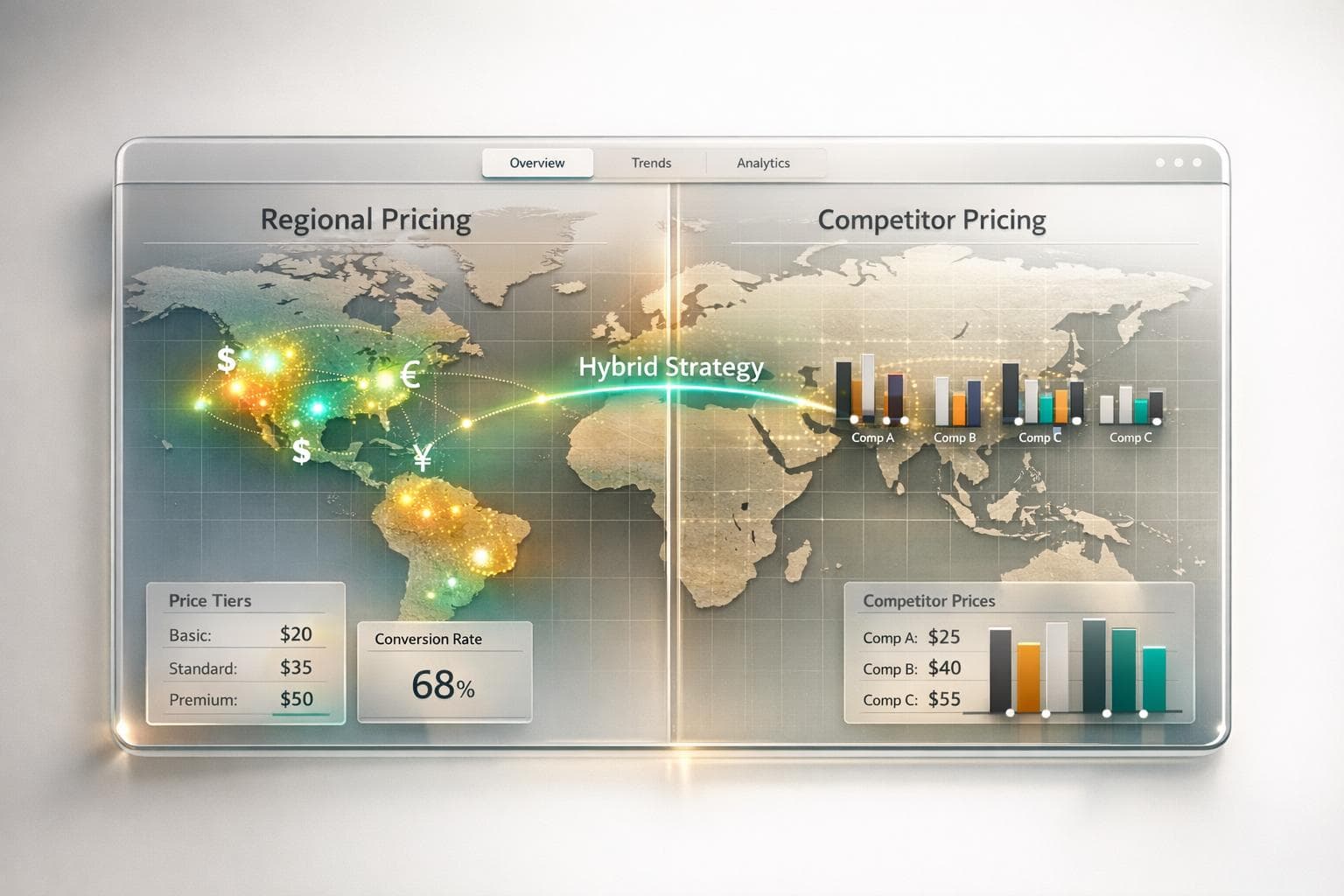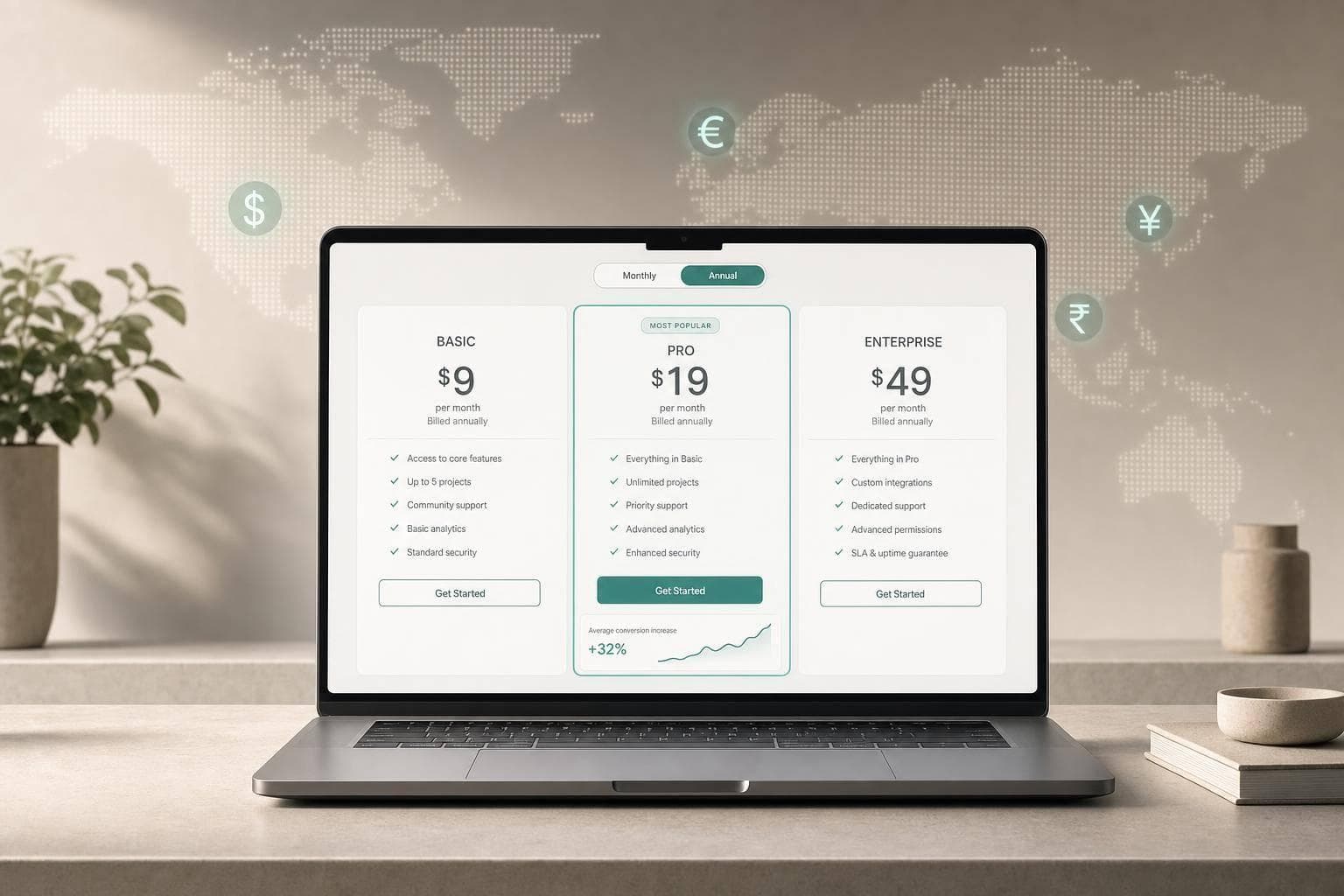
Regional pricing tailors subscription costs to local economic conditions, rather than applying a single global rate. This approach, price localization done right, ensures affordability in price-sensitive markets and maximizes revenue in wealthier regions. Companies like Netflix, Spotify, and YouTube Premium have adopted this model, leading to improved conversion rates and revenue growth.
Key Insights:
- What it is: Adjusting prices to reflect local purchasing power, not just converting currencies.
- Why it matters: Flat pricing can alienate users in lower-income regions and undervalue services in wealthier markets.
- Impact: Regional pricing can boost trials and subscriptions by 15-30% in price-sensitive areas.
- Challenges: Manual price updates are time-consuming and prone to errors, especially with currency fluctuations.
- Solutions: Tools like Mirava streamline pricing adjustments, integrating with platforms like RevenueCat and Adapty for seamless updates.
By leveraging data-driven strategies and automation, businesses can optimize regional pricing to balance affordability and revenue goals effectively.
How to price your subscription app globally - Featuring Jacob Rushfinn
sbb-itb-43fe43a
Strategies for Regional Subscription Tier Optimization
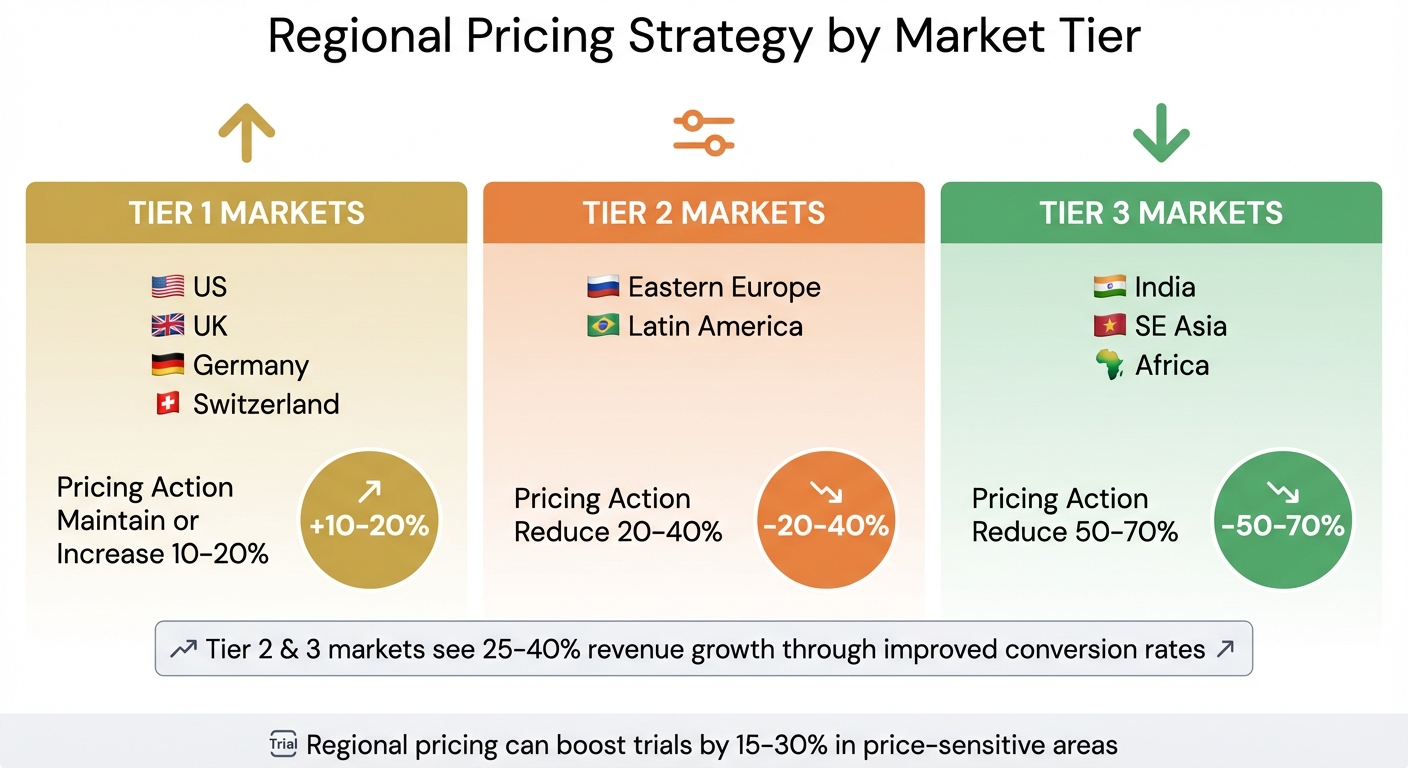
Regional Pricing Tiers: Recommended Price Adjustments by Market Category
Fine-tuning subscription pricing across regions can be challenging, but by combining data insights with an understanding of consumer psychology, businesses can simplify the process while maximizing results.
Data-Driven Pricing Models
A practical starting point for regional pricing is market tiering, where countries are grouped into 3–5 tiers based on economic indicators. Instead of setting unique prices for every market, this approach balances efficiency with sensitivity to purchasing power differences.
Modern pricing strategies go beyond GDP data, favoring salary-based benchmarking tied to specific user personas. For example, a 2026 analysis highlighted that a $1,995 annual membership represents just 1.3% of a US marketing manager's salary ($154,266) but accounts for 10.7% of an Argentine marketing manager's salary ($18,524) [3]. This willingness-to-pay (WTP) analysis incorporates local purchasing behaviors, subscription norms, and category-specific expectations to determine pricing sweet spots [1].
The disparity in subscription costs across countries is striking. For instance, Netflix subscribers in Switzerland pay 7.6 times more than those in Pakistan, while Spotify’s pricing in Denmark is 24 times higher than in Nigeria [3]. These differences are not random; they reflect actual purchasing power and established pricing norms in each region.
"Geographic pricing introduces complexity, yet it can unlock 15–20% in growth." - Subscription Index [3]
While data provides the foundation, psychological insights further refine pricing strategies, as explored below.
Psychological Pricing and Number Rounding
The way prices are presented can significantly influence customer perception, and this varies by region. In the US, the classic $9.99 pricing strategy is effective, but in other regions, whole numbers or alternative rounding patterns resonate better. Local expectations play a big role in what feels fair - users are influenced by "anchors" set by major services like Netflix, Spotify, Apple Music, and YouTube Premium in their specific markets [1].
"Endings like .99 or whole numbers perform differently across countries. Mirava optimizes rounding norms to enhance perceived value." - Mirava [1]
Aligning pricing with these established anchors can boost conversions. For example, while the UK and Nordic countries are more accepting of higher price points, Southeast Asian markets tend to favor lower entry-level pricing [1].
How to Structure Multiple Subscription Tiers
Combining data insights with psychological nuances, structuring subscription tiers requires clear regional adjustments. Offering Basic, Pro, and Premium plans often means tailoring pricing strategies to match the economic realities of each market. In wealthier countries like Switzerland, Norway, and Singapore, consumers can typically afford to pay 50–200% more than standard USD rates [1].
| Market Category | Region Examples | Recommended Price Action |
|---|---|---|
| Tier 1 | US, UK, Germany, Switzerland | Maintain or Increase 10–20% |
| Tier 2 | Eastern Europe, Latin America | Reduce 20–40% |
| Tier 3 | India, SE Asia, Africa | Reduce 50–70% |
Both the Apple App Store and Google Play Store provide tools for implementing regional pricing adjustments. These include purchasing-power updates and currency exchange rate corrections [1]. The goal is to strike a balance between affordability for local users and overall revenue targets. In Tier 2 and Tier 3 markets, lower prices often lead to 25–40% growth in revenue through improved conversion rates [1].
How to Implement Regional Pricing
This section walks you through a practical process for executing regional pricing strategies, from gathering market data to automating updates. Transitioning from strategy to action requires clear steps to collect data, validate pricing, and deploy changes without relying on manual spreadsheets or repeated engineering efforts.
Gathering Regional Market Data
To implement regional pricing effectively, start by establishing a baseline using Purchasing Power Parity (PPP). Reliable sources like the World Bank, OECD, or IMF can help determine what a $9.99 USD subscription would equate to in another region, reflecting local purchasing power rather than simple currency conversion. Update this data annually or every six months to account for inflation and economic trends.
Next, examine the local subscription culture to understand what users in each region are accustomed to paying. For instance, Nordic countries often accept higher prices, while Southeast Asia typically demands lower entry points. Compare these expectations with local competitors and global players like Netflix, Spotify, and YouTube to align with established pricing norms. Monthly tracking through App Store pricing reports or analytics tools can keep your benchmarks current.
"Every country has different norms for what an app 'should' cost." - Mirava [1]
In addition, consider local rounding conventions to align prices with regional perceptions. Keep an eye on foreign exchange (FX) trends to ensure your prices stay consistent with USD targets [2].
Once you’ve established accurate regional data and cultural benchmarks, you’ll be ready to test specific price points.
Setting and Testing Price Points
Begin with your PPP-based baseline and test three pricing variants: baseline, 20% premium, and 20% discount. Aim to test each variant with at least 1,000 users over a 2–4 week period. Roll out the winning price gradually - start with 10% of users, then expand to 50%, and finally 100% - while keeping a 5–10% control group for comparison.
Focus on metrics like Revenue Per User (RPU), conversion rates, lifetime value, and retention over 7, 30, and 90 days. Lowering prices in regions with high price sensitivity can drive 15–30% more trials and paid conversions without increasing traffic [2].
For both iOS and Android platforms, regional price adjustments can be made directly through the store consoles (App Store Connect or Google Play Console), eliminating the need for new app builds or SDK changes.
Automating Price Updates Across Platforms
Once you’ve validated your price points, automation ensures smooth and accurate updates across regions. Manual updates via spreadsheets can be inefficient and prone to errors. Tools like Mirava integrate seamlessly with App Store Connect, Google Play, and Stripe, allowing you to automate price updates and sync data with billing platforms like RevenueCat and Adapty.
Automation enables features like scheduled rollouts, caps on maximum price changes by country, and a complete history of updates for easy reversals if needed. Delayed updates can lead to FX drift [2], but automated systems can monitor FX trends and suggest corrections to keep prices aligned with your revenue goals.
| Feature | Manual Process | Automated (via Mirava/Store Integration) |
|---|---|---|
| Implementation | Requires engineering time and new app builds | No code changes or SDKs required |
| Price Accuracy | Prone to FX drift and "ugly" endings | Uses FX normalization and psychological rounding |
| Regional Control | Often one global price anchored to USD | Per-country control based on local willingness-to-pay |
| Testing | High risk; difficult to track and revert | Structured A/B tests with full version history |
| Billing Integration | Manual sync with RevenueCat/Adapty | Automatic; billing tools fetch updated store prices |
It’s important to note that Apple and Google automatically protect active subscribers when prices change. New pricing typically applies only to new customers unless a specific "price increase" workflow is initiated.
Tools for Regional Pricing Automation
To ensure consistent and optimized pricing across regions, automation tools are indispensable. Once you've laid out your pricing strategy and confirmed your price points, these tools can handle updates across platforms, simplifying operations. A well-structured monetization workflow typically relies on two key layers: pricing intelligence, which identifies the best prices to charge, and billing infrastructure, which manages payments, subscriptions, and entitlements.
Mirava: Pricing Intelligence Platform
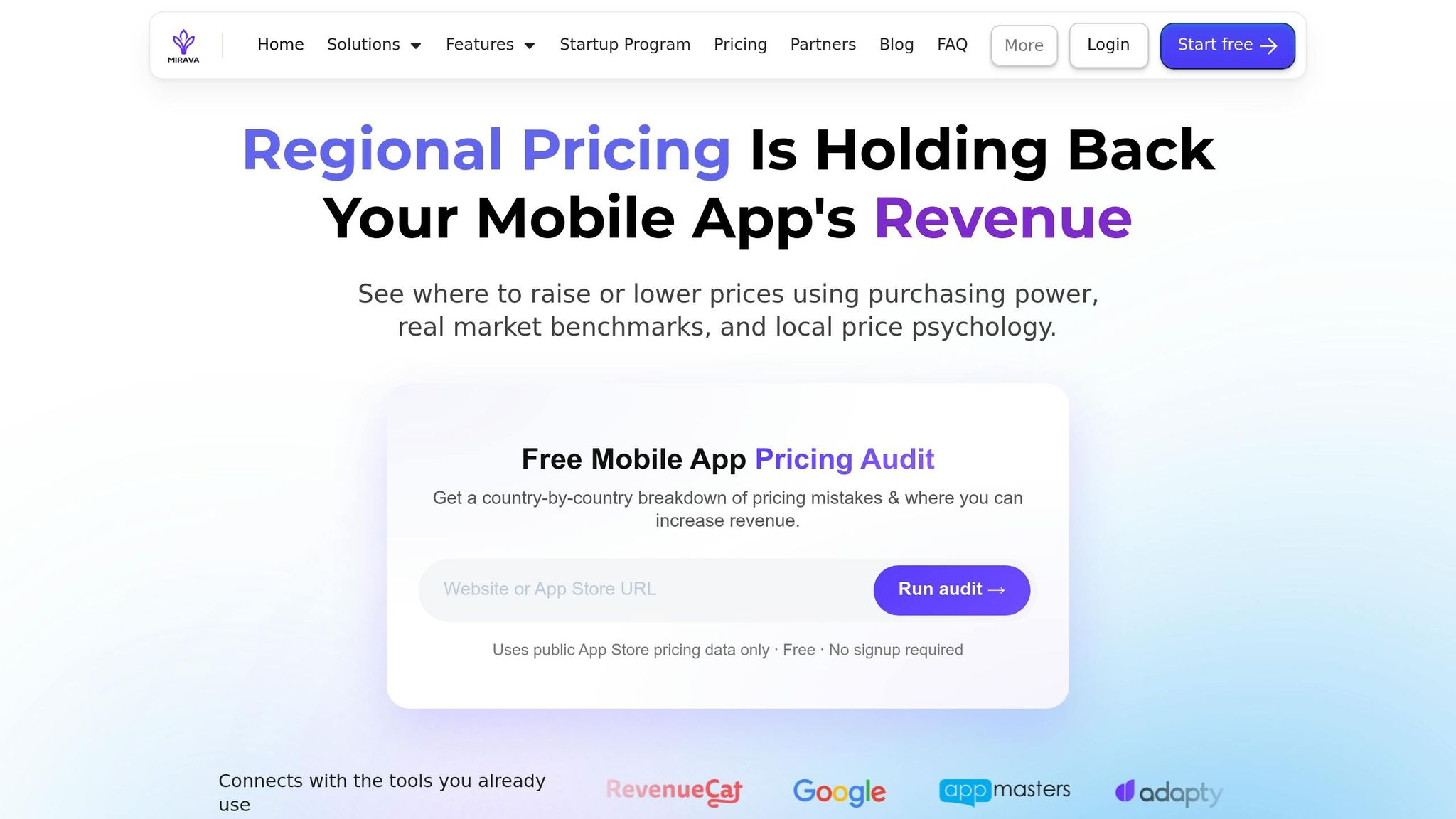
A standout tool in this space is Mirava, a pricing intelligence platform designed to streamline regional pricing. Acting as the upstream decision-maker, Mirava determines optimal prices before they reach app stores. It centralizes pricing for platforms like the App Store, Google Play, and Stripe, eliminating the need for manual uploads or switching between dashboards.
Mirava's Willingness-to-Pay (WTP) engine is its core strength. By analyzing market trends, regional subscription preferences, category-specific norms, and global benchmarks, it calculates precise prices for over 170 countries. Unlike traditional methods that rely heavily on GDP or PPP data, Mirava pulls from pricing indexes shaped by real-world purchasing behaviors seen in platforms like Netflix, Spotify, Apple, and YouTube. This approach ensures pricing reflects actual consumer habits. Additionally, it applies regional psychological rounding and tracks foreign exchange fluctuations to ensure local prices align with your global strategy.
"Most apps just set a universal price, use Apple's default localization, or guess with random multipliers and hope for the best. This index fixes that. It shows exactly how much users pay in 60+ countries compared to the US baseline." - Vitaly Davydov, CEO and Co-Founder at Adapty [4]
With Mirava, teams can update prices across multiple countries in one go, while retaining manual approval to comply with Apple and Google policies.
Billing and Paywall Platforms
Once Mirava updates store-level pricing, the next layer - billing and subscription management - takes over. This is where platforms like RevenueCat, Adapty, Purchasely, and Superwall come into play. These tools automatically sync with updated pricing from Mirava, managing transactional operations such as receipt validation, A/B testing seasonal app pricing strategies, entitlement handling, and subscription lifecycle monitoring.
"Mirava updates prices at the store level. Tools like RevenueCat and Adapty read those changes automatically, so your paywalls, trials and entitlement logic stay exactly as they are." - Mirava [5]
This division of responsibilities allows product and finance teams to focus on pricing as a standalone layer, while billing and paywall platforms handle the operational details. Together, these tools create a seamless workflow where pricing intelligence integrates smoothly with subscription infrastructure, ensuring a cohesive monetization strategy.
Measuring and Improving Regional Pricing
Metrics to Track
Tracking the right metrics is essential for refining regional pricing strategies. Average Revenue Per Paid User (ARPPU) is a critical indicator, especially when testing price increases in higher-income regions like Switzerland or Norway. It helps determine if revenue gains outweigh potential conversion losses [2]. Similarly, Trial-to-Paid Conversion rates provide insight into how well entry-level pricing tiers perform in markets where users are more price-conscious [2].
Another key metric is Revenue Per User (RPU), which reflects the actual revenue generated per individual and serves as a guiding measure for overall performance. Lifetime Value (LTV) highlights the long-term viability of your pricing strategy, while retention rates ensure that lower prices aren’t just attracting short-term users. Research shows that localized pricing can boost trials and paid starts by 15–30% in more price-sensitive regions [2].
By closely monitoring these metrics, you can continuously refine your pricing strategy to meet both local and global revenue objectives.
Testing and Adjusting Prices
Regular price reviews are essential to keep regional pricing aligned with market conditions and overall business goals. These reviews should occur multiple times a year to account for factors like inflation, currency fluctuations, and the results of past experiments [2]. Using real-time data helps mitigate revenue losses caused by exchange rate changes [1] [2].
Before testing new pricing strategies, establish clear minimum and maximum price thresholds to safeguard profit margins [2]. When implementing changes - whether lowering prices in more cost-sensitive markets or increasing them in premium regions - focus on applying these adjustments to new customers. Both Apple and Google automatically protect existing subscribers from price increases, ensuring minimal disruption to your current user base [1] [2].
"Lowering prices where your app is too expensive often unlocks 15–30% more trials and paid starts without extra traffic." - Mirava [2]
Strategic collaboration is key to executing these adjustments effectively.
Team Workflows for Price Changes
Streamlined workflows and centralized tools are vital for managing pricing updates efficiently. A central dashboard that tracks pricing changes and their impact on performance ensures transparency across teams like finance, growth, and product [2]. Maintaining a price history within these dashboards allows teams to evaluate past adjustments and quickly revert any unsuccessful experiments [2].
While automated tools provide the necessary data for these decisions, it’s the collaboration between teams that ensures smooth execution. This approach aligns pricing strategies with broader business objectives and keeps experimentation well-structured and controlled.
Conclusion
Regional pricing shifts subscription apps from one-size-fits-all models to tailored services that align with local economic conditions. By adjusting prices to reflect local purchasing power, apps can tap into emerging markets once seen as "zero-revenue" territories and capture higher revenue in affluent regions like Switzerland and Norway. This approach has shown to boost revenue by 25–40% compared to flat USD pricing [1].
This strategy has become the norm among industry leaders. Companies like Netflix, Spotify, YouTube Premium, and Apple Music have adopted dynamic regional pricing tiers that account for currency fluctuations and local subscription habits [1]. The benefits are clear: better conversion rates and more stable, long-term revenue streams by aligning prices with what users can realistically afford.
As Mirava puts it:
"Local pricing outperforms flat global pricing. Every. Single. Time." - Mirava [1]
This highlights the critical distinction between simply converting prices into local currencies and fully optimizing regional pricing. Currency localization maintains the same USD-equivalent price, which often misses the mark in price-sensitive markets. True regional pricing, on the other hand, adjusts rates based on local economic realities, leading to far better conversion rates [1].
Achieving success in this area requires a mix of pricing intelligence and the right tools for execution. Platforms like Mirava act as the data layer that determines optimal pricing across more than 170 countries. Meanwhile, tools such as RevenueCat, Adapty, Purchasely, and Superwall manage billing, paywalls, and entitlements. Together, these systems enable apps to implement advanced regional pricing strategies efficiently, ensuring they remain competitive as market conditions change.
FAQs
How do I choose the right country tiers for regional pricing?
To determine the right country tiers, it's essential to consider factors like local economic conditions, user purchasing power, and market expectations. Adjusting prices based on Purchasing Power Parity (PPP) rather than straightforward currency conversions helps maintain affordability and aligns with users' financial realities.
Platforms such as Mirava offer pricing insights informed by global purchasing trends. Complementary tools like RevenueCat, Adapty, Purchasely, and Superwall handle paywalls and entitlements, allowing for smooth execution of your pricing strategy.
What’s the best way to test regional price points without hurting revenue?
To experiment with regional price points without jeopardizing revenue, A/B testing grounded in Purchasing Power Parity (PPP) data is a smart approach. This method aligns pricing with local economic conditions rather than relying on straightforward currency conversions.
Begin by setting prices based on PPP data, then test different variations while closely monitoring key metrics such as conversion rate, ARPU (Average Revenue Per User), and retention. Tools like RevenueCat or Adapty can handle paywall management effectively, while Mirava offers the pricing insights needed to steer these experiments in the right direction.
How can I automate regional price updates across iOS, Android, and Stripe?
You can streamline regional price updates across iOS, Android, and Stripe by leveraging platforms like Mirava. These tools allow you to handle batch updates, align prices with App Store and Google Play tier structures, and keep an eye on currency fluctuations and market trends.
Mirava enables you to set prices tailored to regional purchasing power and psychological pricing strategies. It also lets you push updates across platforms and automatically adjust prices as market conditions evolve, ensuring uniformity without the need for manual intervention.