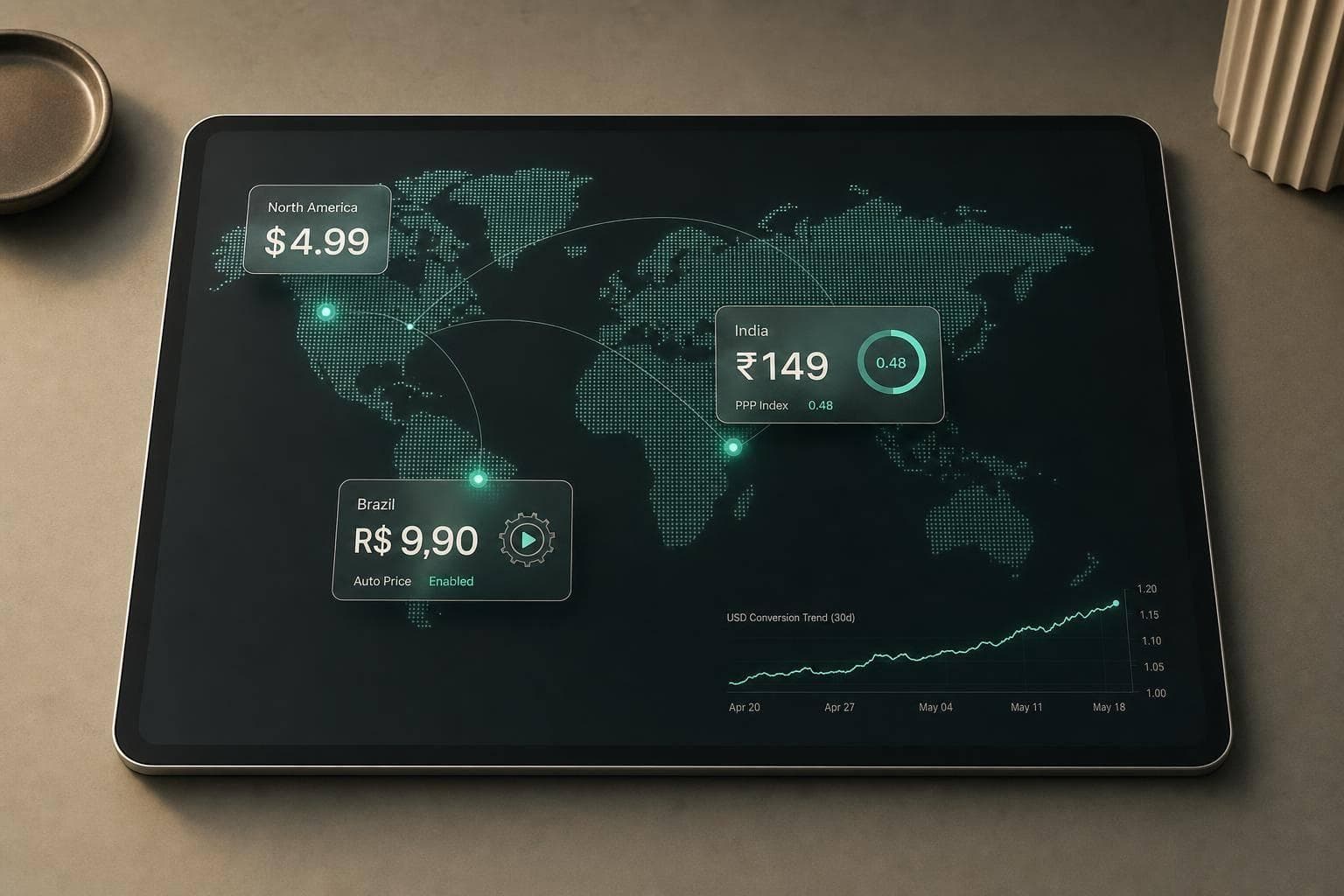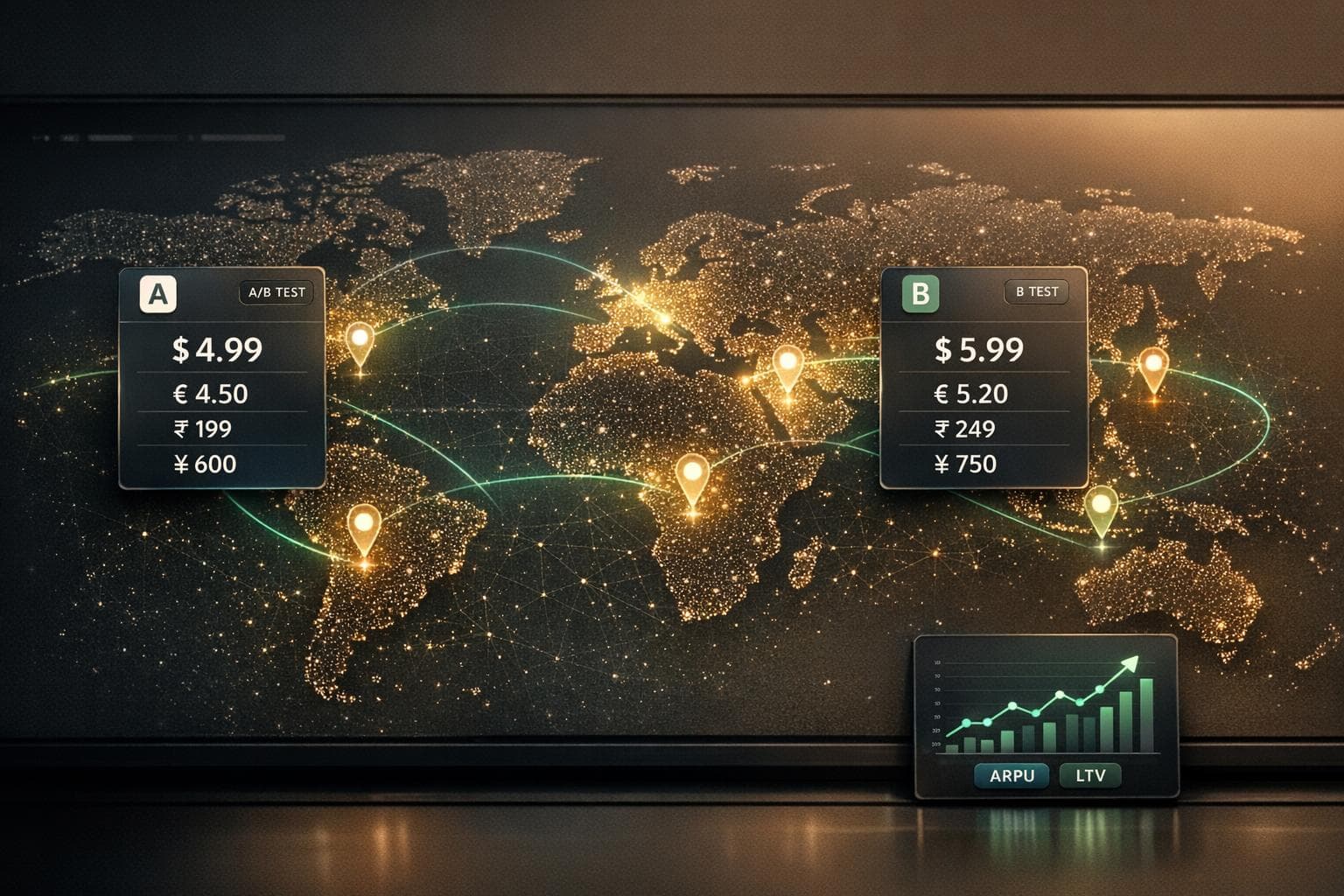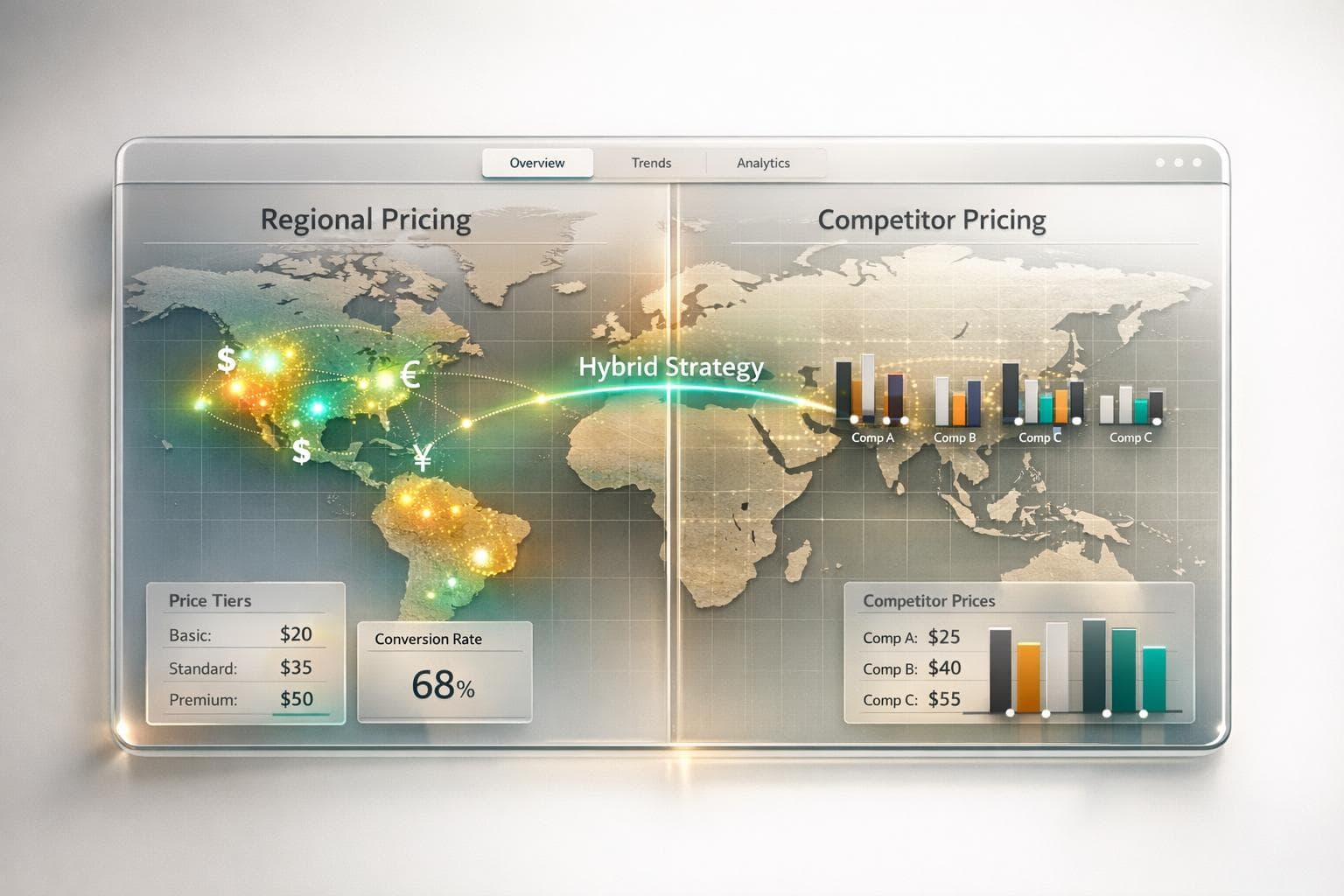
Apple’s regional app pricing system simplifies currency conversion and tax adjustments but often overlooks local purchasing power. This can lead to mismatched pricing, impacting conversions in markets with lower affordability like India, Brazil, and Southeast Asia. For example, a $9.99 subscription may be reasonable in the U.S. but unaffordable in India, where developers often reduce prices by 50–80% to align with local spending habits.
Key Takeaways:
- Apple offers 800 default price points, with adjustments based on exchange rates and taxes.
- Developers can manually tweak prices for specific regions but face challenges keeping up with tax and currency fluctuations.
- Tools like Mirava provide a solution by analyzing purchasing behavior, allowing developers to set region-specific prices that reflect local affordability. Aligning prices with local affordability tends to lift conversions in price-sensitive markets.
Quick Summary:
- Apple’s System: Automates currency and tax adjustments but doesn’t factor in local purchasing power.
- Mirava’s Advantage: Uses purchasing behavior data to recommend optimal pricing, offering tools like psychological rounding and A/B testing for better alignment with regional markets.
Developers aiming to grow globally must go beyond Apple’s default pricing by leveraging tools like Mirava to optimize for local affordability and boost conversions.
1. Apple's Regional Pricing System
Pricing Adjustments
Apple's pricing model starts with developers selecting a base country or region as their anchor point. From this, Apple calculates prices for 174 other storefronts across 43 currencies using public exchange rates [8]. This system aims to maintain consistent global earnings and discourage users from exploiting price differences between storefronts.
Apple notifies developers at least 14 days in advance of any price changes in its storefronts [9]. However, the base region's price remains unchanged unless the developer manually adjusts it - Apple only updates the other storefronts to align with the anchor market [8]. For example, in January 2026, price adjustments were made in Bhutan (5% GST), Kazakhstan (16% VAT), and Russia (22% VAT) [2].
In the case of auto-renewable subscriptions, Apple does not automatically adjust prices for tax or exchange rate fluctuations. Any price increase exceeding 50% or roughly $5 per period (or $50 per year) requires manual action and user consent [4].
Customization Options
Developers have access to 800 default price points, with an additional 100 higher tiers (up to $10,000) available upon request [8]. Pricing can be managed in three ways: fully automated by Apple, manually adjusted for specific storefronts, or through a hybrid approach where some regions are automated while others are customized [9].
Manual pricing offers complete control but demands constant monitoring of local tax and currency changes [8]. Developers can also use Temporary Price Changes for short-term promotions, which automatically revert to the original price once the promotion ends [9].
In 2025, Flo reduced its prices in Brazil to drive growth in non-English-speaking markets, while Duolingo leveraged higher perceived value to charge more in Spain and France [5]. These examples highlight how developers can tailor pricing strategies to different regions, bridging the gap between uniform adjustments and local purchasing power.
Purchasing Power Considerations
Apple's system primarily focuses on taxes and currency rates, often overlooking the actual purchasing power of users. For instance, Apple might suggest a 21% price cut for India, but many apps set prices 50% to 80% lower to align better with local affordability [5]. In the UK, while Apple's system recommends a 26% price increase, developers often price their apps about 10% lower than the U.S. equivalent [5].
"If your conversion rate in India is five times lower than in Canada, Australia, or US, well, there's some mismatch." - Jacob Rushfinn, Founder, Rushfinn Consulting [5]
| Region | Apple Recommended Adjustment (vs. US) | Actual Optimized App Adjustment |
|---|---|---|
| India | ~21% lower | 50%–80% lower |
| United Kingdom | ~26% higher | ~10% lower |
| Brazil | Standard FX/Tax Equalization | Significant manual decreases often used |
To see precise local pricing, it's better to use a VPN to access local storefronts directly rather than relying on third-party tools [5]. In regions with lower purchasing power, switching from annual plans to weekly or monthly options can help lower the entry barrier [5].
Automation and Analytics
Apple offers developers advanced analytics tools to refine pricing strategies. In March 2025, over 100 new metrics were introduced in App Store Connect Analytics, including peer group benchmarks for "download-to-paid conversion" and "proceeds per download" [2]. These metrics allow developers to compare performance across regions and track user behavior, such as how long it takes users in new markets to make a purchase compared to established ones [2].
In March 2026, Apple expanded App Store Connect's language support to include 11 new languages like Bangla, Gujarati, and Telugu, bringing the total to 50 supported localizations for metadata [6]. This update reflects the growing importance of regional language support in markets like India, where localizing content can significantly improve conversion rates.
sbb-itb-43fe43a
The Global App Pricing Hack Apple Doesn't Want You to Know
2. Mirava Monetisation Intelligence Platform
Mirava refines regional pricing strategies by analyzing actual digital purchasing habits, building on Apple's currency-based model.
Pricing Adjustments
Unlike Apple's exchange-rate-based system, Mirava employs a Willingness-to-Pay (WTP) algorithm. This approach examines real purchasing behavior across more than 170 countries, moving beyond simple currency conversion. By studying what users spend on subscriptions from services like Netflix, Spotify, Apple, and YouTube, Mirava fine-tunes local pricing with psychological rounding - using endings like .99, .95, or .00. Prices are updated within 24–48 hours, ensuring they stay relevant.
"A system that's focused entirely on business mechanics, with no regard for customer value, was never going to succeed long-term" [5].
- Jacob Rushfinn, Founder, Rushfinn Consulting
Customization Options
Mirava offers developers four pricing strategies: the Mirava Index, PPP (Purchasing Power Parity), Willingness-to-Pay, or custom ratios. These options allow businesses to tailor pricing for various markets while adhering to Apple's official price tiers. Developers can also safeguard their margins by setting minimum and maximum price boundaries.
Many teams avoid touching regional pricing because doing it by hand feels like too much work. With automation, you can test new strategies without wrestling with spreadsheets or App Store rules - removing a common barrier to growth.
Sitting upstream of tools like RevenueCat and Adapty, Mirava determines optimal pricing, while those platforms handle billing, paywalls, and entitlements. This setup ensures prices align with local purchasing power, paving the way for targeted adjustments.
Purchasing Power Considerations
Mirava bridges the gap between Apple's pricing suggestions and actual market conditions with a method called Subscription Norm Anchoring. This approach positions prices within ranges established by global services like Netflix and Spotify, making pricing more relatable to local users.
The platform also provides a free pricing audit, highlighting markets where apps may be overpriced - leading to lost conversions - or underpriced, leaving revenue untapped.
Automation and Analytics
Mirava simplifies pricing updates across iOS and Android with a single click, replacing the time-intensive App Store Connect process. Its dashboard offers insights like price history, experimental outcomes, and "pricing opportunity" scores. The platform also adjusts for FX drift, helping maintain revenue stability and improve trials and paid conversions in price-sensitive regions.
Mirava's pricing plans include a free option (connect your accounts, run the price audit, apply flat price updates), a Premium plan at $49 per app per month - or $499 per app per year with 2 months free - with access to the full WTP algorithm and psychological rounding, and custom Enterprise pricing.
Strengths and Weaknesses
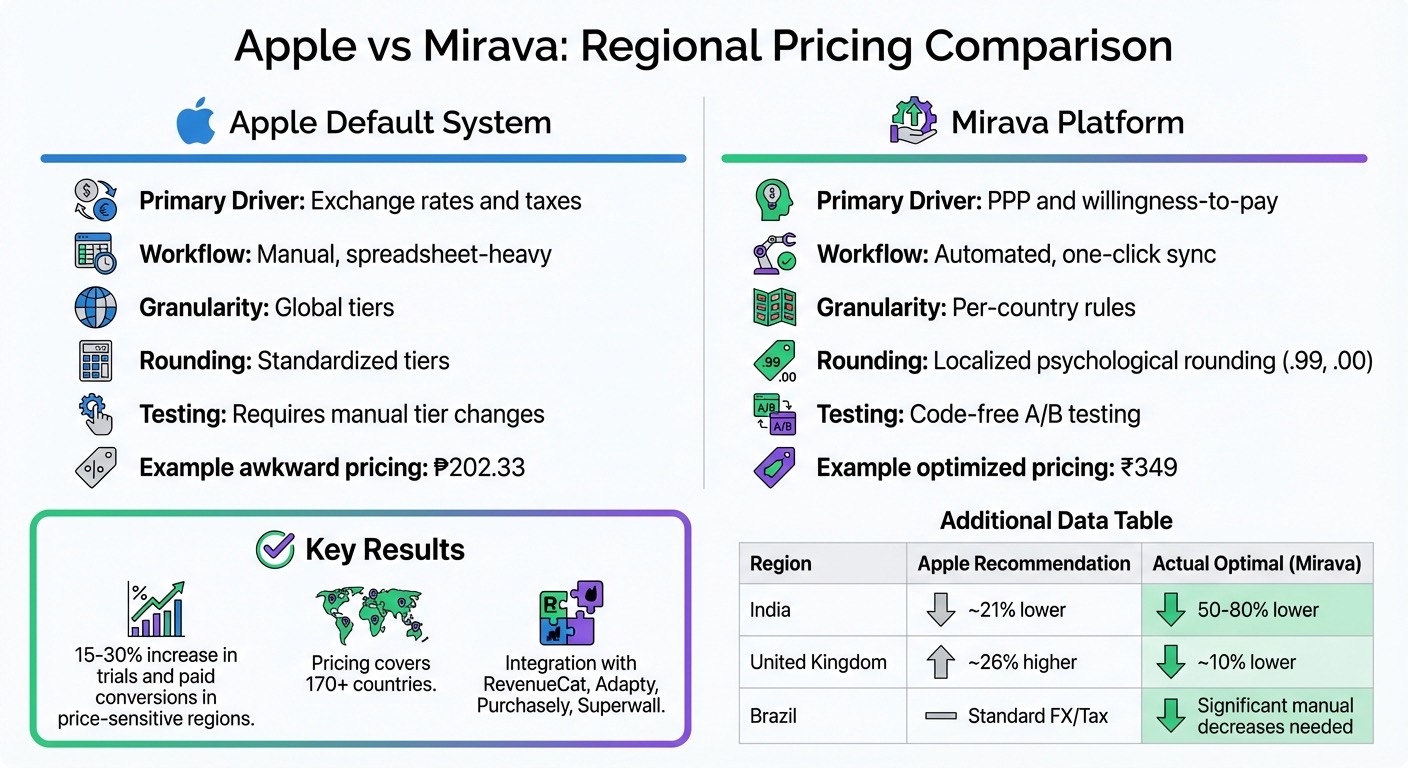
Apple vs Mirava Regional App Pricing: Key Differences and Features Comparison
Apple's pricing system is undeniably efficient, offering automated adjustments for currency and taxes, which simplifies global launches. However, it often misses the mark when it comes to reflecting local purchasing behaviors. Many developers rely on Apple's default pricing tiers, which can create mismatches between local market realities and user affordability. This gap highlights the need for tools that refine pricing strategies to better align with regional conditions.
"Apple and Google's suggested price points aren't based on local spending power or perceived value, but are influenced by factors like taxes, exchange rates, and other market mechanics"
- Daphne Tideman, Growth Expert, RevenueCat [5]
Mirava tackles these challenges by leveraging Purchasing Power Parity (PPP) and willingness-to-pay data, pulling insights from platforms like Netflix, Spotify, and YouTube. With Mirava, developers can sync pricing across over 170 storefronts with a single click, avoiding the spreadsheet-heavy workflows typical of manual updates. The platform also offers no-code A/B testing and scheduled rollouts, reducing risks like churn when experimenting with price changes. By fine-tuning prices in price-sensitive regions, lowering costs to match local affordability can meaningfully increase trials and paid starts without requiring additional traffic.
| Feature | Apple Default System | Mirava Platform |
|---|---|---|
| Primary Driver | Exchange rates and taxes [5] | PPP and willingness-to-pay |
| Workflow | Manual, spreadsheet-heavy | Automated, one-click sync |
| Granularity | Global tiers | Per-country rules |
| Rounding | Standardized tiers | Localized psychological rounding |
| Testing | Requires manual tier changes | Code-free A/B testing |
Apple's rigid tier system sometimes produces awkward pricing, such as ₱202.33, which feels unnatural to users. Mirava addresses this by applying localized psychological rounding, ensuring prices end in familiar figures like .99 or .00. The platform's Premium plan, priced at $49 per app per month ($499 per year), sits alongside a free tier, making it accessible for developers. It also integrates seamlessly with partners like RevenueCat, Adapty, Purchasely, and Superwall, enabling long-term tracking of user lifetime value (LTV) [5].
"If your conversion rate in India is five times lower than in Canada, Australia, or U.S., well, there's some mismatch... pricing could be the culprit"
- Jacob Rushfinn, Founder, Rushfinn Consulting [5]
Real-world examples highlight how localized pricing pays off. When apps align prices with local purchasing power in price-sensitive regions like Latin America, subscription volume can rise sharply. Flo's co-founder Dmitri adjusted pricing in Brazil, which propelled the country to become the app's third-largest market. This move contributed to 80% growth in non-English markets, far outpacing the 35% growth seen in English-speaking regions [5].
Conclusion
Apple's pricing system delivers consistency by automating currency conversion, tax calculations, and earnings standardization across 175 storefronts[1]. However, this approach primarily addresses business mechanics - exchange rates and taxes - while overlooking local purchasing power. This gap becomes especially clear in emerging markets, where Apple's recommended pricing often fails to align with what users can afford. The result? Conversion rates in these regions can sometimes be up to five times lower[5].
To tackle these disparities, developers are increasingly adopting advanced tools like Mirava. By leveraging purchasing power parity (PPP) and data-driven insights, Mirava calculates fair, market-specific prices. It simplifies the process by automating bulk price updates across more than 170 countries and integrates seamlessly with tools like RevenueCat, Adapty, Purchasely, and Superwall. Acting as the pricing intelligence layer, Mirava identifies optimal pricing while leaving billing, paywalls, and entitlements to its ecosystem partners. For developers aiming to use pricing as a growth driver, especially in regions such as Latin America, Southeast Asia, or India, this approach can meaningfully increase trials and paid starts without needing additional traffic.
Bridging these pricing gaps requires more than automation - it demands thoughtful testing of local pricing strategies. Start by experimenting with significant price differences (e.g., $39 versus $69) to understand price elasticity[5]. Next, focus on your top three regions outside your home market, applying local price psychology. For example, round prices to ₹349 instead of using a direct conversion like ₹376.19. While Apple's infrastructure is excellent for compliance and base tiering, pairing it with intelligent tools ensures your pricing reflects local purchasing habits rather than just currency calculations.
FAQs
Why doesn’t Apple’s regional pricing reflect local purchasing power?
Apple's approach to regional pricing often falls short of reflecting local purchasing power. Instead, it primarily factors in elements like taxes, exchange rates, and fixed pricing tiers. This can create situations where prices fail to align with the economic realities of specific regions, leading to affordability challenges for users.
When should I override Apple’s default price tiers for specific countries?
To fine-tune your pricing strategy, consider overriding Apple’s default price tiers. This allows you to set prices that better reflect local purchasing power, regional market trends, and what users in specific areas are willing to pay. By stepping beyond Apple’s automatic currency conversions, you can create a more tailored pricing approach that has the potential to increase revenue.
How can I test regional prices without breaking subscriptions or causing churn?
You can experiment with regional pricing safely by conducting staged price tests directly through the App Store. Tools like Mirava simplify this process, allowing you to tweak prices across different regions without needing to modify code or juggle spreadsheets. These adjustments stay fully synchronized, ensuring a smooth experience. Additionally, Apple’s automatic price updates help maintain consistent pricing across markets. To minimize churn, focus on your primary markets first, track retention metrics closely, and leverage platforms like RevenueCat or Adapty to handle billing and entitlements seamlessly.