Understanding what drives your users' willingness to pay (WTP) is critical for app pricing success. Age, income, education, and regional differences significantly impact how much users are ready to spend on subscriptions. Misaligned pricing - too high or too low - can lead to lost revenue or alienated users. Here's what you need to know:
- Age: Younger users (18–39) value social features and convenience, while older users (50+) prioritize trust and practical benefits.
- Income: High-income users prefer premium tiers and tolerate price increases, while low-income users respond better to freemium models and affordable entry points.
- Education: College graduates are 2.59x more likely to pay for apps, often due to higher digital literacy and perceived value.
- Regions: Developed markets can sustain higher prices, while emerging markets require pricing aligned with local income levels (e.g., 0.5–1% of monthly income).
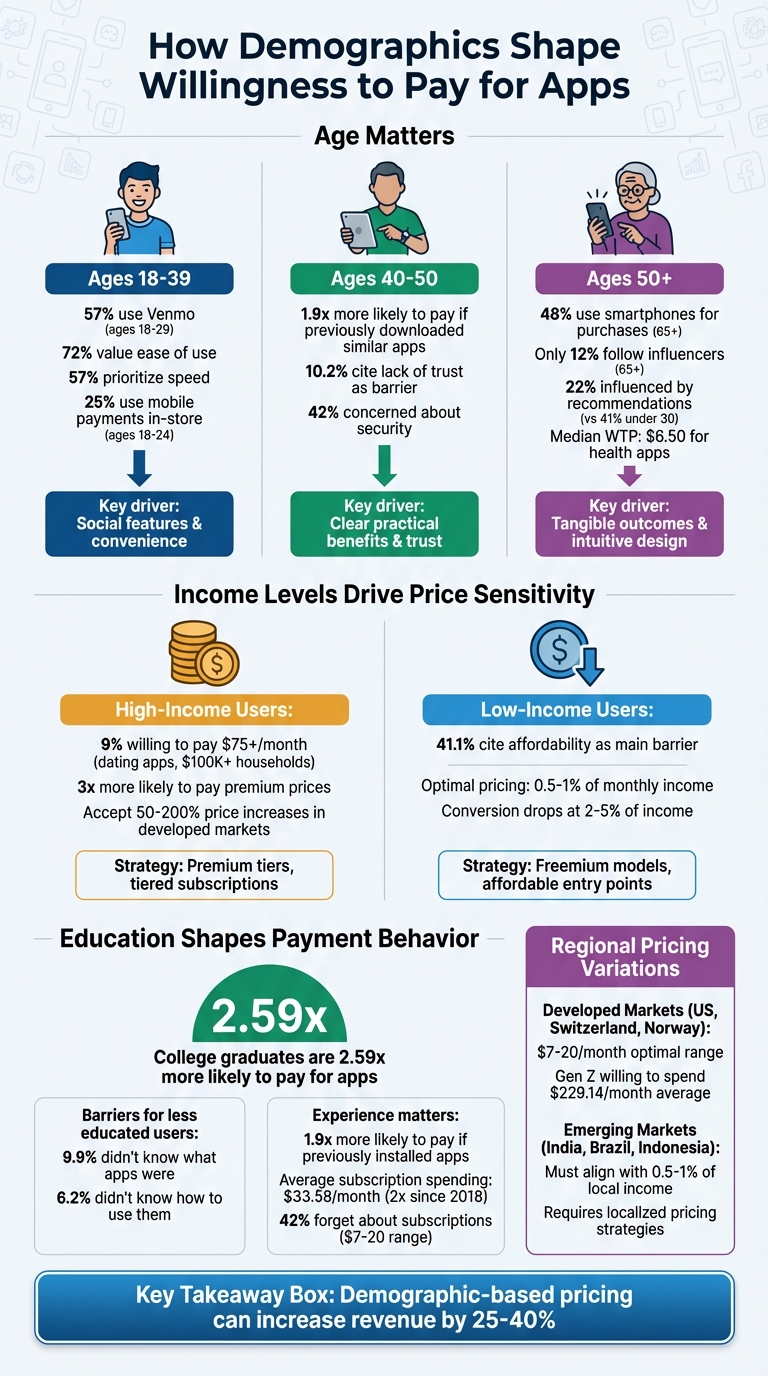
How Age, Income, and Education Impact App Willingness to Pay
Understand in Under 5: Willingness to Pay
sbb-itb-43fe43a
How Age Affects Willingness to Pay
Age plays a significant role in shaping how users interact with and value app purchases. Younger users often seek speed and social connectivity, while older demographics prioritize trust and practicality. These contrasting preferences have a direct impact on conversion rates and overall revenue potential.
The differences are clear in usage data: 25% of U.S. adults aged 18-24 use mobile payment apps for in-store purchases, compared to just 8% of those aged 55 and older[5]. This gap reflects not just differing levels of tech adoption but also distinct attitudes toward digital spending. By understanding these patterns, developers can tailor pricing strategies to align with what each age group values most.
Users Ages 18-39
For younger users, apps often serve as essential tools for social interaction. 57% of U.S. adults aged 18-29 use Venmo, with 44% citing "splitting expenses with others" as a key reason - something that less than 10% of users aged 50 and older prioritize[6]. This social functionality drives adoption more effectively than traditional marketing efforts.
Convenience trumps security concerns for this group. 72% value ease of use, and 57% prioritize transaction speed, while only 25% express concerns about privacy[5]. They are willing to pay for apps that seamlessly integrate into their daily routines, whether for entertainment, productivity, or financial transactions. However, their high engagement comes with risks - 18% of payment app users aged 18-29 report experiencing fraud, compared to 12% of users aged 30 and older[6].
To appeal to this demographic, developers should emphasize social features and peer-to-peer functionality. Apps that enable group activities or shared experiences tend to perform better in this age group, making such features a key driver for premium pricing.
Users Ages 40-50
Middle-aged users approach app purchases with a focus on clear, practical benefits. They are less concerned with trends and more likely to spend on apps that demonstrate real value. Past experience strongly influences future spending, as users who have previously downloaded health apps are 1.9 times more likely to pay for new ones[7]. This creates a ripple effect - once converted, these users are more open to exploring other paid apps.
Trust remains a hurdle for many in this age bracket. 10.2% cite lack of trust as their main reason for not paying, and 42% express concerns about the security of digital wallets[7][8]. Developers can address these concerns by offering transparent privacy policies and clear value propositions. Free trials or "lite" versions allow users to test an app’s utility before committing to a purchase, helping to build confidence and reduce hesitation.
Users Ages 50+
Older users tend to approach app purchases with caution, focusing on apps that provide clear and tangible benefits. While 48% of adults aged 65 and older use smartphones for online purchases, this is significantly lower than the 91% of users aged 18-49[9]. The issue isn’t necessarily tech literacy but rather different shopping habits and a higher threshold for trust.
Social media has limited influence on this demographic. Only 12% of social media users aged 65+ follow influencers, compared to 72% of users aged 18-29[9]. Even when influenced by recommendations, older users make purchases at half the rate of younger groups: 22% of those aged 50+ versus 41% of those under 30[9]. For this group, outcome-driven marketing is most effective - they need to clearly see how an app solves a specific problem.
Pricing for this demographic is more sensitive. Research indicates a median willingness to pay of around $6.50 for health apps[7]. However, many in this group feel that certain services, particularly health-related ones, should be free, which adds another layer of complexity for paid app models[7]. Success with this audience often hinges on intuitive design, clear communication of value, and flexible pricing options that cater to varying levels of comfort with digital spending.
Income Levels and Price Sensitivity
When it comes to pricing, income levels play a critical role in shaping user behavior. Higher-income users are generally more open to paying premium prices, while lower-income users prioritize affordability. This difference stems from varying purchasing power. For instance, when a subscription costs between 2–5% of an individual's monthly income, conversion rates drop significantly. On the other hand, if the price represents only 0.5–1% of monthly income, users are far more likely to subscribe.
The numbers illustrate this well. Among U.S. dating app users aged 18–44, 9% are willing to pay over $75 per month, with most of these users belonging to households earning $100,000 or more annually[11]. High earners are three times more likely to pay $75+ monthly compared to their lower-income counterparts[11]. A separate study on health apps revealed that 58.9% of users were willing to pay, with the median willingness-to-pay hovering around $6.50[3]. These differences highlight the need for pricing strategies tailored to distinct income groups.
High-Income vs. Low-Income Users
Diving deeper into income-based behavior, high- and low-income users reveal contrasting attitudes toward pricing. High-income users tend to be less sensitive to price changes and are drawn to tiered subscription models that offer clear value. A good example is Spotify's premium family plans, which continue to thrive with minimal resistance from this group[1]. These users are also more likely to accept price hikes without significant churn, provided the perceived value remains intact.
Conversely, low-income users often hesitate to spend due to tighter budgets. In one study, 41.1% of users stated affordability as the main reason for not paying for apps[3]. However, strategies like freemium models, free trials, and tiered pricing can help developers tap into this segment. These approaches allow those with limited means to access basic features while still generating revenue from users who can afford paid options[3].
For developers, treating each market as its own profit center is essential. Relying on high-income regions to offset losses in lower-income areas can lead to missed opportunities. Additionally, psychological pricing techniques - such as using charm pricing in local currencies (e.g., $0.99 instead of $1.00) - can increase conversions by 15–20% in price-sensitive markets. Implementing purchasing power parity pricing is a practical way to maximize conversions while catering to diverse income segments.
How Education and Experience Affect Payment Decisions
Users with a bachelor's degree or higher are 2.59 times more likely to pay for apps compared to those with less education[7]. This difference stems from the fact that higher education often brings stronger digital literacy and a clearer understanding of how technology can provide value. College graduates are better equipped to connect an app's features to real-world benefits, which helps them make more informed purchasing decisions.
Education Level Impact
Education plays a noticeable role in shaping payment behavior. Among users who are unwilling to pay for apps, 9.9% said they didn’t know what the apps were, and 6.2% cited not knowing how to use them as primary reasons[7]. These figures highlight a complexity barrier for less educated consumers, making it harder for them to see the value in certain apps. On the other hand, individuals with higher education tend to evaluate an app more quickly and assess whether it effectively addresses their needs.
"Income, age, and education are significant predictors of which payment instruments consumers adopt and use." - Claire Greene, Julian Perry, and Joanna Stavins[2]
For app developers, this underscores the importance of creating user-friendly designs, particularly when targeting a wide audience. Features like straightforward instructions, simplified navigation, and messaging that focuses on outcomes can help overcome barriers for users with lower digital literacy levels[13, 19]. While education is a key factor, prior experience with apps also plays a vital role in shaping payment habits.
Prior App Usage and Payment Patterns
Previous experience with apps significantly influences a user’s willingness to pay. For instance, individuals who have already installed apps are 1.9 times more likely to pay for them[7]. These users are quicker to recognize an app’s value. Additionally, a person’s past spending habits often dictate their future payment decisions - those who have paid more in the past are generally willing to spend more now[7].
The rise of subscription models has amplified this trend. On average, users now spend $33.58 per month on subscriptions, nearly twice the amount recorded in 2018[12]. Younger generations and early adopters, familiar with recurring fees, tend to spend more as this payment model becomes second nature. Interestingly, 42% of users forget about their ongoing subscriptions, especially for apps priced between $7 and $20[12]. This "set it and forget it" behavior creates an opportunity for developers to target users who are already comfortable with recurring payments.
Both education and prior app usage enhance a user’s ability to see the value in an app, shaping more thoughtful payment decisions that reflect the complex factors influencing willingness to pay.
Regional Differences in Demographic Impact
When considering factors like age, income, education, and app experience, regional variations play a major role in shaping pricing strategies. A pricing model that performs well in New York might fall flat in Mumbai, even among users with similar demographic profiles. The key lies in understanding how income levels, subscription habits, and digital payment behaviors interact with these demographic factors in different regions.
Developed Markets (e.g., United States)
In wealthier nations like the United States, Switzerland, Norway, and Singapore, users are often willing to pay 50–200% above standard global pricing without negatively impacting conversion rates[13]. This willingness isn't purely tied to higher disposable incomes but also reflects established subscription habits and familiarity with digital payment systems. For instance, Gen Z users in the United States report being ready to spend an average of $229.14 per month on websites, apps, and online services if free alternatives were unavailable[10].
The optimal price range for monthly app subscriptions in these markets typically falls between $7.00 and $20.00[12]. This range strikes a balance: it generates substantial revenue while remaining low enough for users to consider it a routine expense. Younger, tech-savvy consumers - accustomed to services like Netflix, Spotify, and Apple Music - play a significant role in sustaining this trend. Meanwhile, emerging markets face a different reality, where even modest subscription fees can act as a barrier to adoption.
Emerging Markets
In countries like India, Turkey, Brazil, and Indonesia, global pricing standards often feel out of reach for the average user[13]. For example, a $29 annual subscription can be prohibitively expensive.
Early adopters in these regions, particularly younger and tech-savvy users, recognize the value of digital services but expect pricing to align with local economic realities. To achieve strong conversion rates, app costs should generally fall within 0.5–1% of local monthly income. When subscription prices rise to 2–5% of income, conversion rates tend to drop sharply[13]. Additionally, preferences for psychological pricing - such as specific rounding practices - vary across countries in Southeast Asia and South America, requiring further localization[13].
While countries like the UK and Nordic nations can sustain higher subscription tiers due to economic and cultural factors, markets in Southeast Asia often expect much lower price points. It's not just about income disparities; it's also about aligning with what feels "normal" or acceptable in each region. When pricing resonates with local expectations, users are far more likely to convert. These differences highlight the importance of tailoring pricing strategies to reflect local purchasing power and cultural norms effectively.
Using Demographic Data to Optimize App Pricing
Developers can turn demographic insights into actionable pricing strategies that go beyond simple currency conversion. By understanding what users in different segments are willing to pay, it’s possible to create pricing models that resonate with diverse audiences.
How Mirava Helps with Pricing Optimization
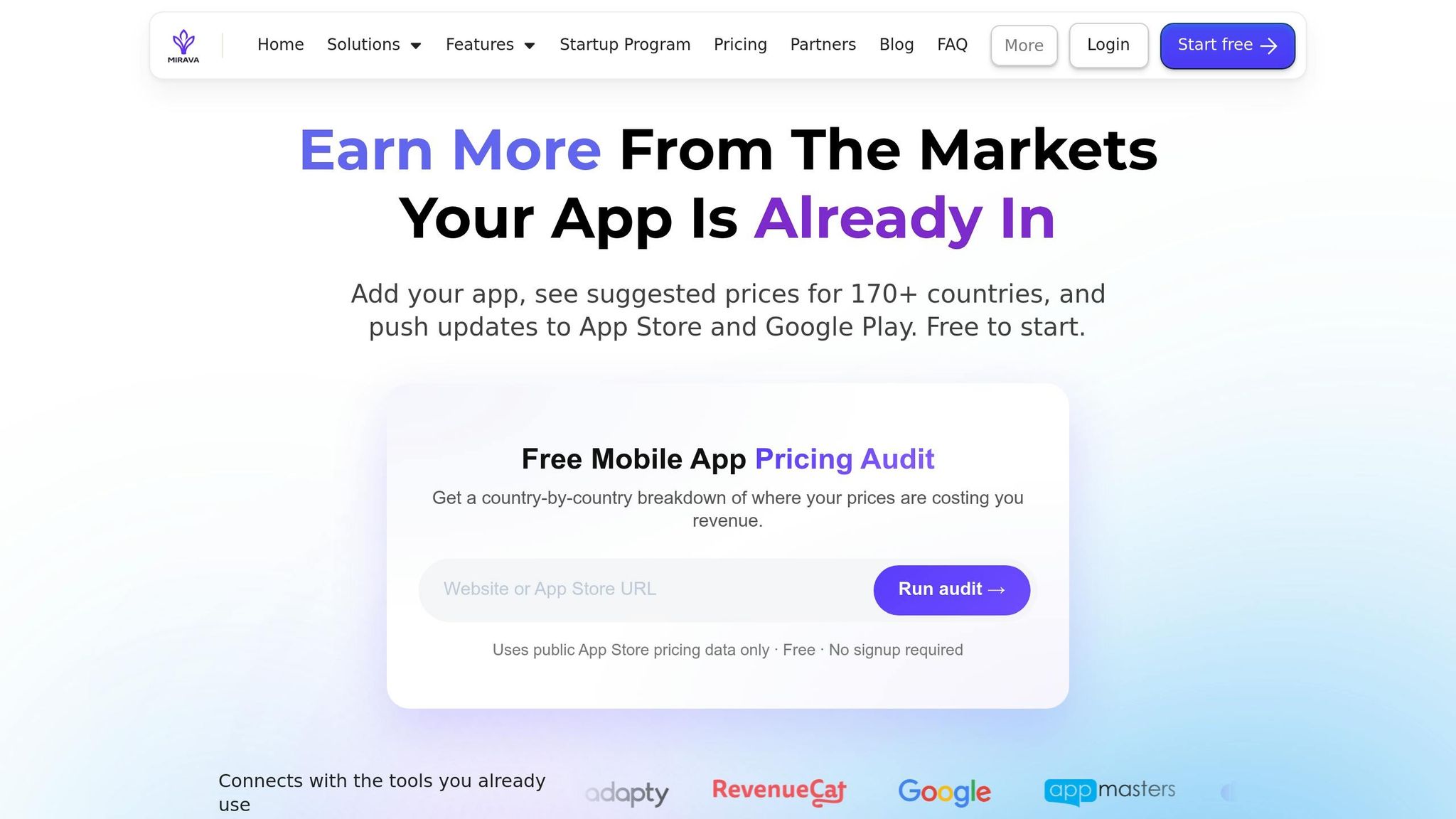
Mirava serves as a Monetization Intelligence Platform, complementing tools like RevenueCat, Adapty, Purchasely, and Superwall. While these platforms manage billing, paywalls, and entitlements, Mirava focuses on determining optimal pricing by analyzing global purchasing behavior from platforms such as Netflix, Spotify, Apple, and YouTube across more than 170 countries.
Rather than relying on general metrics like GDP or PPP, Mirava identifies effective pricing bands based on real-world data, including installs, trials, and conversion rates. For instance, in mature markets, users may tolerate price increases of 50–200% without a noticeable drop in conversions[13]. On the other hand, emerging markets often require lower entry-level pricing to align with local income levels. Mirava also simplifies processes like bulk price updates, demographic-based willingness-to-pay analysis, and strategic pricing adjustments (e.g., rounding prices to .99 for psychological appeal).
Additionally, developers can experiment with cohort-specific pricing - applying changes only to new subscribers while maintaining existing revenue streams. This data-driven approach replaces guesswork with insights drawn from factors like age, income, and regional purchasing trends.
Pricing Strategies for Different Demographics
Tiered pricing is a powerful tool for addressing varying demographic needs. For instance, high-income users in developed markets may accept premium tiers priced between $9.99 and $15.00 per month. Meanwhile, entry-level pricing around $4.99 or freemium models can attract younger users or those from lower-income groups who may need time to see the app’s value.
Users with prior experience purchasing apps are often more willing to pay[3]. Offering free "lite" versions can help build trust and demonstrate the app’s value, making it easier to convert these users to paid plans.
A/B testing and measuring pricing experiments is another effective way to fine-tune strategies. For example, younger, tech-savvy users might respond well to weekly price points of $4.99 or $7.99, while older users with less app experience might prefer a lower price like $2.99. Monitoring key metrics like conversion rates and average revenue per user (ARPU) can reveal what works best. For example, education apps may see an ARPU of around $15.50 per month, while gaming apps range between $2.00 and $8.00 depending on the audience and region.
"When prices feel 'native,' users convert more. This is not theory - it's consistently proven in subscription behavior." - Mirava[13]
Pricing strategies should reflect local economic conditions and demographic expectations. In wealthier regions, higher price tiers are often acceptable due to greater disposable income. In contrast, emerging markets benefit from subscription costs that remain within 0.5–1% of local monthly income[13]. By leveraging demographic insights and automated regional pricing adjustments, developers can boost revenue while maintaining accessibility for price-sensitive users. Ongoing testing and refinement are crucial to adapting to shifting market conditions.
Conclusion
Demographics - such as age, income, education level, and app experience - play a key role in shaping what users are willing to pay. For instance, users with bachelor's degrees are far more likely to pay for apps[2][3], while those aged 25–44 show a 20–40% higher willingness to pay for digital content compared to older age groups[4]. Overlooking these trends can lead to missed revenue opportunities or misaligned pricing strategies that alienate entire user segments.
These patterns vary significantly across global markets. In mature markets like the United States, higher-income, well-educated users are generally more accepting of premium pricing, particularly for monthly subscriptions that align with their expectations. On the other hand, in emerging markets, pricing must be carefully tailored to local income levels to remain accessible[13]. A blanket approach to pricing risks overcharging cost-sensitive regions or undervaluing markets where users are prepared to spend more.
Mirava eliminates the guesswork by leveraging real purchasing behavior from global platforms. It identifies effective pricing ranges and automates regional adjustments. Positioned upstream of billing tools like RevenueCat, Adapty, Purchasely, and Superwall, Mirava determines the right pricing strategy, while those platforms handle billing and paywalls.
When demographic-based pricing strategies are applied effectively, revenue can increase by 25–40%. Research underscores the financial benefits of tailoring pricing to demographic insights across various app categories. Strategies like tiered pricing for different income levels, freemium models for less-experienced users, and localized pricing adjustments based on regional economic conditions all contribute to better conversion rates and higher lifetime value. Incorporating these insights into your pricing approach is a clear path to stronger results.
FAQs
How do I set prices that match local income levels?
To make your app pricing more accessible and fair, focus on regional purchasing power rather than just converting currencies. This approach takes into account local income levels, spending patterns, and economic conditions, ensuring your pricing feels reasonable to users in different regions. Tools like Mirava can simplify this process by analyzing market data and suggesting pricing strategies that balance affordability with revenue growth. Additionally, offering tiered pricing or micro-transactions can help attract and retain users by catering to varied budgets.
What’s the best pricing model for different age groups?
The best pricing model often depends on the age group, as spending habits and perceptions of value differ widely. For instance, Millennials and other younger adults tend to lean toward subscription models that offer flexible tiers, as they’re accustomed to recurring payments and value ongoing access. On the other hand, older demographics may gravitate toward value-based pricing, particularly when it includes affordable entry points that feel approachable.
Platforms such as Mirava play a key role in navigating these preferences by analyzing regional and demographic data. This allows businesses to craft pricing strategies that not only align with local purchasing power but also resonate with the unique expectations of users across different age groups. By understanding these nuances, businesses can better connect with their target audiences.
How can I use demographic data without hurting conversions?
To make the most of demographic data while maintaining conversions, it's important to adjust pricing based on local economic realities and user expectations. A uniform pricing strategy can backfire, either deterring users or leaving money on the table. Instead, rely on tools that evaluate purchasing habits and regional affordability to determine pricing that feels reasonable to users. Use A/B testing to confirm these adjustments align with local willingness to pay, which can boost both revenue and user confidence.