Localized pricing is a proven way to increase app conversions and revenue by aligning subscription costs with local purchasing power and consumer habits. Many developers stick to flat, global prices, like $9.99, but this often alienates users in price-sensitive markets like India or Brazil. By tailoring prices to reflect regional economies, apps can attract more paying users and reduce cart abandonment.
Key insights include:
- Apps lowering prices to match local affordability in emerging markets often see meaningful revenue growth.
- Flo, a period tracking app, achieved 80% growth in non-English regions by adjusting prices in Brazil.
- Tools like Mirava recommend region-specific prices, while platforms like RevenueCat handle billing.
To implement localized pricing:
- Use data to identify pricing mismatches.
- Test pricing tiers (e.g., $39 vs. $69) to gauge sensitivity.
- Use tools to optimize and automate region-specific pricing.
This strategy helps apps compete not just with other apps but within local economies, unlocking growth in underperforming regions.
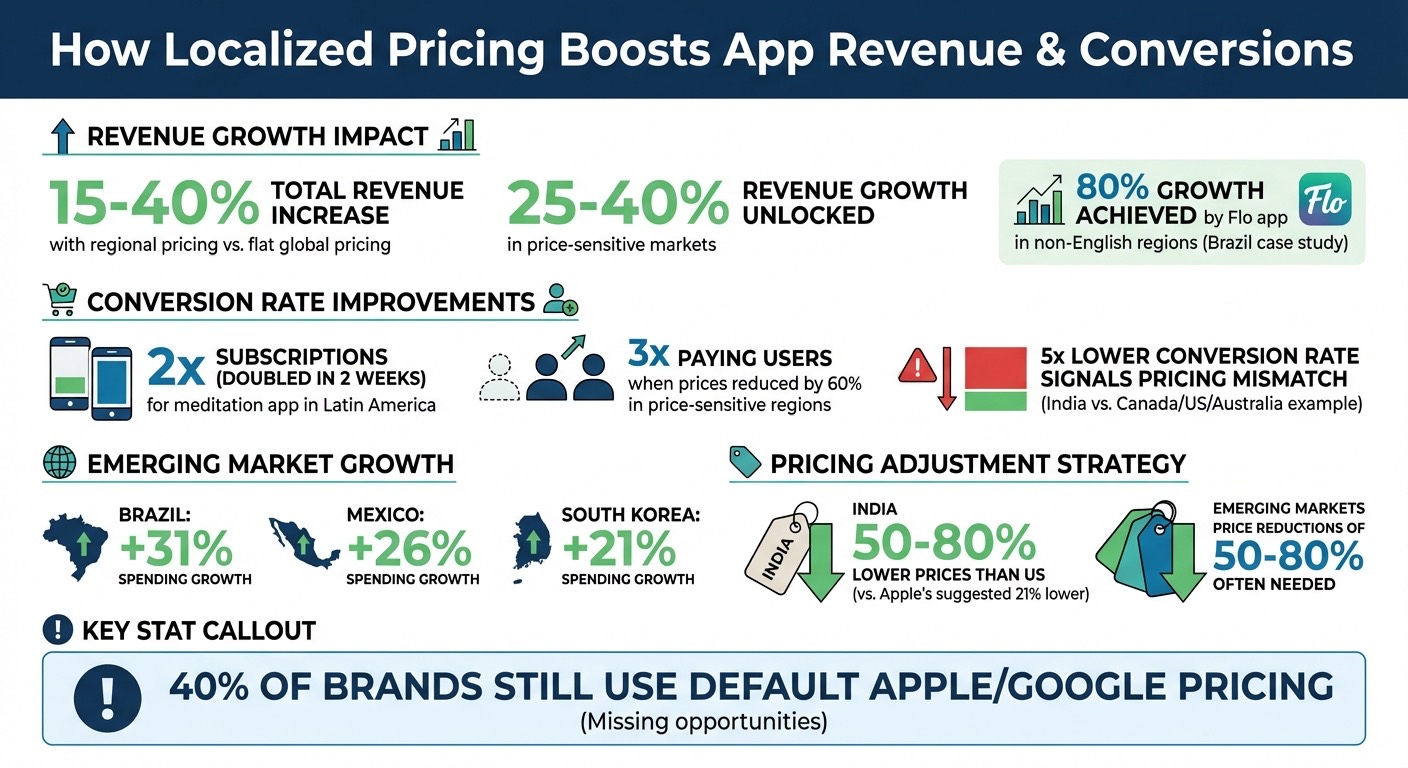
Localized Pricing Impact: Revenue Growth and Conversion Statistics by Region
How Localized Pricing Affects Conversions
Conversion Rate Data and Results
Tailoring subscription prices to align with local purchasing power has shown measurable success in boosting conversions. When apps adjust their pricing strategy for a price-sensitive region like Latin America, subscriptions can climb quickly. This underscores how adapting to regional economic conditions can significantly influence user behavior.
However, understanding the relationship between pricing and conversions can be tricky. Jacob Rushfinn, Founder of Rushfinn Consulting, highlights this complexity:
"If your conversion rate in India is five times lower than in Canada, Australia, or the U.S., there's a pricing mismatch. If it matches your best market, lowering prices further is unlikely to boost conversions." [2]
In price-sensitive regions, reducing prices to local affordability can substantially increase the number of paying users. Testing various pricing tiers, such as $39 versus $69, is a practical way to understand how sensitive your audience is to price changes [2].
These adjustments not only improve conversion rates but also help reduce cart abandonment, further illustrating the advantages of localized pricing.
How Transparent Pricing Reduces Cart Abandonment
Transparent, region-specific pricing doesn't just enhance conversions - it also fosters trust. When users encounter prices that feel fair and appropriate for their local economy, they're less likely to hesitate at checkout. As Demian Voorhagen aptly puts it:
"Value isn't universal - it's relative. You're not just competing with other apps, you're competing with the local economy."
Unlike simple currency conversion, regional pricing takes into account factors like local income levels and purchasing power. By creating a perception of fairness, this approach minimizes cart abandonment. Apps that implement such strategies can unlock meaningful revenue growth in markets where a flat, global price would otherwise deter potential customers.
sbb-itb-43fe43a
How to price your subscription app globally - Featuring Jacob Rushfinn
Revenue Growth from Regional Pricing
Regional pricing doesn’t just improve conversions - it also fuels substantial revenue growth.
Market Case Studies
Adjusting prices based on regional dynamics has proven to significantly boost revenue. By tailoring prices to local markets, apps often see total revenue climb compared to using a flat global pricing model. The increase in conversions more than offsets the lower individual price points.
For example, Flo turned an underperforming region into a key contributor to its overall revenue by strategically lowering prices. This move opened the door to customer segments that were previously priced out, effectively growing the app's total revenue potential[2].
Growth Opportunities in Emerging Markets
Emerging markets are becoming pivotal for mobile apps, particularly non-gaming categories. Spending in regions like Brazil, Mexico, and South Korea has surged - up 31%, 26%, and 21%, respectively[2]. However, succeeding in these markets requires more than simply converting prices into local currencies.
Take India as a case in point. While Apple suggests pricing roughly 21% lower than U.S. levels, many successful apps go further, setting prices 50–80% lower to match local purchasing power[2]. This strategy reflects not only the lower costs of acquiring users in these regions but also the potential to convert highly engaged users into paying customers. When apps see strong engagement and retention but weak conversion rates, it often signals a pricing mismatch[2].
Tools like RevenueCat and Adapty streamline the billing process for region-specific pricing. Meanwhile, upstream solutions like Mirava analyze purchasing behavior across more than 170 countries to recommend the best price points for each market. These tools highlight how localized pricing strategies can unlock new revenue streams, demonstrating their importance in a global app economy.
How to Implement Localized Pricing
Localized pricing has been shown to boost both revenue and conversions, but success hinges on proper implementation. To make it work globally, start with data-driven decisions, streamline processes through automation, and integrate seamlessly with your existing tools.
Using Pricing Intelligence Platforms
Surprisingly, about 40% of brands still stick with default pricing from Apple and Google[2]. This approach often leaves untapped revenue opportunities. Pricing intelligence platforms step in by analyzing actual purchasing behavior across regions to recommend better price points.
Mirava, for example, leverages its proprietary pricing indexes to calculate tailored prices for over 170 countries. It also handles key elements like psychological rounding (e.g., ending prices in .99 or .00 to match local preferences), willingness-to-pay assessments, and bulk updates for both the App Store and Google Play. Surfacing the biggest pricing gaps next to your top markets is often a wake-up call - the kind of insight the stores don't show you natively.
Mirava’s scalable plans allow businesses to access more advanced features as their pricing needs evolve.
After identifying the best prices, subscription platforms ensure smooth billing and seamless customer access across markets.
Working with Subscription Platforms
While pricing intelligence platforms determine what to charge and where, subscription platforms like RevenueCat, Adapty, Purchasely, and Superwall handle the operational side - billing, entitlements, and paywalls. This upstream-downstream relationship ensures accurate pricing implementation and simplifies tracking long-term performance.
Managing over 175 pricing tiers manually across platforms like Apple, Google, and Stripe is a logistical headache that invites errors. Automated tools sync these tiers, eliminating mismatches between App Store and Google Play pricing.
Many teams avoid touching pricing because doing it by hand feels like too much work. With the right tooling, they can test new strategies without worrying about spreadsheets or App Store rules.
Platforms like RevenueCat Experiments can also help evaluate pricing changes based on Lifetime Value (LTV) and retention over several months, rather than focusing solely on short-term conversion gains.
"Pricing tests take a long time: You need to evaluate long-term monetization, not just short-term revenue bumps. It usually takes 3–6 months to understand the full impact on retention and LTV." - Daphne Tideman, growth expert[2]
Once the technical setup is complete, attention shifts to rolling out a regional pricing strategy.
Best Practices for Pricing Localization
Before diving into regional pricing, fine-tune your base market first. Conduct large-scale A/B tests (e.g., $39 vs. $69, rather than $39 vs. $43) to establish a clear benchmark. Once your foundation is solid, segment markets into tiers and apply tailored strategies to each.
Here’s a four-week roadmap for implementing regional pricing:
- Week 1: Enable region-specific pricing in three test markets.
- Week 2: Use purchasing power parity data to adjust prices.
- Week 3: Conduct A/B tests comparing global pricing to regional pricing.
- Week 4: Analyze LTV data and expand successful pricing tiers.
Manually verify local app store pricing using a VPN to ensure accuracy, including psychological rounding like ₹99 instead of ₹100.
To prevent VPN arbitrage, enforce geo-IP restrictions and require local payment methods, such as UPI in India or Alipay in China. When testing new pricing tiers, keep existing subscribers on their original plans. Apple and Google automatically protect active subscriptions, so changes mainly affect new customers.
Conclusion
Localized pricing goes beyond being a mere feature - it's a proven approach to driving conversions and increasing revenue. Data consistently highlights revenue growth in emerging markets when pricing aligns with local purchasing power instead of relying on basic currency conversion. This approach opens up opportunities in regions that may have previously underperformed or generated no revenue at all, making it clear that a strategic shift is necessary.
Relying solely on Apple and Google's exchange-based pricing tiers misses the mark, as these systems don't account for the true value perceived by consumers. As a key takeaway:
"Value isn't universal - it's relative. You're not just competing with other apps, you're competing with the local economy." - Demian Voorhagen
This underscores the importance of using data-driven tools to gauge what users in different regions are both willing and able to pay.
Automation simplifies the complexity of managing pricing across over 175 regions, accounting for currency fluctuations and platform-specific rules. Tools like Mirava analyze digital purchasing behavior to recommend optimal pricing, while platforms such as RevenueCat, Adapty, Purchasely, and Superwall handle billing, entitlements, and paywalls. By combining these tools, businesses can minimize manual errors and focus on strategic testing and growth.
The path forward starts with refining pricing in your core market. From there, expand into high-potential regions by leveraging purchasing power parity data and local competitor insights. Keep an eye on long-term metrics like Lifetime Value (LTV) and retention, rather than just short-term conversion gains. The most successful global apps achieve this by integrating data, automation, and thoughtful pricing strategies.
FAQs
How do I know which countries need lower (or higher) prices?
When deciding which countries require price adjustments, it’s crucial to focus on factors like local purchasing power, economic conditions, and user spending habits rather than simply converting currencies. Mirava enables developers to analyze actual purchasing data from over 170 countries, providing insights to set prices that match regional affordability. By tailoring pricing to local markets, apps often see higher conversion rates and increased revenue. Tools like RevenueCat and Adapty make it easier to apply these pricing strategies effectively.
Will localized pricing reduce my overall revenue or increase it?
Localized pricing helps drive revenue growth by aligning product costs with the purchasing power and expectations of specific markets. Businesses that tailor pricing to local conditions can see meaningful revenue increases. This approach enables companies to extract greater value from varied markets while staying competitive.
How can I prevent users from using a VPN to buy cheaper subscriptions?
To prevent VPN-based price manipulation, focus on localized pricing that matches subscription rates to the actual location of users. By aligning costs with local purchasing power, you reduce the motivation for users to switch regions in search of lower prices.
On top of this, deploy technical solutions such as IP address verification, device fingerprinting, or behavioral analysis. These tools work together to maintain fair pricing across regions and make it more challenging for VPN users to bypass restrictions.