Netflix and Spotify have mastered demand-based pricing by tailoring subscription costs to regional markets and user behavior. This strategy optimizes revenue while ensuring accessibility across diverse economic conditions. Key takeaways:
- Regional Pricing: Netflix adjusts subscription costs based on GDP per capita, with prices ranging from $3 in Turkey to $20.46 in Switzerland. Spotify offers plans as low as $1.67 in India, leveraging affordability to grow in emerging markets.
- User Behavior Insights: Netflix uses metrics like watch hours and engagement to refine pricing, while Spotify personalizes offers based on listening habits, driving a 39% free-to-paid conversion rate.
- Freemium vs. Tiered Models: Spotify attracts users with a free tier and converts them to Premium, while Netflix uses tiered plans (e.g., Basic, Standard, Premium) to cater to different budgets and preferences.
For app developers, these strategies highlight the importance of regional pricing, user data analysis, and subscription tiers. Tools like Mirava, RevenueCat, and Adapty can help implement these approaches effectively.
Quick Comparison
| Feature | Netflix Approach | Spotify Approach |
|---|---|---|
| Primary Model | Tiered Subscription | Freemium (Free-to-Paid) |
| Value Driver | Technical quality (e.g., HD) | Free access, then convenience |
| Entry Strategy | Affordable paid options | Zero-cost entry |
| Retention Factor | Exclusive content | Personalization + habit-forming |
| Price Sensitivity | Tiered plans for all budgets | Free tier reduces barriers |
Demand-based pricing is a growth lever for global apps. Localizing prices and analyzing user behavior can increase revenue by 15–40%, as seen with Netflix and Spotify.
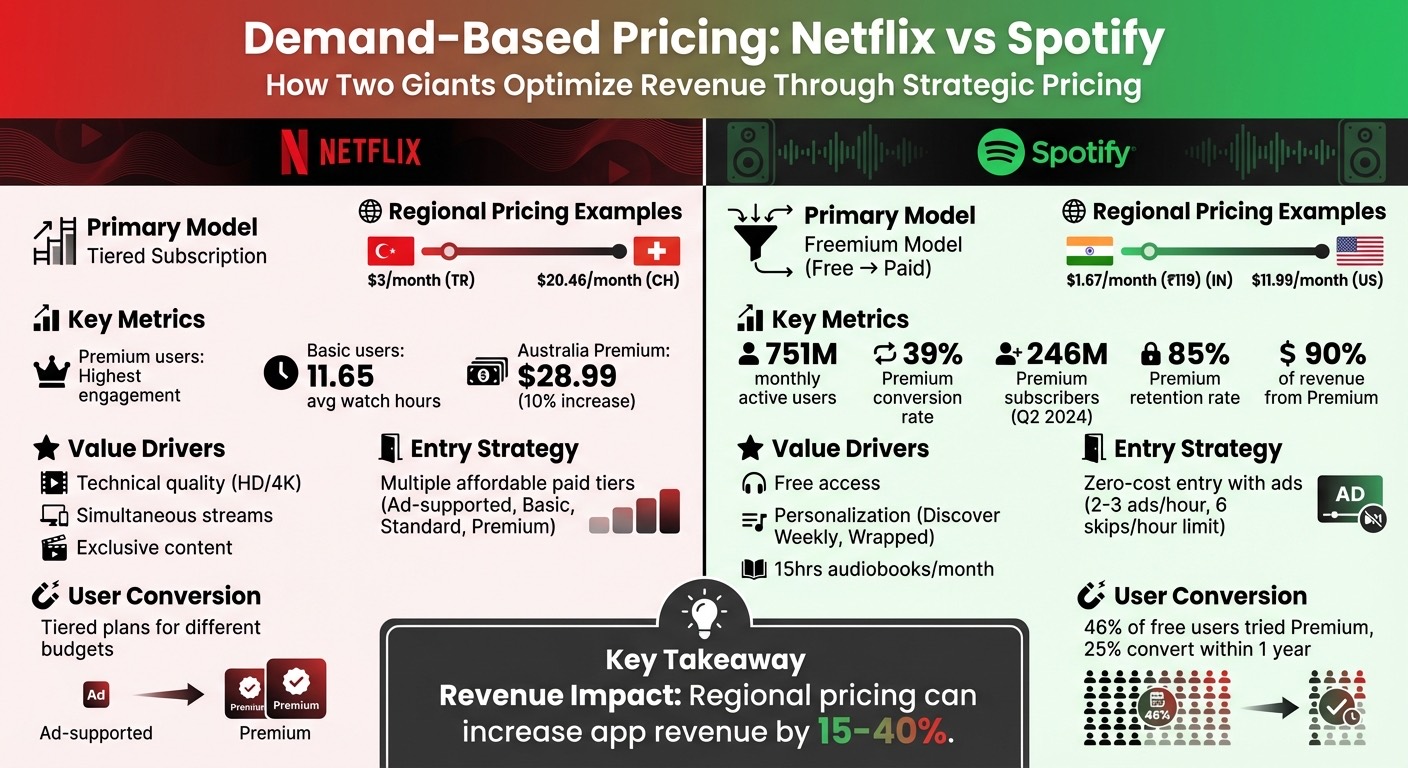
Netflix vs Spotify Demand-Based Pricing Strategies Comparison
How Netflix Uses Demand-Based Pricing
Pricing Based on Viewing Behavior
Netflix relies on detailed insights into viewer habits to shape its pricing strategies. By analyzing metrics like watch hours, daily viewing time, and engagement trends across its subscription tiers, the company identifies which features resonate most with users. For instance, a study of 5,000 users revealed that Premium subscribers show the highest engagement levels, while Basic plan users average approximately 11.65 watch hours overall [4]. These patterns help Netflix pinpoint which features drive value for different segments.
To refine its pricing further, Netflix evaluates the Price Elasticity of Demand (PED), which measures how price changes impact customer behavior. A notable example occurred in 2011 when a price increase led to slower subscriber growth and higher churn rates, highlighting the sensitivity of demand to cost adjustments. Additionally, by tracking account sharing - estimated at around three profiles per account - Netflix gains a deeper understanding of how Standard and Premium plans are utilized [4]. This data feeds into its finely tuned regional pricing strategies.
Regional Pricing for Market Growth
Netflix uses its behavioral data to tailor pricing at the regional level, aiming to expand its reach in diverse markets. Subscription fees are adjusted based on factors like GDP per capita and local purchasing power [9]. For instance, the cost of a standard plan can range from $3.00 per month in Turkey to $20.46 in Switzerland and Liechtenstein [9].
In December 2021, Netflix lowered prices in India to capture a larger share of the market, where competition from local services like Hotstar and Voot is fierce. The company also launched a mobile-only subscription plan targeting budget-conscious users who primarily watch content on smartphones [7][9]. Conversely, in mature markets like Australia, Netflix increased its Premium plan to $28.99 per month in August 2025, representing a 10% hike across all tiers, to drive revenue growth [7][8]. Collaborations with local telecom providers, such as Airtel in India, further enhance accessibility by bundling Netflix with other services [7].
Subscription Tiers for Different User Segments
Netflix combines insights from viewing habits and regional economic data to shape its tiered subscription offerings. The platform's plans - Ad-supported, Basic, Standard, and Premium - are designed to cater to a broad range of user preferences [10][6]. Among these, the Standard plan is often positioned as a psychological anchor, presenting itself as the optimal value choice for many users [6].
"For Netflix, pricing is not just about money - it is about behavior" [6].
sbb-itb-43fe43a
How Spotify Uses Freemium and Tiered Pricing
The Freemium Model: Converting Free Users to Paid
Spotify’s free tier functions as a gateway, drawing in users with ad-supported listening while encouraging upgrades to paid subscriptions. By Q4 2025, the platform had amassed 751 million monthly active users, with 61% on the ad-supported tier and 39% subscribing to Premium [17].
The free tier is intentionally limited to highlight the benefits of upgrading. For example, free users encounter 2–3 ads per hour, a 6-skip-per-hour limit, and shuffle-only playback on mobile devices [11]. As Gustav Söderström, Spotify's Chief R&D Officer, explains:
"Freemium isn't about giving stuff away - it's about designing a journey where paying feels like liberation" [11].
This strategy has proven effective. 46% of free users have trialed Premium, and 25% transition to a paid subscription within a year [11]. Since 2018, Premium subscribers have grown from 75 million to 246 million by Q2 2024 [12]. Spotify enhances this conversion process by leveraging machine learning to identify high-engagement moments, offering personalized discounts, and trial opportunities to at-risk free users [11]. These efforts have sustained a 39% conversion rate for Premium users [12][14], with Premium subscribers contributing 90% of Spotify’s total revenue [13].
Spotify further refines its approach by tailoring offers based on individual listening habits.
Personalized Offers Based on Listening Data
Spotify uses its vast trove of listening data to craft personalized offers that encourage free users to upgrade. Features like Discover Weekly, Daily Mix, and the annual Wrapped campaign showcase Spotify’s personalization capabilities while increasing user engagement. The AI DJ feature, launched in 2024, is now used by 16% of Premium users weekly, further enhancing the platform’s appeal [17]. This focus on personalization has helped Spotify achieve an 85% retention rate for Premium users, well above the industry average of 60%, while reducing churn to 3.5% by Q4 2025 [11][17].
CEO Daniel Ek highlights this philosophy:
"If you know what your user wants, you can build what they need - even before they know they need it" [14].
To add more value and justify price increases, Spotify bundles Premium tiers with non-music content. By 2024, Premium users gained access to 15 hours of audiobook listening per month and exclusive podcast content [12]. Podcasts alone now account for 19% of new Premium signups [17]. In the same year, Spotify raised its U.S. Individual plan price to $11.99 per month and introduced a high-fidelity "Supremium" tier aimed at audiophiles [12].
These personalized strategies work in tandem with Spotify’s regional and demographic pricing adjustments.
Regional and Demographic Pricing
Spotify complements its freemium and personalization strategies with region-specific and demographic-focused pricing models to expand its reach. For instance, in India, the Premium Individual plan is priced at 119 rupees (about $1.67) per month, compared to $11.99 in the U.S. Mobile-only plans are also available in price-sensitive regions like India and the Philippines [12]. By late 2025, India had become Spotify’s second-largest market, with over 100 million monthly active users [17].
Demographic segmentation further sharpens Spotify’s pricing approach. Family Plans account for 44% of all Premium accounts, while Student and Duo plans make up 21%. The Student plan offers a 50% discount compared to the Individual tier [12][17]. Additionally, 65% of new Premium subscribers in Q1 2025 came through partnerships with telecom providers, which bundle Spotify subscriptions into mobile data plans [15].
Spotify’s user base skews young, with Gen Z (ages 18–24) making up 38% of users and over 50% under age 34 [15]. Social features also play a role in retention, as users who interact with at least three friends monthly have a retention rate exceeding 90% [15]. These insights guide Spotify’s continued investment in social tools and demographic-specific pricing strategies.
Netflix vs. Spotify: Pricing Strategy Comparison
Netflix and Spotify both utilize demand-based pricing, but their methods differ significantly. Netflix employs a tiered pricing structure with options like Basic, Standard, and Premium. This allows customers to select a plan that aligns with their budget and feature preferences, such as HD streaming or the ability to watch on multiple devices. On the other hand, Spotify adopts a freemium model, offering a free, ad-supported tier to eliminate barriers to entry. This approach encourages users to explore the platform before upgrading to a paid plan after experiencing its value [18].
Netflix's strategy caters to various budget levels by providing multiple paid entry points, ensuring inclusivity. Spotify, however, focuses on building trust and proving value first, then converting users to paid tiers. As highlighted by Mueller Group Limited [18], Netflix avoids price exclusion by offering tiered plans, while Spotify emphasizes value demonstration before monetization.
Both companies initially used penetration pricing to disrupt their respective markets. Over time, as they gained substantial user bases, their focus shifted to profitability. Netflix justifies its price increases by reinvesting revenue into original content production. Meanwhile, Spotify capitalizes on personalized experiences and high-margin content like podcasts, which JP Morgan estimates to have margins exceeding 70% [19].
Side-by-Side Strategy Comparison
| Feature | Netflix Approach | Spotify Approach |
|---|---|---|
| Primary Model | Tiered Subscription (Ladder) | Freemium (Free-to-Paid) |
| Value Driver | Technical quality (e.g., resolution) and simultaneous streaming | Free access to remove barriers, leading to enhanced convenience |
| Entry Strategy | Affordable paid options | Zero-cost entry to demonstrate value |
| Retention Factor | Exclusive original content library | Habit-building through personalized listening data |
| Price Sensitivity | Appeals to diverse budgets through tiered plans | Attracts risk-averse users with free access |
This comparison highlights the distinct ways Netflix and Spotify approach customer acquisition and retention. The subscription economy, expected to exceed $1.5 trillion by 2026, has grown about 4.6 times faster than the S&P 500 over the past decade [18]. Netflix and Spotify illustrate that demand-based pricing requires a tailored approach, shaped by how customers engage with and commit to a product. For mobile app developers, these strategies offer valuable lessons in regional pricing and personalizing the user experience.
What Mobile App Developers Can Learn
Netflix and Spotify’s pricing strategies offer valuable lessons for mobile app developers aiming to grow globally. By adopting similar approaches, developers can fine-tune their pricing models to align with regional markets and user behavior.
Using Regional Pricing to Scale Globally
Netflix and Spotify frequently adjust their prices based on local subscription habits and currency fluctuations [2]. Mobile app developers can apply this strategy to unlock revenue growth, with regional pricing potentially increasing app revenue by 15% to 40% [2]. However, nearly 40% of brands still rely on the default pricing structures provided by Apple and Google, which often fail to reflect local purchasing power [1].
The default pricing recommendations from Apple and Google primarily account for exchange rates and taxes, ignoring customer value. This can lead to misaligned pricing. For instance, in India, Apple’s suggested pricing is about 21% lower than U.S. prices, but many successful apps reduce prices by 50% to 80% to better match local demand [1]. Apps that cut prices substantially in lower-income regions and tailor them to local economic conditions have reported meaningful gains in paying users and conversions.
"You're not just competing with other apps, you're competing with the local economy." – Demian Voorhagen, CEO, Mirava
To stay competitive, developers should round prices to local norms (e.g., ₹349 or ₱199) and benchmark against leading local apps [2]. In wealthier regions like Switzerland or Norway, users may accept prices 50–200% higher without impacting conversion rates [2]. Regularly reviewing and dynamically adjusting prices based on local market trends is essential for sustained growth.
Using User Behavior to Personalize Pricing
Following Netflix and Spotify’s example, developers can introduce tiered subscription models to cater to diverse user needs and budgets. Spotify’s freemium approach demonstrates the value of letting users experience the product before committing to a paid plan.
"When people experience value before committing, price resistance dissolves on its own." – Mueller Group [18]
Effective pricing strategies combine insights into user behavior, regional subscription patterns, and category-specific expectations. Technical measures like currency normalization further enhance pricing precision.
Working with Monetization Tools
Modern monetization strategies often involve a pricing intelligence layer, such as Mirava, which uses data from platforms like Netflix, Spotify, Apple, and YouTube to set region-specific prices. Tools like RevenueCat, Adapty, Purchasely, and Superwall then manage billing and paywalls.
Once prices are optimized, platforms like RevenueCat, Adapty, and Purchasely can handle implementation. For example, RevenueCat’s "RevenueCat Experiments" feature enables developers to test regional pricing with A/B experiments and assess their effects on metrics like lifetime value, retention, and churn [1]. Testing significantly different price tiers (e.g., $39 vs. $69) provides insights into price elasticity [1].
"Price is such an impactful growth lever that it shouldn't be underestimated. While it takes some upfront work to get it right, the payoff in scaling your app internationally can be significant." – Daphne Tideman, Growth Specialist [1]
Apple and Google typically shield existing subscribers from price changes, so localized pricing adjustments often only affect new users or upgrades. Developers should monitor the impact of these changes on lifetime value and churn over a 3–6 month period rather than focusing solely on immediate conversion gains [1][2]. By integrating advanced pricing intelligence early in the process, developers can align regional and behavior-based strategies with proven market practices, creating a roadmap for sustainable revenue growth in a competitive global market.
Conclusion
Netflix and Spotify demonstrate that pricing is not just about exchange rates - it’s about understanding local purchasing power, subscription habits, and market competition. For mobile app developers, this strategy provides a clear direction: adopting regional pricing best practices can boost revenue by 15% to 40%. In contrast, sticking to a flat global price risks losing revenue in affluent markets and limiting accessibility in developing ones [2].
The takeaway here is clear: pricing is a growth lever. Apps like Flo and Duolingo have shown that aligning prices with local purchasing power fosters market expansion. For instance, while Apple suggests pricing in India should be 21% lower than in the U.S., many successful apps go even further, setting prices that better reflect local demand [1]. These decisions are informed by analyzing subscription patterns and benchmarking against competitors. Such examples highlight the importance of using advanced tools to execute tailored pricing strategies effectively.
"If the biggest apps in the world use localized pricing, there's a reason: It works." – Mirava [2]
To navigate the complexities of pricing across 175+ markets, automating region-specific strategies is no longer optional - it’s essential. Platforms like Mirava streamline this process by determining optimal regional rates, while tools such as RevenueCat, Adapty, Purchasely, and Superwall handle billing and paywall management. Together, these solutions empower developers to adopt the same strategies as global leaders without adding operational strain.
FAQs
How do I pick the right price for each country?
To set the right price for each country, it's essential to tailor pricing to reflect regional purchasing power and market expectations rather than applying a single global price. This involves strategies such as analyzing demand trends, running A/B tests informed by Purchasing Power Parity (PPP) data, and creating custom pricing indexes that account for local costs and how customers perceive value. Make sure to align prices with local conventions, use rounded figures familiar to the region, and leverage automation to keep prices updated for better revenue and conversion rates.
When should I use freemium vs. subscription tiers?
Choosing between freemium and subscription tiers hinges on your app's objectives and how you plan to engage users. Freemium models are effective for drawing in a wide audience by providing free access with optional paid features, helping to grow your user base and gradually convert free users into paying customers. On the other hand, subscription tiers allow you to cater to various user segments by offering tailored benefits at multiple price levels. Many apps successfully blend these approaches to broaden their audience while optimizing revenue streams.
What metrics tell me if a price change worked?
When evaluating the success of a price change, it's essential to track a few key metrics. Look for increased revenue, higher conversion rates, and an improvement in user lifetime value (LTV). Additionally, results from A/B testing - especially when using regional pricing informed by purchasing power data - can provide valuable insights. These metrics will help you gauge the effectiveness of your pricing adjustments with precision.