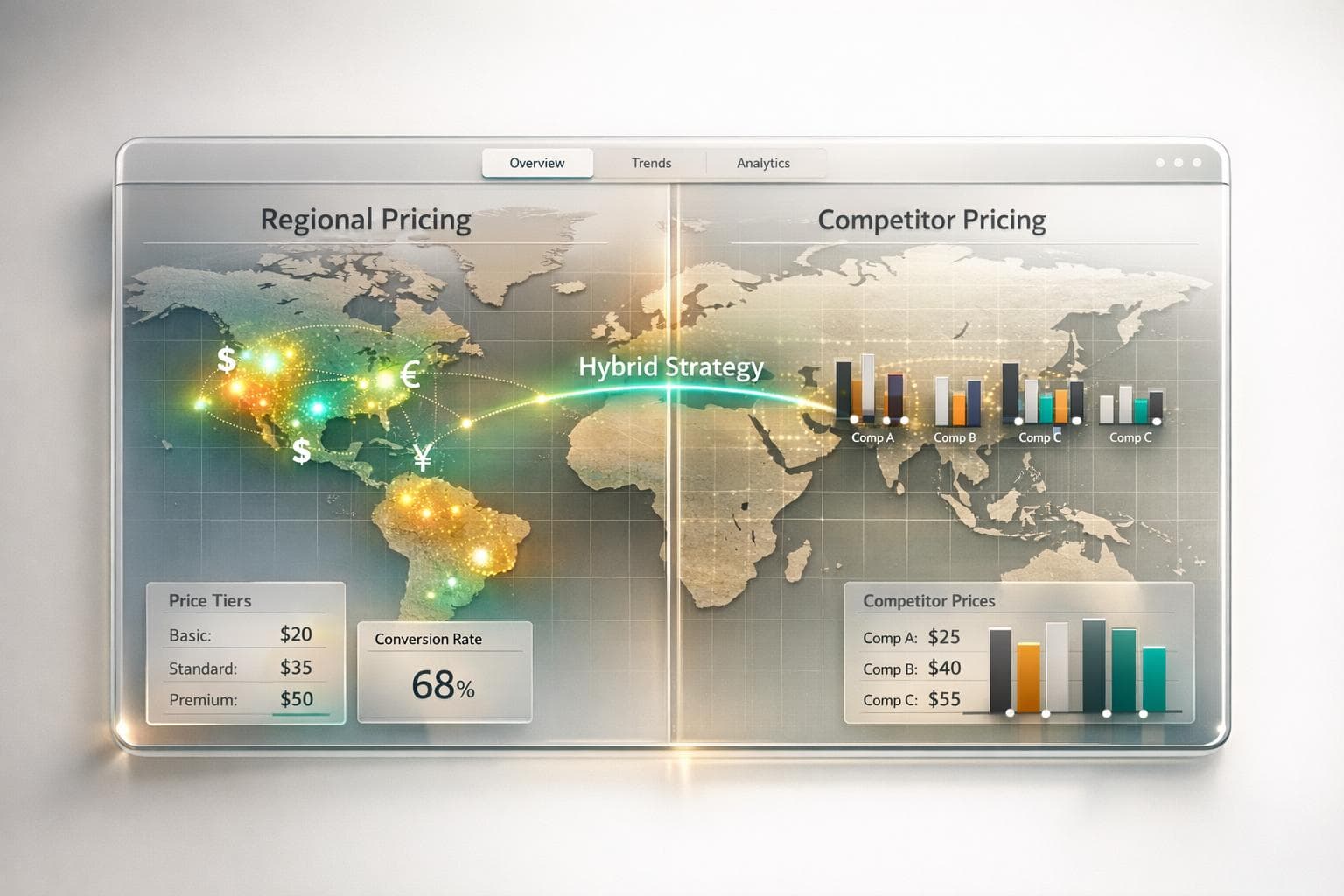
Regional pricing and competitor pricing are two key strategies for mobile app monetization, each with distinct benefits and challenges. Regional pricing adjusts subscription costs based on local purchasing power, making apps more accessible in emerging markets. Competitor pricing benchmarks your rates against similar apps, ensuring competitiveness in crowded categories. Choosing the right approach depends on your app’s target market, user behavior, and revenue goals.
Key Takeaways:
- Regional Pricing: Boosts conversions in price-sensitive regions by aligning costs with local economic conditions.
- Competitor Pricing: Helps maintain market position by aligning with rivals' prices, especially in saturated markets.
- Hybrid Approach: Combining both strategies can maximize revenue by balancing local affordability with competitive positioning.
Quick Comparison:
| Feature | Regional Pricing | Competitor Pricing |
|---|---|---|
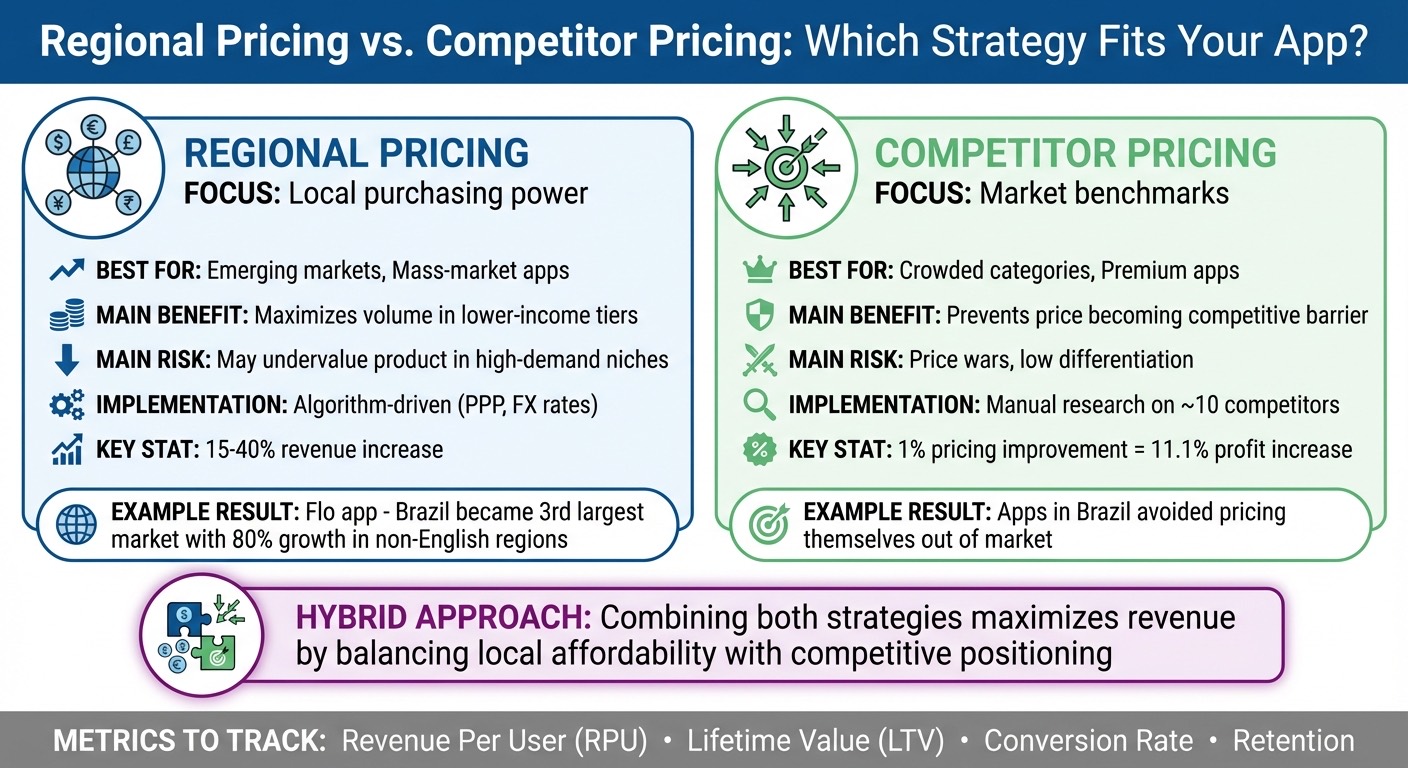
| Focus | Local purchasing power | Market benchmarks |
| Best For | Emerging markets, mass-market apps | Crowded categories, premium apps |
| Main Risk | Undervaluing in high-demand regions | Price wars, low differentiation |
| Implementation | Algorithm-driven (e.g., PPP, FX rates) | Manual research on competitors |
For example, a meditation app doubled subscriptions in Latin America using regional pricing, while competitor analysis helped an app in Brazil avoid pricing itself out of the market. Tools like Mirava simplify regional pricing adjustments, while platforms like RevenueCat and Adapty support competitor-based strategies. To succeed, test bold pricing experiments, monitor metrics like LTV and RPU, and tailor your approach to each market.
Regional vs Competitor Pricing Strategies for Mobile Apps
World-wide Pricing For Your App
sbb-itb-43fe43a
What is Regional Pricing?
Regional pricing involves tailoring subscription costs to align with local purchasing power - like charging $9.99 in the US but lowering prices in markets with different economic conditions. The idea is to make subscriptions more accessible while boosting overall global revenue.
This approach goes beyond the standard pricing practices of app stores. While app stores convert prices based on exchange rates and taxes, they often overlook perceived value and local economic factors. Although app stores may suggest regional adjustments, many successful apps take this further, setting prices strategically to match local demand [3].
The results can be impressive. In 2025, the period-tracking app Flo slashed prices in Brazil after experimenting with regional pricing. This adjustment turned Brazil into their third-largest market, fueling an 80% growth rate in non-English-speaking regions within a year [3]. Lower ad costs in Brazil helped offset the reduced price points, proving that regional pricing isn’t just about cutting prices - it’s about striking the right balance for each market.
Next, we’ll dive into how to set up purchasing power parity pricing for different markets.
How Regional Pricing Works
Regional pricing uses purchasing power parity (PPP), local economic data, and psychological pricing strategies to fine-tune subscription rates for each country. PPP measures how much a dollar can buy in various economies, offering a clearer picture of affordability than simple currency conversion.
Platforms like Mirava streamline this process across 170+ countries, leveraging pricing indexes built from data on Netflix, Spotify, Apple, and YouTube. These indexes reflect real digital purchasing habits instead of relying solely on GDP or PPP figures. Mirava also applies local pricing conventions. Once pricing rules are set, the platform updates rates instantly on the App Store and Google Play. Positioned upstream of tools like RevenueCat and Adapty, Mirava focuses on determining optimal prices, while those platforms manage billing and paywalls.
When to Use Regional Pricing
Regional pricing is particularly effective when expanding into markets with vastly different economic conditions. If your app sees high download numbers but conversion rates that lag behind top-performing markets, it’s a clear sign of a pricing mismatch [3].
"If your conversion rate in India is five times lower than in Canada, Australia, or US, well, there's some mismatch, right?" [3]
- Jacob Rushfinn, Founder of Rushfinn Consulting
This strategy works best for mass-market apps targeting price-sensitive users in emerging markets. For instance, non-gaming app spending grew by 31% in Brazil, 26% in Mexico, and 21% in South Korea in 2025 [3], highlighting the revenue opportunities in these regions when pricing is adjusted thoughtfully. On the other hand, premium apps aimed at affluent users might prefer to maintain higher prices globally to preserve their brand's exclusivity.
While regional pricing adapts costs to local conditions, other strategies, like competitive benchmarking, offer alternative ways to maximise revenue.
What is Competitor Pricing?
Competitor pricing involves setting your subscription rates based on the prices of similar apps in the market. Instead of focusing on costs or estimating customer value, this approach looks at what competitors are charging and positions your app within that range [5]. Unlike regional pricing, which considers local purchasing power, competitor pricing relies on market benchmarks and user expectations. In competitive spaces like fitness, meditation, or photo editing, this method offers a reliable starting point [5], as users in these categories tend to have clear ideas of what they’re willing to pay. Charging significantly more than lower-priced or free alternatives without a strong justification can result in users dismissing your app outright [1]. The aim isn’t just to match competitors’ prices but to communicate the value of your app and the experience users can expect [9].
"The biggest pricing mistake isn't charging too much or too little - it's not understanding what problem you're actually solving for users and how much that solution is worth to them" [9]
- Glance
Competitor pricing is particularly effective when markets reach price stability in crowded categories [10]. Staying within the typical price range helps maintain competitiveness and minimizes the risk of losing users to cheaper alternatives. However, this strategy demands ongoing vigilance - a competitor’s price drop could quickly impact your market share if not addressed promptly [10].
How Competitor Pricing Works
Start by identifying your direct competitors - apps with similar features, targeting the same audience, or appearing in search results for related keywords [6]. Once identified, study their subscription pricing models, including pricing tiers, trial periods, annual discounts, and access to premium features [5].
Tools like App Radar can help track keyword rankings, while SEMrush, Ahrefs, or SpyFu provide insights into competitors’ ad strategies [6][7]. Platforms like App Annie, Sensor Tower, or SimilarWeb are useful for reviewing pricing strategies of the top apps in your niche across different regional app stores [2]. Beyond numerical data, app store reviews offer valuable context - user feedback on pricing can reveal whether your app aligns with market expectations. For instance, if users frequently mention that a $9.99/month meditation app feels overpriced, it might indicate you need to either lower your price or enhance your offering to justify the cost.
Once you’ve gathered this data, calculate a price index by dividing your price by the average competitor price and multiplying by 100. An index above 100 indicates premium positioning [14]. This metric helps you decide whether to match competitors, undercut them to attract users, or charge more if your app offers distinct advantages.
When to Use Competitor Pricing
Competitor pricing works best in crowded markets where products are similar, and users often compare options [10][13]. For instance, if you’re launching a fitness tracker or task manager in a saturated category, this approach helps you avoid pricing yourself out of the market. It’s especially effective in regions with high competition and expensive traffic - such as the United States, United Kingdom, or Australia [11]. In these Tier 1 markets, starting with a slightly lower price can help secure early users and reviews, allowing you to gradually raise rates as your app’s value becomes evident [8].
However, in emerging categories where price expectations aren’t yet established, you may have more freedom to set higher prices - though you’ll need to clearly communicate your app’s value [5]. If your app delivers substantially better results than competitors, such as saving users significant time, competitor pricing might limit your revenue potential. In these cases, a value-based pricing strategy could yield better results [9][13].
A practical consideration: if your app’s conversion rate in one region is dramatically lower than in others, it could signal a pricing mismatch - for example, your price might be well above local competitors. Combining competitor insights with regional adjustments can help you strike the right balance in your pricing strategy.
Pros and Cons of Regional Pricing
Regional pricing, as opposed to flat or competitor-based pricing, brings a mix of opportunities and hurdles that directly affect revenue growth and operational demands. Moving from a single global price to localized pricing often produces meaningful revenue gains. This method not only allows for higher charges in wealthier markets but also opens doors to regions where flat pricing previously failed to gain traction.
Tailoring prices to match local purchasing power and consumer expectations often leads to improved conversion rates. For instance, while Apple suggests pricing in India should be 21% lower than in the U.S., many apps go further, adjusting prices to be 50–80% lower to align with local demand[3]. The impact of this approach is evident in markets like Brazil, Mexico, and South Korea, where non-gaming app spending rose by 31%, 26%, and 21%, respectively, in 2025[3].
That said, regional pricing comes with its share of challenges. Managing different price points across over 170 countries can be a logistical headache, compounded by mismatches in App Store and Google Play pricing tiers and the unpredictability of foreign exchange rates. On Apple’s platform, price increases above specified thresholds require existing subscribers to manually opt in, which often leads to cancellations[3]. Additionally, pricing experiments can take anywhere from three to six months to yield meaningful insights into their effects on lifetime value and retention[3]. These factors highlight the need for a well-balanced approach to regional pricing.
| Advantages | Disadvantages |
|---|---|
| Increased Global Revenue: Captures value in both affluent and emerging markets | Operational Complexity: Requires managing prices across 170+ countries, dealing with mismatched store tiers and FX volatility |
| Higher Conversion Rates: Localized prices resonate better with consumers, driving improved conversion rates | Subscriber Churn: Platforms like Apple may require users to re-subscribe after price hikes, increasing cancellation rates[3] |
| Market Expansion: Enables access to markets previously unreachable due to flat pricing | Lengthy Testing Periods: Pricing experiments can take 3–6 months to assess long-term outcomes[3] |
| Competitive Positioning: Matches local competitor pricing to remain attractive in specific markets | Brand Perception Risk: Lowering prices in certain regions could undermine a premium brand image[3] |
Interestingly, around 40% of brands still rely on automatic price localization provided by app stores, which adjusts prices based solely on exchange rates rather than actual consumer behavior[3]. This approach often leaves potential revenue untapped. Mirava, by contrast, calculates prices based on real purchasing patterns and automates bulk updates across stores. Positioned upstream of tools like RevenueCat and Adapty, Mirava determines optimal pricing before those platforms handle billing and paywalls. Below, we explore the specific benefits and challenges of regional pricing.
Benefits of Regional Pricing
The standout advantage of regional pricing is its ability to drive revenue growth while maintaining accessibility in diverse markets. By aligning pricing with local purchasing power, developers can maximize lifetime value and minimize churn in price-sensitive areas.
Regional pricing also facilitates market expansion. Adapting to local price norms allows apps to attract users who might otherwise never convert under a flat pricing model. Additionally, this strategy provides a competitive edge by considering local preferences, such as culturally preferred price endings, and by enabling dynamic adjustments to account for currency fluctuations.
Drawbacks of Regional Pricing
Operational complexity is the most pressing downside of regional pricing. Managing numerous price points across global storefronts demands constant attention to tier mismatches and currency fluctuations. On Apple’s platform, significant price hikes introduce churn risks, as subscribers must actively opt in to continue their subscriptions[3].
Another challenge is the need for extensive research. Successful regional pricing requires deep insights into local purchasing power, competitor pricing, and consumer willingness to pay - factors that go beyond standard economic indicators like GDP. For premium apps, there’s also a risk that lowering prices in specific regions could harm their perceived value, even if the overall revenue increase justifies the move[3].
Mirava addresses these hurdles by automating bulk price updates across over 170 countries, integrating psychological pricing techniques, and providing detailed analyses of consumer willingness to pay. Mirava updates prices at the store level, and downstream tools like RevenueCat, Adapty, Purchasely, and Superwall read the new prices automatically to handle billing, paywalls, and entitlements.
Pros and Cons of Competitor Pricing
Competitor pricing, unlike regional pricing that adjusts for local purchasing power, focuses on aligning with market norms. This approach is appealing for developers seeking quick alignment with market standards without diving into extensive research. However, over 90% of online shoppers consider pricing the main factor influencing their purchase decisions[17]. Simply mirroring competitors can lead to a cycle of price competition, which may not always work in your favor.
The biggest strength of competitor pricing lies in its simplicity. By following the pricing trends set by market leaders, marketing managers can establish reasonable price points with minimal effort. This approach is generally considered low-risk because it leverages proven benchmarks[13][16]. In saturated markets, like fitness or photo editing, aligning with established price patterns helps reduce decision-making friction and prevents losing customers to competitors offering lower prices[5][1]. Studies suggest that even a modest 1% improvement in pricing can lead to an average profit increase of 11.1%[13], making competitive benchmarking an attractive starting point.
However, this strategy isn’t without its downsides. It assumes competitors’ pricing is accurate, meaning any mistakes they make are likely to be repeated[10][17]. Additionally, it overlooks your unique cost structure, potentially leading to unsustainable pricing. In premium markets, competing solely on price can harm your brand, as consumers often associate higher prices with better quality or exclusivity[17]. Another major risk is the potential for a "race to the bottom", where constant price adjustments erode profit margins for everyone in the market[17].
| Advantages | Disadvantages |
|---|---|
| Simplicity: Minimal research needed; follow market leaders to set prices[13][16] | Ignores Internal Costs: Risks pricing that doesn’t cover expenses like overhead or production[10][17] |
| Quick Market Fit: Aligns with established price points in crowded markets, reducing decision-making friction[5][1] | Reliance on Competitor Accuracy: Assumes competitors’ prices are correct; replicates their errors if not[10][17] |
| Low Risk: Uses benchmarks that have proven viable for competitors[13] | Price Wars: Can lead to margin erosion when reacting to every competitor move[17] |
| Competitive Positioning: Prevents market share loss to rivals with lower prices[16] | Loss of Differentiation: Matching market prices makes it harder to stand out[5] |
For mobile apps, competitor pricing works best in established markets with comparable offerings, where 68% of users rank price as a top priority[18]. However, it’s less effective for apps with unique features or those targeting premium audiences. Below are key benefits and challenges of this approach.
Benefits of Competitor Pricing
A major advantage is speeding up market entry in crowded categories. By adopting competitors’ pricing structures - such as monthly versus annual subscription tiers - you make your pricing familiar and intuitive to potential customers[5][1]. This reduces the cognitive effort required for users to evaluate your offer.
Competitor pricing also eliminates the need for extensive willingness-to-pay research. Instead, you can calculate an average price across competitors to establish a baseline[13]. This strategy is particularly effective in mature industries with large user bases, where competitive pricing often reflects market equilibrium[13]. Additionally, pricing can serve as a positioning tool: where your price sits relative to competitors signals the level of quality users can expect[9].
Drawbacks of Competitor Pricing
The biggest pitfall is reliance on competitors’ pricing strategies. If rivals miscalculate, your pricing will mirror their mistakes[10][17]. For smaller businesses, the costs of hiring pricing experts or using automated competitor monitoring tools can be a significant financial strain[10][17].
Another concern is the likelihood of price wars. When companies compete solely on price, profit margins shrink, and products risk becoming commoditized. This is especially problematic in highly competitive markets, where differentiation becomes nearly impossible[17][19]. In fact, 90% of competitor-based pricing scenarios point to price-sensitive markets, commoditized products, or price wars[19]. For premium apps, matching lower-priced competitors can dilute your brand’s perceived value, signaling lower quality to potential customers[17]. Unlike regional pricing's impact on revenue, competitor pricing lacks the flexibility to capture additional value in markets where customers are willing to pay more. This highlights the importance of knowing how to test regional pricing to find the optimal balance.
Regional Pricing vs. Competitor Pricing: Side-by-Side Comparison
Regional and competitor pricing take different routes to drive revenue growth. Regional pricing adapts to local economic factors and purchasing power, whereas competitor pricing aligns with the market landscape by benchmarking against rivals. The right approach depends on your app's category, audience, and growth stage. Here's a closer look at how these strategies differ and what they offer.
Main Differences
Regional pricing relies on algorithm-driven adjustments that consider Purchasing Power Parity (PPP), currency exchange rates, and willingness-to-pay data. This method is particularly effective for mass-market apps targeting emerging markets, where Western pricing models can be a barrier. By tailoring prices to local conditions, regional pricing opens doors to previously untapped audiences.
On the other hand, competitor pricing involves manual research across roughly 10 similar apps to determine the market's "going rate." This approach is better suited for premium apps or markets with high competition, where pricing can signal quality or brand positioning. However, it assumes that competitors have fine-tuned their pricing strategies, which may not always be the case - leading to potential inaccuracies.
| Feature | Regional Pricing | Competitor Pricing |
|---|---|---|
| Primary Driver | Local purchasing power and perceived value | Rival price points and market benchmarks |
| Implementation | Algorithmic (PPP factors, FX rates, WTP) | Manual research across ~10 comparable apps |
| Best For | Mass-market apps expanding to emerging markets | Premium apps or highly saturated categories |
| Main Benefit | Maximizes volume in lower-income tiers | Prevents price becoming a competitive barrier |
| Main Risk | May undervalue product in high-demand niches | May adopt unoptimized competitor pricing |
For example, while Apple suggests a 21% discount in India compared to U.S. pricing, many successful apps apply reductions of 50–80% to better reflect local purchasing power[3]. Despite this, nearly 40% of brands still stick to default app store pricing, which often misses the mark on local value and consumer demand[3].
These differences underline why the tools supporting each strategy are tailored to their unique requirements.
Tools for Each Strategy
Regional pricing benefits from advanced platforms that automate PPP-based calculations and streamline multi-region deployment. For instance, Mirava integrates pricing intelligence across 170+ countries, using data from sources like Netflix, Spotify, Apple, and YouTube. It calculates region-specific prices based on actual digital purchasing habits and automates updates to App Store Connect and the Google Play Console. This eliminates the need for manual spreadsheets and simplifies large-scale pricing adjustments.
Competitor pricing, on the other hand, often starts with manual research. Using VPNs to access local app stores is a common practice, as many price-monitoring tools lack reliability[3]. Once baseline prices are set, platforms like RevenueCat, Adapty, and Superwall take over, managing billing, paywalls, and A/B testing. These tools help refine pricing strategies by providing insights into in-app purchases and subscriber behavior.
Many teams avoid touching regional pricing simply because doing it by hand feels like too much work - removing that friction lets them test new strategies without worrying about spreadsheets or App Store rules.
When experimenting with pricing strategies, opt for bold tests - such as comparing $39 to $69 - rather than subtle changes. This approach provides clearer insights into price elasticity[3]. Additionally, track metrics like Revenue Per User (RPU) and lifetime value (LTV), which offer a fuller picture of whether lower regional prices drive long-term retention or simply result in short-term churn[3].
How to Choose Between Regional and Competitor Pricing
To maximize revenue, blending regional and competitor pricing into a hybrid strategy often delivers better results than relying on either approach alone. Competitor pricing assumes your rivals have already perfected their pricing, which is rarely the case[3]. On the other hand, regional pricing without a broader market perspective risks undervaluing high-potential segments. By combining regional insights with competitive benchmarks, you can create a pricing framework that balances both market dynamics and customer value.
Start by refining your base price in your primary market. Conduct bold experiments - such as testing $39 versus $69 - to understand how sensitive your audience is to price changes[3].
"The quality of your initial price will shape every localized decision you make. Garbage in, garbage out."[3]
- Daphne Tideman, Growth Specialist
Once you’ve validated your base price, build a custom pricing index by benchmarking against roughly 10 similar apps. Include both global leaders and local competitors to account for variations in regional spending habits. With a solid base price and benchmarking data, incorporate regional economic factors to further refine your pricing.
Using purchasing power parity (PPP) data as a guide, test three pricing variants in each region: a baseline price, a 20% premium, and a 20% discount. Run these tests for 2 to 4 weeks to capture local purchasing patterns and adjust accordingly.
For regions with lower purchasing power, consider tailoring your package offerings. For example, Impulse, a brain training app, eliminated annual subscriptions in Brazil and shifted to weekly or lifetime plans to align with local payment preferences[3]. Similarly, Duolingo charges more in Spain and France than in the U.S. because English proficiency is perceived as more valuable for career and academic opportunities in those countries[3]. These cases highlight how blending competitor benchmarks with regional insights can create pricing that aligns with both local economic conditions and your app’s market position.
Keep a close eye on metrics like revenue per user (RPU), lifetime value (LTV), and retention to ensure your pricing strategy remains effective. Lower prices in specific regions can still drive significant profits when paired with reduced local advertising costs. Flo’s success in Brazil is a prime example - the country became its third-largest revenue source, thanks to lower acquisition costs[3]. Roll out successful pricing changes gradually, starting with 10% of users, then scaling to 50%, and eventually 100%, while maintaining a 5–10% control group to monitor ongoing performance[3].
To simplify this process, tools like Mirava can handle the heavy lifting by calculating region-specific prices for over 170 countries. Mirava uses real digital purchasing data from platforms like Netflix, Spotify, Apple, and YouTube. Once your pricing strategy is ready, those store-level prices are read automatically by tools like RevenueCat, Adapty, and Superwall to manage billing, paywalls, and A/B testing.
Conclusion
This analysis highlights how combining pricing strategies can help apps navigate diverse market challenges. Competitor pricing ensures you stay in line with market expectations, avoiding the risk of being perceived as overpriced. Meanwhile, regional pricing opens the door to conversions in markets where standard pricing might be a barrier.
"Value isn't universal - it's relative. You're not just competing with other apps, you're competing with the local economy."
- Demian Voorhagen, CEO, Mirava
The impact of regional pricing is clear: apps that tailor prices to local purchasing power often see stronger conversions and subscription growth in price-sensitive regions like Southeast Asia and Latin America. These results stem from understanding that while a $9.99 monthly subscription might be a casual purchase in the U.S., it can represent a significant expense in countries like Brazil or India.
Start by validating your base price through competitor analysis in your primary market. Then, adapt prices for your top 3–5 international markets, considering local economic conditions. Round prices to familiar local figures (e.g., ₹349 instead of ₹376.19) rather than relying on direct currency conversions [2].
Managing these adjustments manually across platforms like iOS and Android can be daunting. That’s where Mirava steps in. It simplifies region-specific pricing by leveraging real purchasing data from platforms like Netflix, Spotify, Apple, and YouTube - focusing on actual consumer behavior rather than just GDP or PPP. Mirava calculates optimized prices for over 170 countries and applies them at the store level, where tools like RevenueCat, Adapty, and Superwall read them automatically to handle billing, paywalls, and A/B testing. This combination ensures your pricing strategy is both precise and easy to execute.
FAQs
How do I know if my app needs regional pricing?
If your app performs well in certain markets but struggles with low conversions or high churn in others, it might be time to rethink a one-size-fits-all pricing approach. Adjusting prices to match local economic realities and user expectations can significantly impact your bottom line, often unlocking meaningful revenue gains when executed well. Tools such as Mirava can fine-tune these regional pricing strategies at the store level, and platforms like RevenueCat, Adapty, Purchasely, and Superwall read the new prices automatically to maximize results.
When does competitor pricing hurt profits or brand value?
Competitor pricing strategies can backfire if they result in underpricing or overpricing. Setting prices too low can cut deeply into profit margins and send the wrong message about your product's worth, while pricing too high risks alienating customers and harming how your brand is perceived.
Basing your pricing solely on what competitors charge, without factoring in local market dynamics or how much customers are willing to pay, can lead to missed opportunities, a drop in sales, and a decline in long-term revenue.
How do I combine regional and competitor pricing without causing churn?
To balance regional and competitor pricing effectively without triggering churn, it's essential to adjust prices based on local economic factors while keeping an eye on competitive benchmarks in each market. Aligning prices with regional purchasing power and currency variations ensures accessibility, while competitor analysis helps maintain market relevance.
Use tools like Mirava to decide what the price should be in each market, and A/B test that decision through your paywall layer. Platforms such as RevenueCat and Adapty manage the split, the billing, and the entitlements.