Policy changes are transforming app revenue models globally, with developers now navigating reduced platform fees, regional regulations, and evolving monetization strategies.
Key takeaways:
- Platform fees are declining: Google charges 10–20%, and Apple’s rates in China dropped to 25%, with small businesses paying as low as 12%.
- Alternative payment systems: Developers save up to 5% using third-party billing but face trade-offs like losing App Store discovery tools.
- Regional regulations: Europe’s Digital Markets Act enforces alternative payment methods, while U.S. antitrust cases and stricter privacy laws increase operational costs.
- Emerging markets drive growth: Japan, Mexico, and Turkey lead with revenue growth of 70–88%, driven by localized pricing and payment systems.
To stay competitive, developers must monitor policy updates, optimize pricing for local markets, and leverage tools like Mirava for pricing intelligence, alongside billing platforms such as RevenueCat and Adapty.
How Policy Changes Affect Revenue by Region
Europe: Digital Markets Act Effects
The Digital Markets Act has reshaped the way apps generate revenue in the European Union. Apple now employs a tiered fee system for alternative payment methods, which includes a 2% acquisition fee for the first six months, a 5% Core Technology Commission, and tiered service fees ranging from 5% to 13%. In total, these fees can add up to 12–20%, compared to the standard 30% commission [1][2]. Google, on the other hand, offers a 3% discount through its User Choice Billing system in the European Economic Area, with fees dropping further to 10% or 17% for apps distributed outside the Play Store [3].
However, adopting external payment systems isn't without its challenges. Developers face additional operational costs of 3–5% for payment processing, fraud prevention, and customer support [1]. In April 2025, Apple faced a €500 million fine for anti-steering practices that prevented developers from promoting more affordable payment options outside the App Store [1]. Developers can reduce fees by opting out of "Tier 2" services like discovery tools and automatic updates, but as RevenueCat's Jens-Fabian Goetzmann observed:
Losing App Store discovery to save a few points rarely pencils out [for small businesses] [2].
While large companies like Spotify and Fortnite are better positioned to leverage alternative billing systems, smaller developers often stick with standard terms to maintain visibility through app store discovery. These European changes stand in stark contrast to the evolving regulatory landscape in the United States.
United States: Antitrust and Privacy Rules
In the U.S., antitrust pressures have led to noticeable reductions in app store fees. Google has lowered its standard 30% commission to 10% or 15% for recurring subscriptions and introduced a flat 5% fee for developers who continue using Google Play Billing [4]. Additionally, in April 2026, Google settled its antitrust case with Epic Games by allowing alternative Android app stores and sharing its Play Store catalog [4]. Epic Games CEO Tim Sweeney highlighted this shift by stating:
Anybody can launch a competitive app store now [4].
Privacy regulations, particularly the California Consumer Privacy Act (CCPA), have also increased operational costs for many companies. For example, businesses offering voice-AI products experienced an average 1.59% decline in Return on Assets after the CCPA was enacted. Smaller firms faced a 25% increase in data storage costs to meet compliance requirements, compared to a 13% rise for larger companies [5]. Apple’s App Tracking Transparency feature has further complicated matters by reducing advertisers' ability to target users effectively, prompting a shift toward first-party data and AI-driven advertising [7].
Asia-Pacific: Super-App Rules and Market Growth
In the Asia-Pacific region, regulatory changes are driving new revenue strategies. Japan's Mobile Software Competition Act and Google's settlement to allow competing app stores on Android have had a significant impact, particularly in markets like India and Southeast Asia, where super-app ecosystems dominate and local payment methods boost conversion rates [3][6].
Developers in these regions now have access to platforms supporting over 150 currencies and a variety of local payment methods, enabling better cross-border conversions [6]. Many are steering users toward external websites for purchases to avoid high app store commissions. However, this approach requires developers to independently manage security, compliance, and fraud prevention [6].
Emerging Markets: Latin America and Middle East-Africa
Emerging markets present a mix of opportunities and challenges under evolving regulatory frameworks. Developers in these regions are benefiting from global changes that allow them to retain a larger share of revenue through alternative payment options [6]. At the same time, these markets demand secure, localized payment systems, and privacy policy changes are driving a shift toward subscription models and first-party monetization [6][7].
Apps that embrace privacy-friendly revenue models, such as subscriptions or first-party data monetization, are seeing revenue growth as competitors struggle to adapt [7]. Meanwhile, Google's Privacy Sandbox initiative is set to replace third-party cookies with privacy-focused technologies. This move encourages the use of AI and machine learning to analyze first-party data for targeted campaigns without relying on personal identifiers [7].
sbb-itb-43fe43a
How Apple lost control of the App Store | The Vergecast
Revenue Comparison Across Regions
App Revenue Growth by Region: Policy Impact and Market Performance 2026
Regional Policy Impact Data
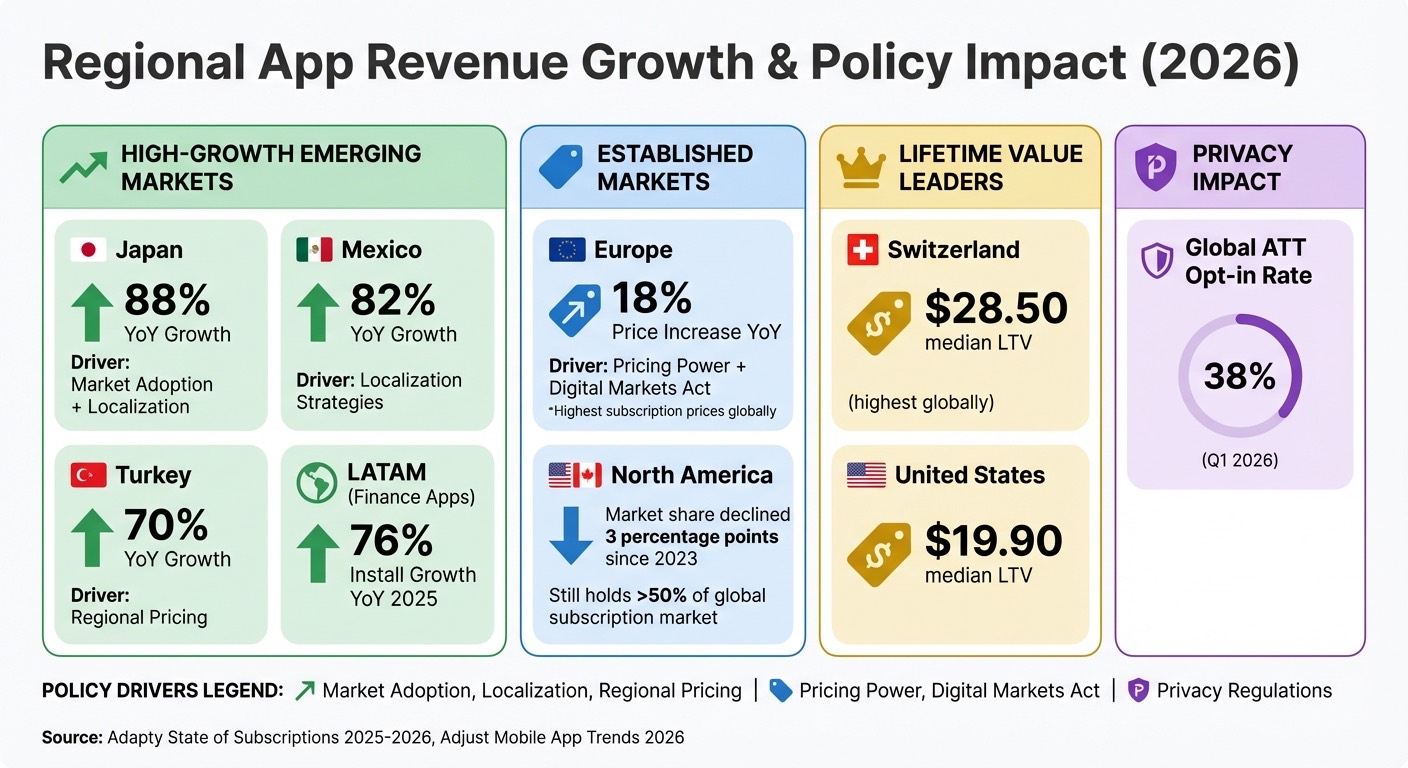
Policy changes affect markets in varying ways. Recent data shows that Europe now boasts the highest app subscription prices, with median prices climbing 18% year-over-year in 2026 [10]. On the other hand, North America, while still holding over half of the global subscription market, has seen its share drop by 3 percentage points since 2023 [10].
Emerging markets are driving much of the growth. Japan leads with an 88% increase, followed by Mexico at 82% and Turkey at 70% [11]. These regions benefit from localized pricing strategies and payment systems. Interestingly, Switzerland now claims the highest median lifetime value at $28.50, surpassing the U.S., where the median is $19.90 [10]. However, regulatory tax changes in these high-growth regions have forced developers to make quick pricing adjustments.
Apple’s 2024 pricing updates in nine countries, including Turkey, Kazakhstan, and Russia, highlight how rapidly tax rule changes can impact both developer earnings and consumer pricing.
| Region/Country | Key Policy/Market Driver | Revenue Growth Impact | Study Source |
|---|---|---|---|
| Global | Privacy (ATT Opt-in) | 38% Opt-in Rate (Q1 2026) | Adjust Mobile App Trends 2026 [9] |
| Japan | Market Adoption + Localization | 88% Growth (YoY 2026) | Adapty State of Subscriptions [11] |
| Mexico | Localization Strategies | 82% Growth (YoY 2026) | Adapty State of Subscriptions [11] |
| Turkey | Regional Pricing | 70% Growth (YoY 2026) | Adapty State of Subscriptions [11] |
| LATAM | Market Adoption (Finance Apps) | 76% Install Growth (YoY 2025) | Adjust Mobile App Trends 2026 [9] |
| Europe | Pricing Power + DMA | 18% Price Increase (YoY 2026) | Adapty State of Subscriptions [10] |
Platforms like Mirava, working alongside billing tools such as RevenueCat and Adapty, enable developers to adapt swiftly to these regional variations.
The global app market is expected to grow at a compound annual rate of 7.25% from 2022 to 2029, reaching $781.70 billion [8]. As regional disparities become increasingly critical, advanced pricing tools are essential for navigating the complexities of policy-driven revenue shifts. When pricing is misaligned for a market, the effect shows up within weeks - which is why localization belongs in early monetization rather than being treated as a 'later' optimization.
How to Adapt to Policy-Driven Revenue Changes
Using Pricing Intelligence Platforms
Keeping up with frequent policy changes across more than 170 countries is nearly impossible with manual processes. Pricing intelligence platforms streamline this challenge, eliminating the need for error-prone spreadsheets and minimizing the risk of breaking store connections. These tools enable developers to go beyond Apple and Google's default pricing, which often only considers taxes and exchange rates, by factoring in local purchasing power.
Take Mirava as an example. It uses pricing indexes derived from the purchasing habits of platforms like Netflix, Spotify, Apple, and YouTube to set region-specific prices. Developers can establish global pricing rules based on Purchasing Power Parity (PPP), exchange rates, or custom multipliers, applying them seamlessly across iOS and Android. Updates are implemented quickly - typically within 24–48 hours - and remain compliant with App Store and Google Play APIs [14].
The results can be significant. Apps that align prices with local purchasing power often see meaningful gains in conversions and subscriptions in price-sensitive regions like Latin America and Southeast Asia - and in some markets, lowering prices to fit local affordability can substantially expand the paying user base. Despite these opportunities, around 40% of app brands still rely on default pricing strategies that ignore local economic conditions [12].
Apple's suggested pricing for India, for instance, is about 21% lower than U.S. prices. However, apps that fine-tune their pricing often go much further, setting prices 50% to 80% lower to better align with local demand [12]. In contrast, in the UK, where Apple suggests a 26% price increase, many successful apps price their subscriptions about 10% lower than their U.S. equivalents [12]. Platforms like Mirava help developers navigate these complexities, including platform-specific challenges like Apple's price increase thresholds, which can lead to mandatory user opt-ins and increased churn. Many teams avoid touching regional pricing simply because doing it by hand feels like too much work - automating it removes that friction so they can test new strategies without wrestling with spreadsheets or App Store rules.
Once pricing is optimized upstream, billing and paywall tools take over to manage revenue collection effectively.
Billing and Paywall Management Tools
While pricing intelligence defines what to charge and where, billing and paywall platforms handle payment collection and ensure offers are presented effectively. Tools like RevenueCat, Adapty, Purchasely, and Superwall play a crucial role here, managing subscriptions and billing logic while building on the pricing intelligence established upstream.
This division of responsibilities creates a smooth workflow. Mirava pushes optimized prices to app stores, while tools like RevenueCat and Adapty manage subscription states. At the same time, Superwall and Purchasely focus on creating user-friendly interfaces that drive conversions. Automated store-level updates are essential, as manual updates across app stores can result in delays and errors, and tools like RevenueCat and Adapty read the new prices automatically.
Integration also enables better tracking of long-term metrics like lifetime value (LTV), churn, and refunds. For example, RevenueCat Experiments allows developers to evaluate how localized pricing impacts retention over time, moving beyond short-term gains [12].
When regulatory changes - such as new taxes under the Digital Markets Act - arise, pricing tools make it easy to adjust custom multipliers or exchange rates, ensuring revenue remains stable. Meanwhile, billing platforms process these updates without requiring code changes or app updates.
Once the billing process is streamlined, developers can focus on refining their pricing strategies for maximum impact.
Pricing Adjustment Methods
Successful pricing strategies often rely on three approaches: Purchasing Power Parity (PPP), Willingness-to-Pay (WTP) analysis, and psychological pricing localization.
- PPP ensures pricing feels consistent across different economies. For example, meaningfully reducing prices in lower-income regions like Southeast Asia or Latin America can help sustain conversion rates.
- WTP analysis uses demand signals to create regional pricing tiers that reflect what users perceive as fair value, rather than relying solely on exchange rates [12].
- Psychological pricing localization involves rounding prices to amounts that feel natural locally. For instance, instead of charging ₱202.33, a price of ₱199 is used. Similarly, ₹349 might replace ₹352. This approach avoids the impression of a "lazy" export and builds user trust.
Duolingo offers a compelling example. By pricing its "Plus" tier at approximately $6.50 (₹549) in India compared to $12.99 in the U.S., the app saw a 400% increase in paid subscriptions from emerging markets, making India its second-largest market by subscriber count [16].
A practical way to benchmark pricing is the "Coffee Test." This suggests setting in-app purchase prices to match the local cost of a cup of coffee - $3 in the U.S. versus ₹50 in India, for example [16]. For subscriptions, using the formula "Annual = Monthly × 10" effectively offers users two months free, which can boost lifetime value [16].
Developers are also encouraged to experiment with bold pricing changes in their primary markets. For instance, testing a $39 subscription against a $69 option helps establish a solid anchor before localizing prices [12]. Tools like VPNs can reveal competitors' storefront prices, while the Van Westendorp Pricing Model identifies acceptable price ranges in specific markets [12].
When immediate action is required - such as Apple's planned tax-related price adjustments in nine countries, including Turkey and Russia, in January 2026 - pricing platforms enable batch updates across all regions, ensuring compliance and consistency [14].
Conclusion
Policy changes are reshaping markets at an increasing pace. From the Digital Markets Act in Europe to new tax regulations in Japan and shifts in Latin America, developers face a constantly evolving regulatory environment. Overlooking these changes can mean missed revenue opportunities or a drop in conversion rates in rapidly growing regions.
In this landscape, pricing strategies have become a critical differentiator between market leaders and those lagging behind. The most successful apps are moving beyond default store pricing, which often ignores local economic realities, and instead are adopting data-driven methods that position pricing as a key driver of growth.
Thankfully, managing pricing across more than 175 regions no longer requires juggling cumbersome spreadsheets. Mirava offers the intelligence layer that determines optimal regional prices, leveraging real-world purchasing data from platforms like Netflix and Spotify. Meanwhile, tools such as RevenueCat, Adapty, Purchasely, and Superwall handle billing and paywall operations. This clear division of responsibilities allows developers to adapt quickly to regulatory updates, whether it’s a new VAT in Mauritius or a GST adjustment in Bhutan.
"Value isn't universal - it's relative. You're not just competing with other apps, you're competing with the local economy." - Demian Voorhagen, Mirava
The numbers speak for themselves. Localized pricing strategies are becoming essential in emerging markets like Brazil (31%), Mexico (26%), and South Korea (21%) [12]. Developers who tailor their pricing to align with local purchasing power often see tangible results, with stronger conversions in price-sensitive regions and a larger paying user base after significant price adjustments. The real challenge isn’t deciding whether to optimize pricing - it’s how quickly you can implement these changes.
FAQs
When is switching to alternative payments actually worth it?
Switching to alternative payment methods can deliver a meaningful revenue boost when paired with well-thought-out regional pricing strategies. By tailoring prices to match local purchasing power and preferences, apps can better align with user expectations, driving higher conversions. Tools such as Mirava provide data-driven insights to fine-tune regional pricing, while platforms like RevenueCat and Adapty take care of billing and paywall management, ensuring a seamless implementation process.
How do privacy rules change the best monetization strategy?
Privacy regulations have tightened restrictions on data collection and user tracking, making it harder to rely on personalized pricing and targeted ads. To adapt, developers need to embrace privacy-compliant strategies. One effective approach is region-specific pricing, which uses aggregated purchasing trends rather than individual user data. Tools like Mirava can play a key role here, offering insights into global markets to help fine-tune revenue strategies.
Beyond pricing, developers should prioritize paywall adjustments, flexible trial periods, and tailored local offers. These tactics align with the shift toward broader, more user-friendly monetization methods that respect privacy while still driving growth.
What’s the fastest way to localize pricing across 170+ countries?
Platforms that streamline pricing decisions are a game-changer for developers. Mirava simplifies the process by using data-driven insights to set region-specific prices. Instead of depending on GDP or PPP metrics, it evaluates real purchasing patterns, psychological price thresholds, and local willingness-to-pay. While tools like RevenueCat, Adapty, Purchasely, and Superwall manage billing and paywall implementation, Mirava acts as the pricing intelligence layer, helping developers optimize revenue across diverse markets.