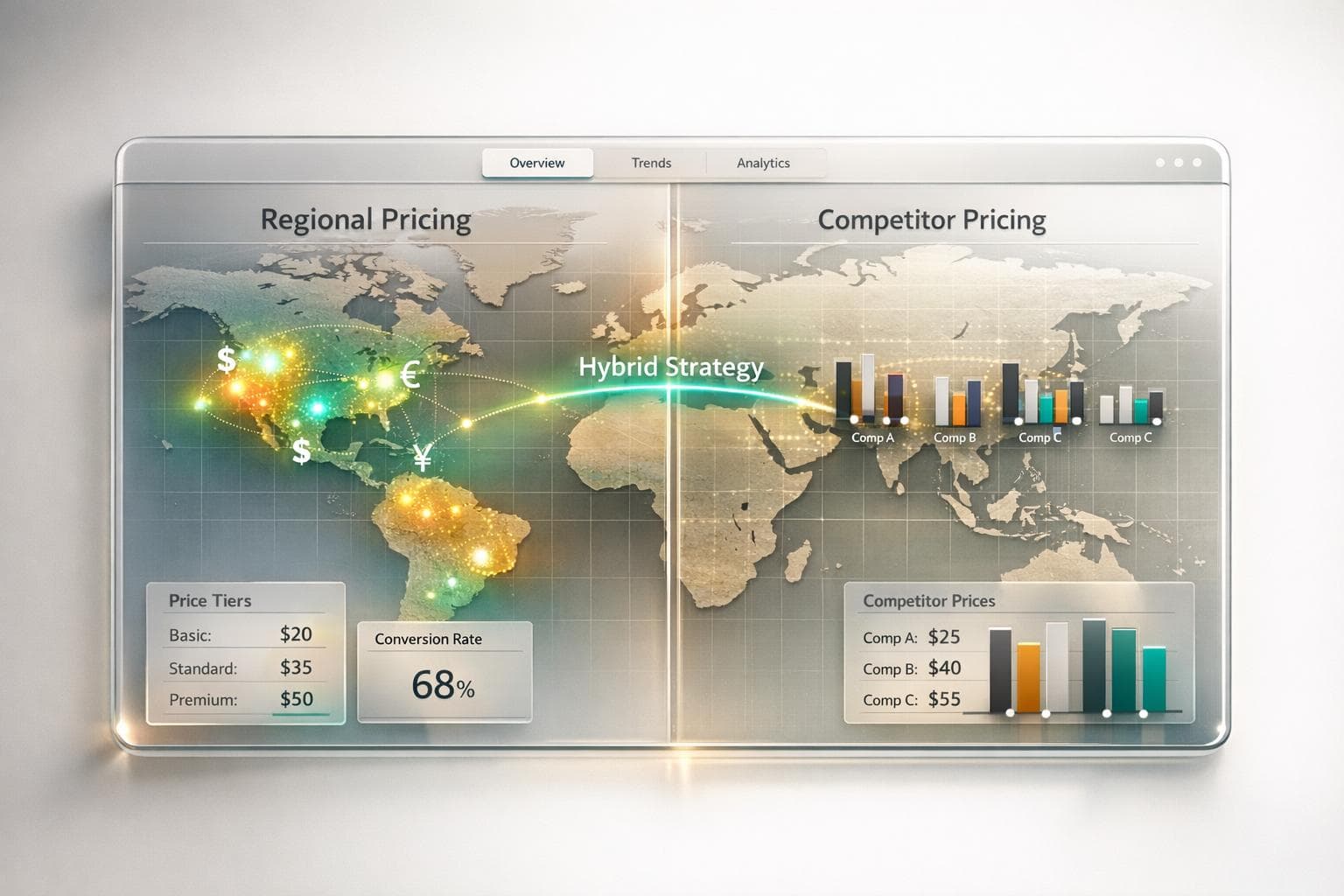
Regional pricing with live rates is a powerful way to grow app revenue globally by tailoring prices to local market conditions. Here's what you need to know:
- Why Regional Pricing Matters: Adjusting prices to match local purchasing power can boost trials and paid starts by 15–30%. For example, Flo, a period-tracking app, saw 80% growth in non-English-speaking markets by localizing pricing in Brazil.
- Live Rates vs. Static Pricing: Static pricing ignores currency fluctuations and market changes, risking revenue loss. Live-rate-informed pricing keeps prices aligned with real-time exchange rates.
- Pricing Models:
- Pure FX Conversion: Simple but doesn’t account for affordability.
- FX + PPP Adjustment: Adds purchasing power parity for fairer pricing.
- FX + Behavior-Based Indexing: Combines PPP with local spending habits for precise results.
- Tools and Workflow: Platforms like Mirava calculate region-specific prices, while tools like RevenueCat and Adapty manage billing and paywalls. Regular reviews and automated workflows ensure pricing stays competitive.
- Key Metrics to Track: Monitor conversion rates, ARPU, churn, and revenue per install to refine pricing and identify gaps.
Takeaway: Localized pricing with live rates ensures fair and competitive pricing across markets, driving growth in regions with varying economic conditions. Start by auditing your top markets, implementing live rates, and reviewing pricing regularly to stay ahead.
Key Concepts in Regional Pricing for Mobile Apps
Base Currency, Local Currencies, and Price Tiers
The base currency, often set as USD, serves as the foundation for all localized pricing adjustments in mobile apps.
"Base price is the anchor price set in your base country or base currency that every other localized price scales from." - Antonio Cappiello, Founder, PricePush [4]
Both Apple and Google rely on this base price but take different approaches to localization. Apple uses a fixed "price point ladder" with approximately 900 predefined tiers across 175 storefronts. In contrast, Google Play allows developers to set specific amounts in local currencies. Apple also factors in local taxes during its automatic price conversions [4].
| Feature | Apple App Store | Google Play Store |
|---|---|---|
| Pricing Structure | Fixed price ladder (~900 tiers) | Arbitrary local currency entry |
| Currency Support | ~44 currencies; some regions use USD | Local currency for most of 77 supported languages |
| Update Method | Territory-level overrides in App Store Connect | Per-country pricing inside each product |
To refine this localized pricing further, developers can incorporate exchange rates using nominal FX methods or Purchasing Power Parity (PPP).
PPP vs. Nominal FX Rates
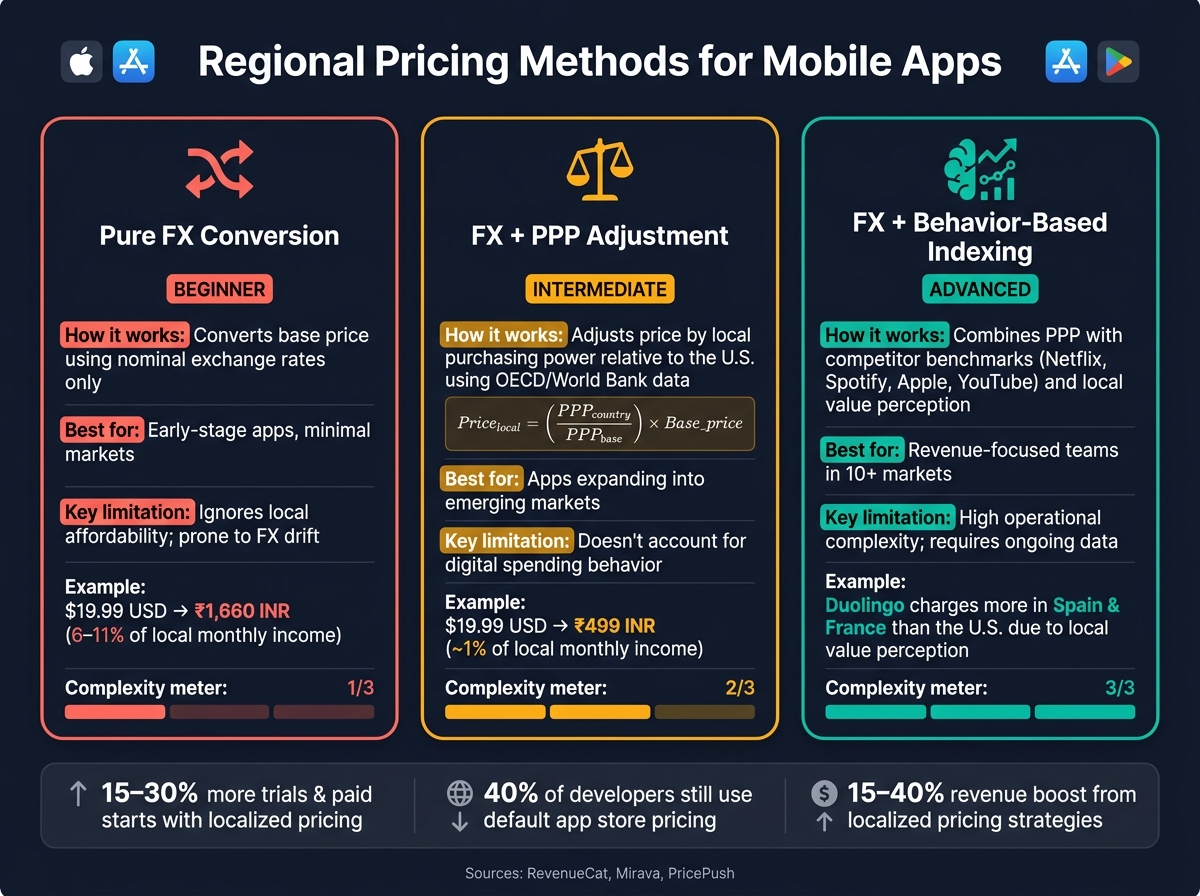
App stores usually convert base prices into local currencies using nominal FX rates. This method provides a simple mathematical conversion but doesn’t consider local income levels or affordability. For example, a $19.99 subscription in the U.S. - representing about 0.4% of the median monthly income ($5,000) - converts to roughly ₹1,660 in India. However, this price could account for 6% to 11% of the local median income, making it less accessible [4].
Purchasing Power Parity (PPP) offers a more customer-centric approach by adjusting prices based on local affordability. The formula for PPP pricing is:
Price_local = (PPP_country / PPP_base) × Base_price
Using data from organizations like the OECD or World Bank, a $19.99 U.S. price translates to approximately ₹440–₹500 in India, often rounded to ₹499 for simplicity. As Daphne Tideman, Growth Specialist, highlights:
"A system that's focused entirely on business mechanics [FX and taxes], with no regard for customer value, was never going to succeed long-term." [3]
Behavior-Based Pricing Indexes
While macroeconomic adjustments like PPP provide a solid starting point, they don’t capture consumer behavior in specific markets. For instance, PPP doesn’t reflect how much customers are actually willing to spend on digital subscriptions. To address this, Mirava builds pricing indexes using data from platforms like Netflix, Spotify, Apple, and YouTube. These insights help developers align their pricing with real-world spending habits, avoiding missteps in fast-changing markets [1].
sbb-itb-43fe43a
How to price your subscription app globally - Featuring Jacob Rushfinn
Building a Regional Pricing Model with Live Rates
Regional Pricing Methods Compared: FX, PPP & Behavior-Based
Step-by-Step Pricing Model Development
Start by validating your base price through "big swing" tests - like comparing $39 to $69 - to understand how sensitive your audience is to price changes before scaling globally [3].
Once the base price is validated, convert it using live foreign exchange (FX) rates. Adjust for local affordability using purchasing power parity (PPP), and fine-tune it further with a behavior-based index that draws on data from competitors across regional and global markets. Mirava simplifies this process by combining PPP and behavior-based indexes, leveraging insights from companies like Netflix, Spotify, Apple, and YouTube. It integrates seamlessly with platforms such as RevenueCat, Adapty, Purchasely, and Superwall, ensuring that once pricing is optimized, billing, paywalls, and entitlements are handled automatically.
Interestingly, about 40% of developers still rely on default app store pricing and rarely update it [3]. As the AppsOps team explains:
"App Store prices are tier-locked, not rate-locked. Once a local price is set, it stays fixed regardless of exchange-rate movement - until a human, or an App Store Connect API call, explicitly changes it." [2]
Local costs also play a role in pricing decisions. Factors like VAT, GST, platform fees, and even regional ad inventory costs must be considered. For instance, lower ad costs in Brazil can justify a reduced price point while still supporting strong unit economics [3]. After determining these initial figures, refine them through psychological rounding and apply minimum and maximum price limits to ensure they align with both market expectations and profitability goals.
Psychological Rounding and Price Guardrails
A precise mathematical price doesn’t always resonate with local consumers. After applying FX and PPP adjustments, you might land on prices like ₹463 or ₺87.30 - figures that may feel unfamiliar or untrustworthy. Rounding these numbers makes them more intuitive and appealing to local shoppers.
"Rounding isn't one global pattern. Every market has conventions that users parse faster because they're used to them." - Antonio Cappiello, Founder, PricePush [4]
Here’s how rounding conventions differ by region:
| Market | Common Rounding Convention | Example |
|---|---|---|
| United States | Ends in .99 | $19.99 |
| India | Ends in 99 for large denominations | ₹499 or ₹999 |
| Japan | Whole hundreds/thousands; no decimals | ¥1,000 |
| Turkey | Round tens or twenty-fives | ₺99 or ₺49.99 |
| Brazil | Uses comma as decimal separator | R$19,99 |
Beyond rounding, it’s essential to establish minimum and maximum price limits. These guardrails prevent automated FX updates or pricing experiments from undercutting your cost floor or exceeding what the market can sustain. Mirava incorporates these limits directly into its workflow, ensuring bulk updates don’t unintentionally harm your margins [1]. Additionally, when increasing prices for existing subscribers, be cautious - significant hikes may require users to actively opt back in, which could lead to higher churn [3].
Comparison of Pricing Methods
Once your model is set, evaluate different pricing methods to find the right balance between precision and simplicity. Not every team needs the same level of complexity:
| Method | How It Works | Best For | Key Limitation |
|---|---|---|---|
| Pure FX Conversion | Converts the base price using nominal exchange rates | Early-stage apps, minimal markets | Ignores local affordability; prone to FX drift |
| FX + PPP Adjustment | Adjusts the price by local purchasing power relative to the U.S. | Apps expanding into emerging markets | Doesn’t account for digital spending behavior |
| FX + Behavior-Based Indexing | Adds competitor benchmarks and local value perception to PPP adjustments | Revenue-focused teams in 10+ markets | High operational complexity; requires ongoing data |
The behavior-based approach offers the greatest precision but is also the most complex to manage manually. For example, Duolingo charges higher prices in Spain and France than in the U.S. due to differing local value perceptions - a nuance neither FX nor PPP adjustments alone can capture [3].
Setting Up Live Rate Monitoring and Update Workflows
Real-Time FX Monitoring and Alerts
Keeping an eye on currency fluctuations is critical, but it’s equally important to focus only on meaningful changes. Setting thresholds for significant shifts helps avoid constant price adjustments, which can confuse users and damage trust. Without these safeguards, you risk "ping-ponging" your pricing.
High-inflation economies require extra vigilance. For example, currencies like the Turkish lira and Argentine peso can experience swings of 10–30% in a single year [4]. Antonio Cappiello, Founder of PricePush, recommends the following approach:
"A workable cadence looks like this. Quarterly review of all localized prices, comparing current FX and PPP data to what's live. Monthly spot-checks on high-inflation markets (Turkey, Argentina, a handful of others depending on the year)." [4]
For more stable markets like the U.S., U.K., and Japan, semi-annual reviews are generally enough. In contrast, growth regions such as Brazil, India, and Southeast Asia benefit from quarterly checks. For highly volatile markets like Turkey, Argentina, or Egypt, monthly monitoring is essential. Additionally, tax changes often trigger unscheduled reviews. For instance, Apple implemented price adjustments in January 2026 across nine countries, including Mauritius, where a 15% VAT was introduced [4].
Platform differences also play a role. Apple uses USD pricing for smaller territories, while Google Play supports local currencies in those same areas [4]. A well-maintained currency map can help you track these differences and avoid mismatches when updating prices across both app stores.
Once a significant shift is identified, the next step is to execute a streamlined price update process.
Price Update Workflows
Once currency movements warrant action, a structured workflow ensures updates are both efficient and accurate. Automation tools can simplify this process by generating a "diff view" that highlights only the prices needing adjustment, saving considerable time [4].
For developers managing updates programmatically, Apple’s App Store Connect API v2 offers powerful features. The appPriceSchedules resource and manualPrices array let you adjust local prices independently of Apple’s ~900-tier price ladder [2][4]. This flexibility is invaluable for tailoring prices to market conditions.
Mirava integrates approval workflows into this process, enabling teams to draft price updates, preview revenue impacts, and push changes to iOS, Android, and Stripe in a single step. Built-in safeguards ensure updates stay within your pricing model’s limits, which is especially useful when multiple team members are involved in pricing decisions. These workflows also create a clear audit trail, ensuring transparency before changes go live.
When updating prices for existing subscribers, it’s crucial to preserve legacy pricing. Apple’s opt-in requirement for price increases means that raising prices for current subscribers without proper handling could lead to cancellations, as users must actively confirm the change [3]. To avoid this, apply new prices only to new subscribers unless a deliberate migration plan is in place.
Batch and Bulk Price Updates
For apps operating in multiple markets, bulk update tools make large-scale pricing changes manageable. Manually updating prices market by market is inefficient, especially when dealing with dozens or hundreds of regions. Bulk tools allow you to apply FX-adjusted, PPP-corrected pricing models that also account for local rounding conventions across all markets in one operation.
Mirava simplifies this process for over 175 countries, providing clean exports that make it easy to review changes before they go live. For teams already using platforms like RevenueCat, Adapty, Purchasely, or Superwall, Mirava acts as the upstream pricing intelligence layer, calculating optimal prices while these tools handle billing, paywalls, and entitlement logic.
Developers who prefer direct API workflows can use App Store Connect’s GET /v1/apps/{id}/pricePoints and POST/PATCH appPriceSchedules endpoints to manage bulk updates across 50+ markets programmatically [2]. After pushing updates, it’s a good idea to verify pricing directly in local storefronts. Using a VPN can help ensure that the displayed prices align with your strategy [3].
Tracking and Improving Pricing Performance After Launch
Key Metrics to Track
Setting your prices is just the start - keeping an eye on how they perform is where the real work begins.
The most important metrics to watch include conversion rate, Average Revenue Per User (ARPU), churn, refund rates, and revenue per install (RPI) by region. Conversion rates, for instance, can reveal whether your pricing resonates with users in different territories. If your app's conversion rate in India is significantly lower than in Canada, Australia, or the US, it might signal that your pricing doesn’t align with local purchasing power or expectations. ARPU across your top markets helps you understand if the revenue generated justifies your pricing decisions, while churn and refund rates can indicate whether users feel they’re getting value for their money.
"[Look at] how many free users are coming in. If your conversion rate in India is five times lower than in Canada, Australia, or US, well, there's some mismatch, right?" - Jacob Rushfinn, Founder, Rushfinn Consulting [3]
Another critical metric is revenue drift, particularly in regions where currency depreciation can erode your margins. Since App Store pricing tiers are fixed, a 30% drop in RPI could indicate that exchange rate changes are impacting your revenue. This challenge is compounded when trying to sync prices across the App Store and Google Play. Tools like Mirava’s analytics can help identify these trends across 170+ countries, allowing you to address issues before they spiral out of control [2].
These metrics are essential for refining your pricing strategy and planning future experiments.
A/B Testing and Analytics Feedback Loops
When experimenting with pricing, small adjustments often fail to provide meaningful insights. For example, testing $39 versus $43 is unlikely to yield clear results. Instead, focus on big swings, such as comparing $39 to $69, to better understand price elasticity [3]. Pricing experiments also require time to reveal their full impact; a 3–6 month window is ideal for assessing effects on user retention and lifetime value.
Platforms like RevenueCat Experiments simplify the process by enabling you to test different App Store pricing tiers without altering your app’s code. Mirava complements this by identifying the most promising price points to experiment with, while RevenueCat tracks user behavior and manages the experiment infrastructure.
A compelling example comes from Flo Health, the period-tracking app. In 2024–2025, Flo conducted pricing experiments in Brazil, significantly lowering prices to match local purchasing power. Despite the discounted rates, Brazil became Flo’s third-largest market, contributing to an 80% increase in non-English-speaking markets within a year, compared to 35% growth in English-speaking markets [3].
This case underscores how thoughtful pricing experiments can unlock growth in emerging markets.
Review Cadence and Long-Term Adjustments
Pricing strategies aren’t static. Markets and currencies shift over time, making regular reviews essential to avoid falling behind.
"The biggest failure mode with localized pricing isn't the initial setup. It's the silent drift that happens 3, 6, 12 months later." - Antonio Cappiello, Founder, PricePush [4]
A structured review cadence can help maintain alignment with market conditions. Here’s an example of how you might organize it:
| Market Tier | Examples | Review Frequency |
|---|---|---|
| Tier 1 (Stable) | US, UK, Japan, Eurozone | Semi-annually |
| Tier 2 (Growth) | Brazil, India, Mexico, South Korea | Quarterly |
| Tier 3 (Volatile) | Turkey, Argentina, Egypt, Nigeria | Monthly |
| Global PPP Dataset | All markets | Annually (World Bank/OECD) |
It’s also crucial to stay alert to changes announced by Apple and Google. For example, Apple's January 2026 pricing adjustments across nine countries might require you to conduct an unscheduled review. Additionally, refreshing your Purchasing Power Parity (PPP) dataset annually using sources like the World Bank or OECD ensures your pricing remains fair and relevant globally.
Conclusion and Next Steps
To achieve success in regional pricing, it’s crucial to apply the strategies and workflows outlined above with consistency and precision. This approach ensures your app remains competitive while maximizing revenue across diverse markets.
Relying solely on app store auto-conversions can leave significant revenue on the table. Apple and Google's default currency conversions fail to account for crucial factors like local purchasing power, psychological pricing thresholds, and user behavior in key markets such as India, Brazil, and South Korea.
Mirava steps in to address these gaps by calculating region-specific prices based on actual behavioral data. It integrates seamlessly with tools like RevenueCat, Adapty, Purchasely, and Superwall, which handle billing, paywalls, and entitlements. Together, these tools ensure that your pricing strategy is not only optimized but also executed smoothly.
"Price is such an impactful growth lever that it shouldn't be underestimated. While it takes some upfront work to get it right, the payoff in scaling your app internationally can be significant." - Daphne Tideman, Growth Specialist, RevenueCat [3]
The potential for growth is undeniable. Non-gaming app spending has seen impressive increases recently, growing by 31% in Brazil, 26% in Mexico, and 21% in South Korea [3]. Yet, despite this, around 40% of brands still adopt a "set it and forget it" approach to global pricing [3]. As this guide demonstrates, using dynamic pricing based on live data ensures both competitiveness and revenue growth. Localized pricing strategies have been shown to boost app revenue by 15–40% [5], while adjusting prices in more price-sensitive regions can lead to 15–30% more trials and paid starts without requiring additional traffic [1].
Now is the time to act. Begin by auditing your top markets for conversion gaps, fine-tune your app pricing strategy, and apply localization techniques such as purchasing power parity (PPP) adjustments and proper rounding rules. Set up regular reviews: monthly for markets with high volatility and quarterly for those with steady growth. Mirava’s free plan offers an easy way to start refining your pricing strategy without any upfront costs.
FAQs
How often should I update regional prices with live FX rates?
To keep pricing strategies aligned and prevent customer fatigue, consider a threshold-based method: adjust prices if currency fluctuations surpass 5–10% within a 30-day period. In relatively steady markets such as the EU or UK, quarterly reviews are generally adequate. However, regions experiencing significant inflation or currency volatility may require monthly updates. Tools like Mirava integrate foreign exchange data with user behavior insights to recommend optimal pricing, which can then be applied through platforms like RevenueCat, Adapty, Purchasely, or Superwall.
Should I use FX-only pricing or add PPP adjustments?
Relying solely on foreign exchange (FX) rates can miss the mark when it comes to local affordability and cost of living, especially in emerging markets. This approach often makes apps less accessible to users in these regions. A more balanced strategy is Purchasing Power Parity (PPP), which takes local income levels into account to create fairer pricing.
Start with PPP as your baseline to ensure prices are better aligned with regional economic conditions. From there, fine-tune your approach by testing willingness-to-pay and applying psychological price points that resonate with users. Tools like Mirava provide region-specific pricing recommendations, while platforms such as RevenueCat, Adapty, Purchasely, and Superwall manage billing and paywalls seamlessly.
How do I avoid churn when raising prices for existing subscribers?
To keep churn low when raising prices, focus on clear communication and giving users enough notice. Inform your audience 30–60 days before the change, explaining the reasons behind it to maintain trust and minimize pushback. Consider rolling out the price adjustment in stages, starting with smaller user groups to gauge reactions. Tools like Mirava can help pinpoint the best price points, while partners such as RevenueCat or Adapty ensure seamless integration with billing systems and paywalls.