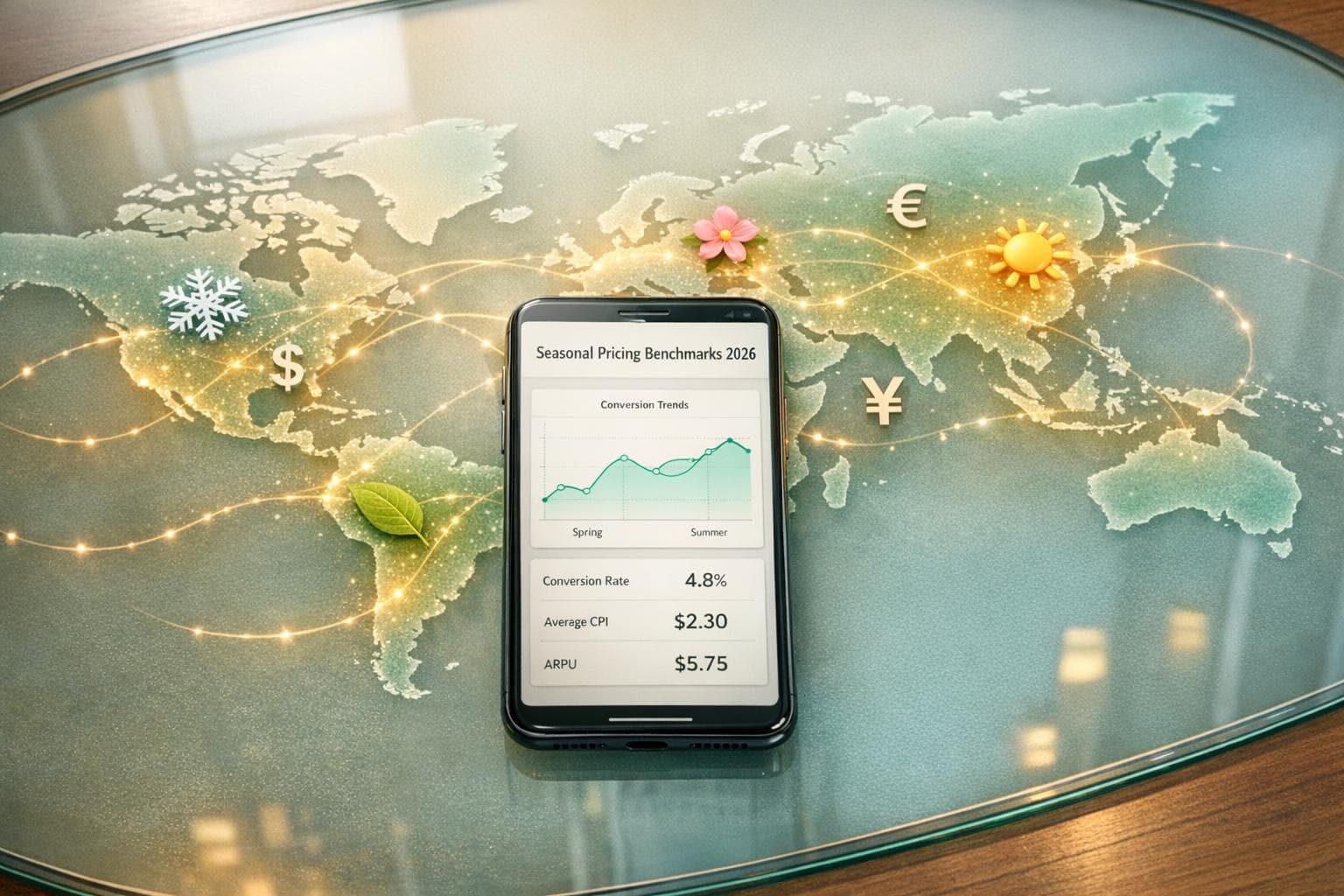
Seasonal pricing is a calendar. The apps that grow through Q4 and the New Year are not the ones cutting deepest. They are the ones that know when demand clusters, how deep to cut in each category, and how to layer a promotion on top of a price that already fits the local market. Get those three right and the season compounds. Get them wrong and you train users to wait for the next sale.
Here is what the 2026 benchmarks say, pulled together from RevenueCat, Adapty, RocketShip HQ, and Business of Apps.
The short version:
- Q4 holidays drive materially more installs and intent, with Black Friday conversion rates running 2.5 to 3.5 times higher than daily averages.
- Discounts are getting shallower on purpose. The average holiday subscription discount fell from 29.1% in 2024 to 26.2% in 2025 as teams chase profit over raw installs.
- Category matters more than the calendar. Health & Fitness peaks December 27 to January 15 on annual plans; gaming peaks on Black Friday weekly plans.
- Regional prices vary by up to 4x globally, so a single global discount is never the same offer in two countries.
- The winning move is to layer seasonal offers on top of localized pricing, not to run one flat sale everywhere.
The seasonal calendar: when demand actually clusters
App demand does not rise evenly. It concentrates into a handful of predictable windows, and each one rewards a different offer.
Q4 holidays (November 20 to December 26) are the most lucrative stretch of the year for subscription apps, but the winners treat the sale as a commitment device rather than a price cut. RocketShip HQ finds that for Black Friday and Cyber Monday, 40 to 50 percent off annual plans is the sweet spot. Discounts below 30 percent or above 60 percent both underperform. And annual promotional subscribers generate two to three times the lifetime revenue of subscribers who took a discounted monthly plan, because the annual commitment carries them past the month-two and month-three churn cliff.
The audience also shifts. From late November through December, gift buyers aged 35 to 55 become a primary segment. Annual gift subscriptions priced between $29.99 and $49.99 line up with the typical $45 to $65 gift budget, and framing like "9 months for the price of 12" sells the value without a discount deeper than 25 percent.
New Year (December 27 to January 15) is the most underused window on the calendar. As RocketShip HQ founder Shamanth Rao puts it, "The New Year window is arguably the most underutilized period for entertainment apps because most growth teams are on holiday break when they should be preparing campaigns for the January 1 to 7 install surge." Extended free trials of 14 to 21 days, aimed at resolution-driven users reorganizing their subscriptions, capture that early-January spike.
Back-to-school (August 15 to September 10) is a second surge for health, wellness, productivity, and education apps as users reset routines. US back-to-school retail spend is projected to hit $85.42 billion in 2026, and family or student plan promotions land well here. Education apps in particular convert on a delay: 23.5% of their trials start more than 31 days after install, so revenue often shows up weeks after the campaign ends.
Gaming and entertainment run on their own clock, peaking hard on the holiday gifting season. Players spent $6.98 billion on mobile games over the 2024 Christmas period, with US consumers alone contributing $2.2 billion on Black Friday.
How deep to discount, and why shallow is winning
The clearest 2026 shift is that bigger discounts stopped winning. The average holiday subscription discount dropped from 29.1% in 2024 to 26.2% in 2025, and brands that used targeted rather than blanket discounting grew 14% year over year. Over-cutting the annual plan is now the common mistake. As Reid DeRamus, founder of Caddie, warns, "If you discount the annual plan too much, you may sacrifice revenue from folks who would have likely paid more."
A useful baseline: annual plans already sit around 17% below the annualized cost of monthly, so a seasonal offer stacks on top of a standing discount. Premium positioning helps here too. Apps in higher price tiers see a 9.8% download-to-trial conversion rate versus 4.3% for lower-priced apps, so a modest discount on a confidently priced plan usually beats a steep cut on a cheap one.
Pricing shifts by app category
Seasonal strategy gets sharper when you price by category, not by calendar alone. The peak window, the plan that dominates, and the trial-to-paid rate all move by vertical.
| Category | Peak window | Dominant plan | Trial-to-paid |
|---|---|---|---|
| Health & Fitness | Dec 27 to Jan 15 | Annual (60.6% of revenue) | 35.0% |
| Gaming | Nov 20 to Dec 26 | Weekly (78%) | n/a |
| Education | Aug 15 to Sep 10 | Annual | High late-start rate |
| Productivity | Aug 15 to Sep 10 | Monthly / Annual | n/a |
Source: Adapty and Airbridge 2025 to 2026 data.
Health & Fitness is the one category where annual plans dominate, at 60.6% of revenue, and it has the highest trial-to-paid rate of any vertical at 35.0%. Its December-to-January peak lands users in a goal-setting, less price-sensitive mindset. Price sensitivity flips the strategy elsewhere: Utility apps see conversion drop 15 to 22% when prices rise, while Health and Productivity apps lose only 5 to 10% under the same move. That gap decides whether a category can hold a premium seasonal price or should lean on trials instead.
Structure the promotion, not just the price
How the offer is built matters as much as the number on it.
Lead with offer phases rather than promo codes for anything at scale. Offer phases are staged, paywall-visible sales that appear automatically to every user, which is what makes a Black Friday push scalable; promo codes are better kept for influencer deals and limited drops. A multi-phase structure works well over the holidays: a short free trial, then a discounted introductory price, then the standard plan, which gives the user time to see value while the limited-time framing creates urgency.
Offer three plans on the paywall. Weekly, monthly, and annual together drive the highest lifetime value in most categories, and weekly plans have grown to nearly half of all subscriptions, giving hesitant holiday shoppers a low-commitment way in. Trials remain the strongest lever: users who start on a trial carry a lifetime value up to 64% higher than those who do not. And since 82% of trial starts happen on the same day a user installs, the onboarding flow has to present the right plan immediately, not days later.
Regional benchmarks for 2026
The price gap between markets is almost always wider than teams expect. Subscription rates vary by up to four times from one country to another, so a single global price leaves money on the table in wealthy markets and prices out lower-income ones.
The global median subscription is roughly $7.48 weekly, $12.99 monthly, and $38.42 annually. In the US, prices run far higher, averaging $11.88 weekly, $17.53 monthly, and $103.76 annually. Europe has now passed North America as the most expensive region, with an 18% year-over-year rise, and charges 29 to 39% more than North American apps on average.
| Market | Avg. weekly | Avg. monthly | Avg. annual |
|---|---|---|---|
| United States | $11.88 | $17.53 | $103.76 |
| Global median | $7.48 | $12.99 | $38.42 |
Source: Business of Apps and Adapty 2025 to 2026 data.
At the country level the spread is stark. Dutch users pay 62% more than the US baseline on weekly plans, while Turkish users pay nearly 3.5 times less. Emerging markets are driving the fastest growth: Japan grew 88%, Mexico 82%, and Turkey 70% year over year, and non-gaming spend rose 31% in Brazil, 26% in Mexico, and 21% in South Korea. Yet 40% of brands still lean on static, automatic store localization, which leaves those surges uncaptured. This is why an emerging-market pricing plan pays off well beyond the holidays.
Layer seasonal offers on localized pricing, not on top of a flat price
Here is the move that ties the whole thing together: set the price to local spending power first, then run the seasonal promotion as a percentage on top of that localized base.
A $9.99 subscription feels trivial in New York and burdensome in Mumbai. Converting $19.99 straight to currency lands at roughly ₹1,660 in India, a meaningful share of monthly income there and a rounding error for a US user. Pricing to local affordability instead of exchange rates is what opens emerging markets, and it is the foundation a seasonal offer sits on. A practical starting structure groups markets into tiers:
| Tier | Market type | % of US price | Example regions |
|---|---|---|---|
| 1 | Developed | 100% | US, UK, Germany, Japan, Australia |
| 2 | Upper-middle | ~70% | Spain, Italy, Malaysia, Saudi Arabia |
| 3 | Mid | ~50% | Brazil, Mexico, Turkey, Thailand |
| 4 | Lower-middle | ~35% | India, Indonesia, Philippines, Vietnam |
| 5 | Lowest | ~25% | Pakistan, Nigeria, Bangladesh |
With that base in place, the seasonal layer becomes simple math. A Black Friday sale in the US can be mirrored by a Diwali promotion in India, each cut from a locally appropriate price. If the localized price is $6.00 and the holiday offer is 20%, the user pays $4.80, an offer that feels fair in-market instead of one that guts your margin. The period-tracking app Flo grew 80% in non-English-speaking markets by tailoring price and plan this way, with Brazil becoming its third-largest market. For the setup mechanics, see how to set up localized pricing and how localized pricing works on Google Play.
Test the season without wrecking your baseline
Benchmarks point the way; disciplined testing is what converts them to revenue. A few rules keep seasonal experiments honest:
- Judge on revenue, not conversion. A 10% drop in conversion is fine if ARPU climbs 30%. Apps that run regular pricing tests see 74% higher MRR than those that do not.
- Do not baseline-test during Black Friday. Peak-season behavior is noisy and will skew a test you plan to trust year-round. Run structural seasonal pricing tests before or after the spike.
- Give each variant room. Aim for at least 200 subscriptions per variant over a 2 to 4 week window, covering one trial period plus one renewal cycle, so the renewal signal is real.
- Isolate the market. Trial a change in one country while holding a comparable one steady, rather than moving everything at once. Our guide to A/B testing in-app purchase pricing walks through the setup.
One more discipline: separate a seasonal blip from a real trend. If revenue per install falls more than 30% while install rates hold, that is a pricing misalignment to fix, not seasonal noise to ride out. High-inflation markets like Turkey and Argentina warrant monthly reviews; stable markets like the US and the Eurozone can be checked semi-annually.
Where the pricing stack fits
Running all of this by hand on iOS, Android, and web means juggling App Store Connect, Google Play Console, billing tools, and spreadsheets. The cleaner setup splits the job in two layers.
Mirava is the pricing intelligence layer. It sets the right price per market using the Mirava Index, built on real digital-spending data from how users in each country actually pay for subscriptions, rather than GDP or a blunt purchasing-power multiplier. From there you push bulk updates in 170-plus countries, preview the revenue impact before shipping, run region tests, and route changes through team approval, with alerts when a price drifts from its target. Downstream, billing tools like RevenueCat, Adapty, Purchasely, and Superwall handle paywalls, entitlements, and transactions.
| Layer | Tool | Seasonal role |
|---|---|---|
| Pricing intelligence | Mirava | Recommends the right price per market |
| Billing & subscriptions | RevenueCat, Adapty | Trials, entitlements, transactions |
| Paywalls | Purchasely, Superwall | Renders prices and seasonal offers |
That division is what lets a seasonal price change roll out consistently everywhere without touching subscription logic. For a wider view of the tooling, see the best mobile app pricing tools for developers.
Seasonal pricing strategies thrive on dynamic adjustments informed by data. Apps that embrace continuous experimentation see substantial gains. Data from 2026 reveals that apps conducting over 50 pricing experiments annually generate 18.7× more revenue compared to those that stick to a single test. Additionally, developers utilizing dynamic pricing systems significantly outperform those relying on static pricing models [3][6].
Seasonal pricing rewards system design over discount depth. Know the four windows, discount the annual plan rather than the monthly one, price to each market before you layer a promo on top, and test on revenue instead of conversion. Do that, and the season stops being a race to the bottom and starts compounding into the year that follows.
FAQs
When should my app run seasonal price changes?
The four windows that reliably move revenue are the Q4 holiday run (November 20 to December 26), New Year resets (December 27 to January 15), back-to-school (August 15 to September 10), and early-summer habit-forming (late May to mid-June). Beyond those, refresh regional prices every 30 to 90 days so they stay aligned with local spending and currency shifts.
Should I discount annual or monthly plans for Black Friday?
Discount the annual plan. RocketShip HQ finds annual promotional subscribers generate two to three times the lifetime revenue of subscribers on discounted monthly plans, because the yearly commitment carries them through the month-two and month-three churn window. A 40 to 50 percent annual discount tends to be the sweet spot; deeper cuts attract low-value users, and shallower ones convert weakly.
How do I combine a seasonal promo with localized pricing without losing revenue?
Set the base price to local spending power first, then apply the seasonal discount as a percentage on top of that localized base. If the localized price is $6.00 and you run a 20 percent holiday offer, the user pays $4.80, which stays fair in that market instead of collapsing your margin. Get the localized baseline right before layering any promo.
How do I set different prices per country without breaking existing subscriptions?
Existing subscribers keep the price they signed up at; a price change only affects new purchases and renewals per each store's rules. Use a pricing intelligence layer like Mirava to decide the right price per market, then let your billing tool (RevenueCat, Adapty, Purchasely, or Superwall) apply it. That keeps subscription logic untouched while prices update in 170-plus countries.