
Pricing psychology matters. Whether you use $9.99 or $10.00 can influence how customers perceive your product. Charm pricing ($9.99) feels cheaper due to the left-digit bias, but it can also imply lower quality. Round pricing ($10.00) signals trust and premium value, especially for higher-end products. The best strategy depends on your market and audience.
Key takeaways:
- Charm pricing works well in the U.S. and Canada, where 60–70% of prices end in 9.
- Round pricing dominates in Japan, South Korea, and Germany, where clarity and simplicity are preferred.
- Regional norms like lucky numbers in China (e.g., 8) or ₹999 in India can significantly impact sales, especially when following an emerging market app pricing playbook.
- Tools like Mirava help optimize pricing globally, ensuring localized price points align with consumer expectations.
Quick Comparison:
| Region | Preferred Style | Key Reason |
|---|---|---|
| United States/Canada | Charm (.99) | Left-digit bias |
| Germany/Nordics | Round (.00) | Clarity and trust |
| Japan/South Korea | Round (100s/1,000s) | Simplicity |
| China | Lucky numbers (8) | Prosperity symbolism |
| India | Charm (₹999) | Market convention |
| Latin America | Round | Economic stability |
| Middle East | Round | Subscription predictability |
Strategic pricing localization can improve conversions by 5–20% by building trust and reducing drop-offs. Platforms like RevenueCat and Adapty handle billing, but upstream tools like Mirava ensure your pricing is optimized for each market.
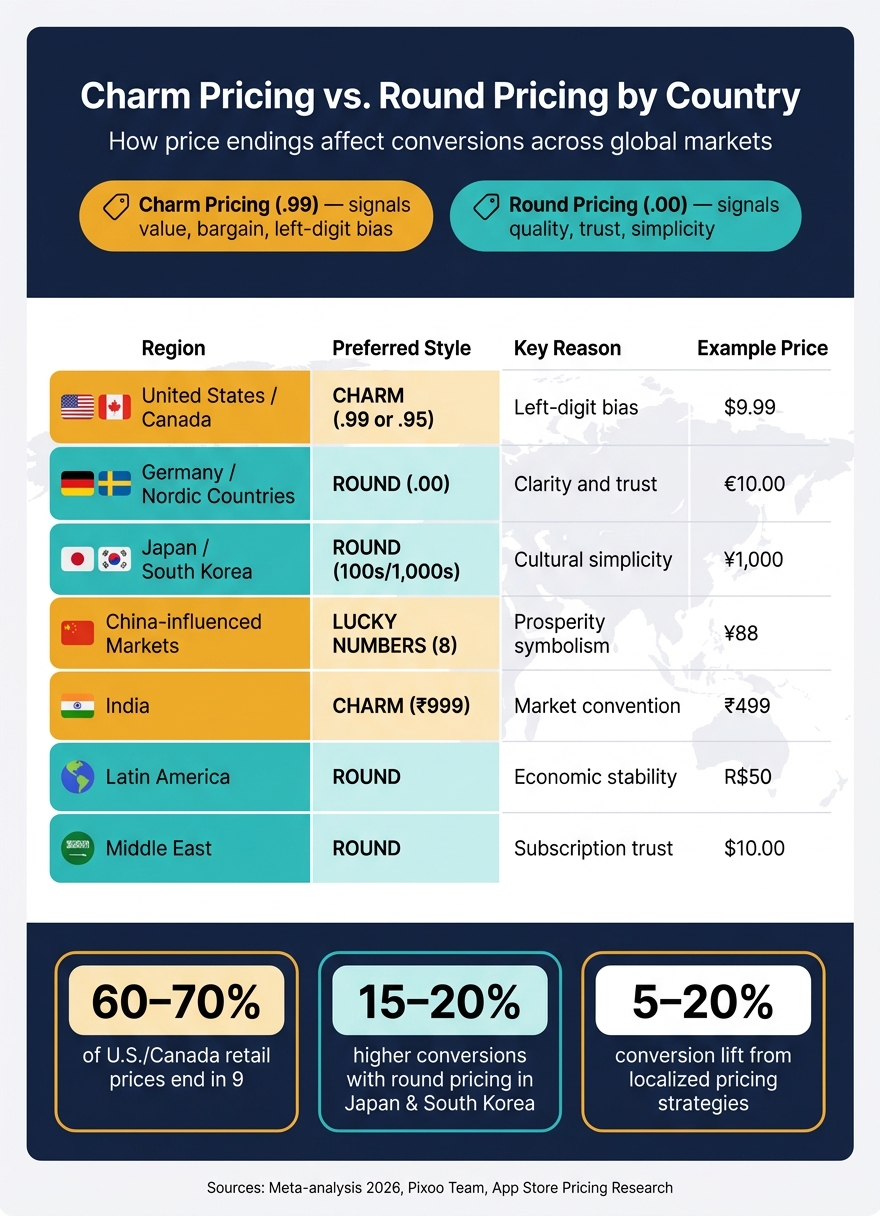
Charm vs. Round Pricing by Country: Global Pricing Psychology Map
#57: Charm Pricing: The greatest trick in marketing?
sbb-itb-43fe43a
Charm Pricing and Round Pricing Explained
These two pricing strategies take opposite approaches to influence consumer perception. Charm pricing uses endings like $9.99, $9.95, or $9.49 to make prices seem lower than they actually are. On the other hand, round pricing opts for clean, whole numbers like $10 or $50, aiming to convey simplicity and confidence. Both methods can be effective when tailored to the right market and product.
Charm Pricing: Why $9.99 Feels Cheaper Than $10
Charm pricing plays on the left-digit effect, where prices such as $9.99 feel significantly cheaper than $10, even though the difference is just one cent. This psychological bias is especially powerful when prices are displayed side-by-side, like on a paywall or comparison page [8].
But there’s a downside. A 2026 meta-analysis revealed that while 9-ending prices improve price perception slightly (g = 0.28, p = 0.007) [3], they also tend to be associated with lower quality. For instance, $9.99 might signal a good deal, but it can also imply a less premium product - this trade-off is crucial for brands positioning themselves as high-end.
Additionally, charm pricing loses its edge at higher price points. For subscription services priced above $10 per month, the psychological impact of a .99 ending diminishes. For example, the difference between $49.99 and $50 is negligible to most consumers. In such cases, round pricing can be a better fit.
Round Pricing: Clarity, Simplicity, and Premium Appeal
Round pricing, which uses numbers like $10, $25, or $100, appeals to consumers by creating a sense of ease and clarity. As Fenneman A. et al. explained, “Rounded prices are easier to process, making them feel 'right.'” This ease of processing strengthens associations with trust, quality, and reliability.
This strategy works particularly well for premium products, enterprise services, and offerings where quality perception is key. Research indicates that consumers often associate round prices with high-stakes purchases where trust and craftsmanship are critical [9].
Here’s a quick comparison of the two methods:
| Charm Pricing (.99) | Round Pricing (.00) | |
|---|---|---|
| Primary Signal | Value, discount, bargain [3] | Quality, premium, reliability [9] |
| Best Digital Use Case | Impulse in-app purchases, entry-level tiers | Enterprise SaaS, flagship products |
| Cognitive Process | Left-digit bias [8] | Processing fluency |
| Main Risk | May dilute brand quality perception [3] | Might appear too expensive for value-seekers |
Choosing between charm pricing and round pricing depends on your product's positioning and your audience's expectations. A thoughtful pricing strategy tailored to specific markets and consumer behaviors can make all the difference.
Charm Pricing vs. Round Pricing by Region
Regional norms significantly influence how price endings resonate with consumers. Here's a closer look at how charm and round pricing perform in various global markets.
North America: The Power of Charm Pricing
In the U.S. and Canada, charm pricing reigns supreme. This strategy is a core component of localized pricing in the App Store and other digital marketplaces. Studies reveal that 60–70% of retail prices in these regions end in the digit 9 [1]. This is largely due to the psychological effect known as left-digit bias, where shoppers focus on the first number of a price. For instance, $19.99 is perceived as "19" rather than "20", making it feel like a deal. However, in premium price tiers, round pricing (e.g., $50 instead of $49.99) is often preferred as it conveys quality and sophistication.
Europe: Preferences Vary Across Borders
Western Europe showcases a mix of pricing tendencies. While charm pricing works well in France and Italy, countries like Germany and those in the Nordic region lean toward round numbers. This preference stems from an emphasis on clarity and trust. For example, €10.00 is often seen as more transparent and reliable than €9.99. In Switzerland, rounded prices such as CHF 15.00 or CHF 15.50 are more common than CHF 14.99.
Asia: Favoring Round Numbers and Symbolism
In Asia, round pricing often takes precedence. In Japan and South Korea, for example, rounded prices like ¥1,000 instead of ¥999 lead to 15–20% higher conversion rates [1]. These markets avoid decimals, instead rounding to the nearest 100 or 1,000, which aligns with their cultural preference for simplicity. As noted by the Pixoo Team:
"Charm pricing (.99 endings) increases conversions in Western markets but can damage sales in Asia." - Pixoo Team [1]
In Chinese-influenced markets, number symbolism further shapes pricing strategies. The number 8, associated with prosperity, makes prices like ¥8 or ¥88 particularly appealing. Conversely, the number 4 is avoided due to its phonetic similarity to the word for death [1].
Emerging Markets: Tailored Approaches to Price Sensitivity
Emerging markets like India, Latin America, and the Middle East each bring unique pricing dynamics. In India, ₹999 is a widely accepted charm price for larger amounts, while smaller values often feature whole numbers or .50 endings. In Latin America, high inflation in countries like Brazil and Argentina has driven a preference for round, stable prices. For instance, in Brazil, prices often use a comma as the decimal separator (e.g., R$19,99) to maintain authenticity. Meanwhile, in the Middle East, round pricing fosters trust in recurring subscriptions by offering predictability.
| Region | Preferred Style | Key Reason |
|---|---|---|
| United States / Canada | Charm (.99 or .95) | Left-digit bias |
| Germany / Nordic Countries | Round (.00) | Clarity and trust |
| Japan / South Korea | Round (100s/1,000s) | Cultural simplicity |
| China-influenced Markets | Lucky numbers (e.g., 8) | Prosperity symbolism |
| India | Charm (₹999) | Market convention |
| Latin America | Round | Economic stability |
| Middle East | Round | Subscription trust |
How to Test and Refine Pricing by Country
Setting Up Country-Specific A/B Price Tests
When testing pricing strategies, grouping countries with similar economic conditions and subscription behaviors can simplify the process and yield actionable insights. For instance, you might group Germany, Austria, and Switzerland together, or the U.S., Canada, and Australia into another band, instead of running separate tests for every country [11].
Each test should include a control group (current price) and a variant (alternative price ending). Before starting, establish your Minimum Detectable Effect (MDE), typically a 5–10% change in conversion rate, and aim for at least a 90% confidence level before interpreting results [14]. Key metrics to monitor include conversion rates, ARPPU (Average Revenue Per Paying User), total revenue, and retention rates. In regions where consumers are more price-sensitive, higher conversion rates may balance out lower ARPPU [6].
Be cautious of the novelty effect, where users initially respond positively to a new price simply because it’s different. To ensure any gains are sustainable, run tests for a sufficient duration - Google Play experiments, for example, can last up to six months [14]. For smaller markets with limited traffic, consider reducing the number of test variants or grouping similar countries to achieve statistical significance more quickly.
Once your tests are complete, consider using pricing intelligence tools to automate regional adjustments and maintain optimized pricing over time.
Using Pricing Intelligence Tools
Managing prices manually across more than 170 countries is impractical. A price like $9.99 in the U.S. might convert to an awkward ₱202.33 in the Philippines, which could negatively impact conversions [5]. Automated tools simplify this by applying psychological rounding to ensure prices feel natural in each market - for example, using .99 endings in North America or whole numbers in Japan.
To streamline regional pricing adjustments, tools like Mirava can apply custom rounding rules at scale. Developers can set parameters - such as minimum and maximum thresholds and rounding preferences - and Mirava ensures these rules are implemented globally, even as exchange rates fluctuate. Without this, currency shifts can turn a carefully chosen charm price into an ineffective one over time [6]. Positioned upstream from subscription management platforms like RevenueCat, Adapty, Purchasely, and Superwall, Mirava determines the best price for each region, while those tools handle billing, paywalls, and entitlements [13][15].
"Local pricing outperforms flat global pricing Every. Single. Time." - Mirava [6]
Localized pricing is consistently effective: apps that move from a single global price to prices aligned with local purchasing power often see meaningful gains in subscriptions and conversions, particularly in price-sensitive regions like Latin America and Southeast Asia. By combining intelligent pricing techniques with partners like RevenueCat, Adapty, Purchasely, and Superwall, developers can ensure optimized prices are seamlessly delivered through their billing and paywall systems.
Applying Pricing Decisions in App Stores
When refining app store pricing strategies, it’s essential to adapt them to local market norms and expectations.
Aligning Price Endings with Store Price Tiers
Once you’ve identified a market's preferred pricing patterns, the next step is to align these with the app store’s pricing framework.
Apple operates with a structured price ladder that includes roughly 900 fixed price points per currency across 175 storefronts. These tiers feature small increments - $0.10 steps up to $10 and $0.50 steps between $10 and $50. This setup allows for flexibility at lower price ranges but limits options at higher amounts, making it harder to achieve precise psychological price endings.
Google Play, on the other hand, offers greater flexibility by accepting any local currency amount, enabling developers to use specific price points like ₺449 in Turkey or R$49,90 in Brazil without being restricted by predefined tiers.
It’s worth noting that Apple doesn’t automatically adjust subscription prices for changes in exchange rates or taxes. For instance, if you set a price like ¥1,000 or ₹499, it will remain unchanged until you manually update it. This became evident in January 2026 when Apple revised tax and pricing rules in nine countries - introducing a 4-point VAT increase in Kazakhstan and a new 15% VAT in Mauritius - leaving many developers unprepared. For markets with stable currencies like the United States, United Kingdom, and the Eurozone, quarterly price reviews are typically sufficient. However, in high-volatility regions such as Turkey or Argentina, monthly reviews are often necessary.
Auto conversion is just currency math; real localization is a pricing strategy that accounts for what each market can actually bear.
These platform-specific pricing considerations naturally lead to tier-specific strategies.
Matching Price Endings to Plan Tiers
For pricing plans, charm pricing works well for entry-level options, while rounded prices are better suited for premium tiers[5]. For example, a $9.99 monthly starter plan can help reduce the perceived cost barrier, while a $50 or $100 annual plan emphasizes its premium value.
This approach, however, needs to be adjusted for regional norms. In the United States, prices ending in .99 are common practice. In Japan, decimals are rarely used, and rounded figures like ¥500 or ¥1,000 are standard for all tiers. India follows the 99-ending pattern for higher amounts, such as ₹499 or ₹999. In Brazil, prices use a comma as the decimal separator (e.g., R$19,99), while in Turkey, rounded figures like ₺149 or ₺449 are preferred, reflecting the region’s economic volatility.
Here’s a quick overview of pricing conventions by market:
| Market | Entry-Level (Charm) | Premium Tier (Round) | Note |
|---|---|---|---|
| United States | $9.99 | $50 or $100 | Standard .99 convention |
| Japan | ¥500 | ¥1,000 | No decimals; round to the nearest hundred or thousand |
| India | ₹499 | ₹999 | Use 99 endings for larger amounts |
| Brazil | R$19,99 | R$49,90 | Comma as decimal separator |
| Turkey | ₺149 | ₺449 | Round tens, reflecting market volatility |
Carefully review pricing thresholds to ensure you don’t unintentionally exceed psychological limits.
Advanced pricing tools can make these adjustments more manageable. Mirava, for instance, offers upstream pricing intelligence that works seamlessly with tools like RevenueCat, Adapty, Purchasely, and Superwall, which handle billing and paywall management.
Conclusion: Picking the Right Price Ending for Each Market
Pricing strategies resonate differently across global markets. In the US, Canada, and the UK, charm pricing - like $9.99 - is second nature to consumers, who not only expect it but often respond positively to it. Meanwhile, in Japan, ¥999 feels awkward, whereas ¥1,000 appears more natural. In China, the number 8 is associated with prosperity and is favored for pricing, while 4 is avoided due to its negative connotations. These subtle cultural preferences can have a direct effect on conversion rates.
The difference between well-aligned and poorly aligned pricing strategies is quantifiable. Tailoring prices to local expectations has been shown to improve conversions by 5–20% [1], as evidenced in markets like Japan. This highlights the importance of understanding and respecting regional pricing norms.
Successfully managing these regional nuances requires more than simple currency conversions. Tools like Mirava streamline this process by delivering regionally optimized prices that incorporate psychological rounding and cultural logic. Positioned upstream of platforms like RevenueCat, Adapty, Purchasely, and Superwall, Mirava ensures pricing strategies are deliberate and well-structured. As Mirava aptly describes it: "Numbers follow a clear internal logic, instead of a mix of legacy experiments and rushed edits." [5] Once these prices are finalized, tools such as RevenueCat, Adapty, Purchasely, and Superwall handle the downstream processes of billing, paywalls, and entitlements.
FAQs
How do I know when to use $9.99 vs $10.00 in each country?
When deciding between charm pricing (e.g., $9.99) and round pricing (e.g., $10.00), it’s essential to consider factors like local market preferences, consumer purchasing power, and how you want your brand to be perceived. In some regions, charm pricing is associated with bargains and affordability, while round pricing often conveys a sense of quality and exclusivity.
Mirava simplifies this process by applying region-specific rounding across your entire catalog. Tools like RevenueCat, Adapty, Purchasely, and Superwall complement this by managing billing and paywall integrations effortlessly.
Do .99 endings hurt premium brands outside the U.S. and Canada?
Yes, pricing that ends in .99 can negatively affect how premium brands are perceived in various regions beyond North America and the UK. While charm pricing often signals a bargain in Western markets, many other areas associate rounded numbers with sophistication and high quality. For example, this is particularly true in Japan, Nordic countries, and the Middle East. To align with these regional preferences, consider using Mirava for tailored pricing strategies, while leveraging tools like RevenueCat, Adapty, Purchasely, or Superwall for handling billing and paywall implementation.
What’s the simplest way to A/B test country-specific price endings in app stores?
The simplest approach is to use a pricing intelligence platform such as Mirava. Mirava determines the best regional prices, factoring in psychological pricing strategies. Meanwhile, tools like RevenueCat, Adapty, Purchasely, and Superwall take care of billing, paywall management, and entitlements.
For Android, the Google Play Console allows price experiments for one-time purchases, though subscriptions are not included. On iOS, pricing adjustments can be made directly in the console, eliminating the need for code changes and enabling a focus on impactful regional pricing differences.