Bundling strategies are reshaping how subscription services retain customers and drive revenue. With churn rates for streaming platforms climbing from 2% in 2019 to 5.5% by 2025, bundling has proven to reduce churn by 34% on average - and in some cases, by as much as 70%. Major players like Netflix, Spotify, Apple, and YouTube are using tailored bundles to address pricing concerns, attract new users, and boost lifetime value. Here's what you need to know:
- Netflix: Focuses on ad-supported tiers, regional pricing, and partnerships with ISPs for discounted bundles like Xfinity's $15 package (Netflix, Peacock, Apple TV+).
- Spotify: Offers Premium tiers (Student, Duo, Family) with perks like Hulu access for students and regional pricing as low as $1.16/month in Nigeria.
- Apple One: Simplifies subscriptions with three tiers, saving users up to $29/month by bundling services like iCloud, Apple Music, and Apple TV+.
- YouTube Premium: Combines ad-free video and YouTube Music with flexible plans, including a $7.99 Lite option and regional pricing starting at $0.90/month.
Quick Comparison
| Platform | Key Features | Price Range (USD) | Regional Pricing Example |
|---|---|---|---|
| Netflix | Ad tiers, ISP bundles, mobile-only plans in India | $2.70–$26.99 | $26.99 (US), $6.50 (India) |
| Spotify | Freemium model, Family plan, Hulu for students | $1.16–$19.94 | $1.16 (Nigeria), $12.99 (US) |
| Apple One | Bundles iCloud, Music, TV+, Arcade, Fitness+ | $19.95–$37.95 | $19.95 (Individual, US) |
| YouTube | Ad-free video, Music Premium, Lite & Family plans | $0.90–$27.99 | $0.90 (Argentina), $13.99 (US) |
The key takeaway? Bundling works best when it aligns with user needs, regional affordability, and perceived value. For app developers, tools like Mirava can help fine-tune pricing strategies by analyzing user behavior and local market data, ensuring bundles drive retention and long-term growth.
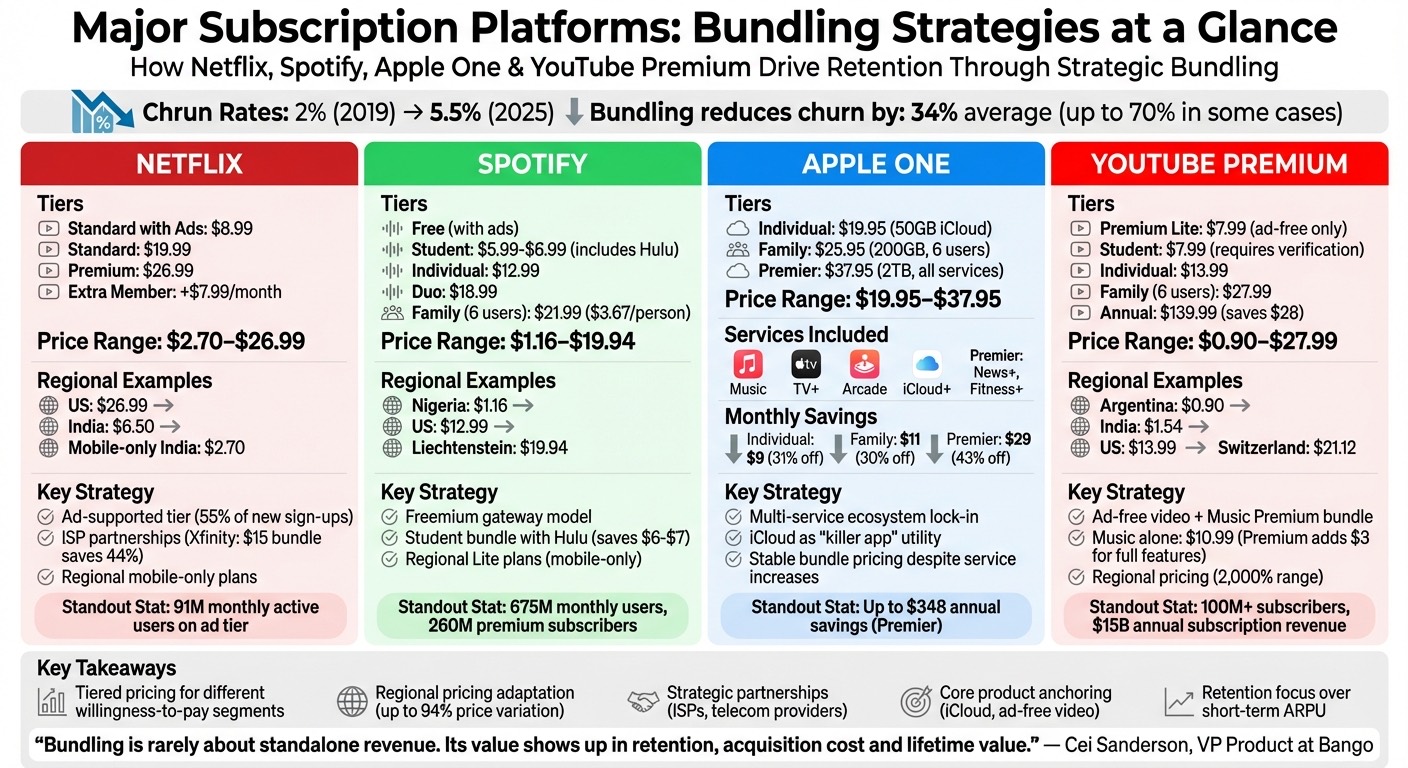
Subscription Bundling Strategies Comparison: Netflix, Spotify, Apple One & YouTube Premium
1. Netflix Bundling Approach
Tiers Offered
Netflix currently provides three subscription options: Standard with Ads, Standard, and Premium. After discontinuing its "Basic" plan in 2023, Netflix now prices these tiers at $8.99, $19.99, and $26.99 respectively (as of March 26, 2026) [9]. The ad-supported tier has seen rapid adoption, accounting for 55% of new sign-ups in Q1 2025 and attracting 91 million monthly active users [8].
Instead of traditional family plans, Netflix has opted for a different approach to monetize account sharing. Subscribers can add individuals outside their primary household by purchasing "Extra Member" slots for $7.99 per month each [3]. This strategy is further tailored to fit the dynamics of different regional markets.
Regional Adaptations
Netflix’s pricing varies significantly across regions. For example, the Premium plan costs $26.99 in the US, but only $6.50 in India and $8.50 in Brazil [3]. In India, Netflix has also introduced mobile-only plans priced at approximately $2.70 per month, which drove nearly 50% of new subscriber additions in the first quarter after their launch [5].
To make inroads into price-sensitive markets, Netflix has partnered with telecom providers. In India, a collaboration with Reliance Jio integrated Netflix into Jio's premium fiber and mobile plans, leveraging Jio's extensive customer network [5][6]. Similar partnerships with Vodafone and Airtel in India, and with LG Electronics for prepaid Netflix services across Asia, Europe, and the Middle East, have helped Netflix expand its presence in emerging markets [6][7].
Price Discounts
Netflix also employs discounted pricing through third-party partnerships to complement its tiered and regional strategies. Rather than offering direct bundles, Netflix collaborates with ISPs and mobile carriers. For instance, the Xfinity StreamSaver bundle, launched in May 2024, includes Netflix, Peacock, and Apple TV+ for $15 per month - a 44% discount compared to standalone subscriptions [10]. Similarly, Verizon offers a Netflix + Max bundle for $10 per month, saving users around $8 or 44% off individual pricing [10]. T-Mobile includes Netflix Standard with Ads at no additional cost in its Go5G Next and Plus wireless plans, though these plans typically require service packages costing $85–$100+ per month [3][10].
"People who get streaming services by signing up via broadband companies like Comcast or Verizon are much less likely to stop and start their subscriptions." – Peter Kafka, Chief Correspondent [4]
sbb-itb-43fe43a
2. Spotify Bundling Approach
Tiers Offered
Spotify uses bundling as a key strategy to improve both user retention and revenue. Its freemium model includes a Free tier with limited features and four Premium tiers - Student, Individual, Duo, and Family. As of early 2026, Spotify serves 675 million monthly users. The Free tier, updated in September 2025 to allow on-demand playback on mobile, acts as a gateway to the more feature-rich Premium plans. Premium subscribers enjoy benefits such as ad-free listening, offline downloads (up to 10,000 tracks across 5 devices), 15 monthly audiobook hours, and complimentary lossless audio. The Family plan, which supports up to six accounts, offers a significant cost advantage, bringing the per-person price down to approximately $3.67 when fully utilized, compared to the $12.99 Individual plan [11].
Price Discounts
Spotify offers targeted discounts to specific user groups. For instance, the Student plan is bundled with Hulu (With Ads) and priced between $5.99 and $6.99, saving students about $6–$7 monthly compared to the Individual plan [11][12]. For multi-user plans like Duo and Family, Spotify enforces address verification using Google Maps. Users who fail to verify within seven days face a 12-month lockout. Among multi-user options, the Duo plan at $18.99 is more economical for two users than the Family plan at $21.99 [11]. These pricing structures are carefully tailored across different regions to maximize appeal.
Regional Adaptations
Spotify’s pricing varies significantly by region, with differences reaching up to 94%. For example, Nigeria offers the lowest-cost Individual plan at $1.16 per month, while Liechtenstein tops the chart at $19.94. In comparison, the U.S. price sits at $12.99. To cater to emerging markets, Spotify has introduced Lite - a mobile-only plan without offline downloads, designed to lower entry barriers [13].
"The subscription is no longer a single news product. It is a structured package of use cases designed to increase frequency of use."
– Greg Piechota, Researcher-in-Residence, INMA [2]
Even with price hikes of 8–12% (around $1–$2) across major markets in 2025–2026, Spotify maintained subscriber stability. This was achieved by aligning the increases with the launch of lossless audio, contributing to a 10% quarterly revenue growth [14].
Spotify’s bundling and pricing strategies offer valuable lessons for mobile app developers. By applying similar data-driven methods and leveraging pricing intelligence platforms like Mirava () - which updates prices at the store level, read automatically by tools such as RevenueCat, Adapty, Purchasely, and Superwall - developers can refine their subscription models and enhance their offerings.
3. Apple One Bundling Approach
Tiers Offered
Apple One simplifies its subscription offerings with three distinct tiers. The Individual plan, priced at $19.95 per month, is tailored for single users and includes Apple Music, Apple TV+, Apple Arcade, and 50GB of iCloud+ storage. The Family plan, at $25.95 per month, extends these benefits to up to six users with 200GB of iCloud+ storage, taking advantage of Apple's Family Sharing feature. For those seeking the most comprehensive package, the Premier tier costs $37.95 per month and adds Apple News+, Apple Fitness+, and 2TB of iCloud+ storage - perfect for families or heavy users [15].
While all tiers include core entertainment services, the Premier plan is only available in regions where Apple News+ is offered, such as the United States, United Kingdom, Canada, and Australia [16]. Apple further simplifies the decision-making process by recommending the most cost-effective bundled plan when users attempt to subscribe to individual services [15]. This strategy not only consolidates access but also delivers clear financial benefits.
Price Discounts
The bundled pricing structure offers compelling savings compared to subscribing to individual services. The Individual plan provides a monthly discount of approximately $9 (31%), while the Family plan saves users around $11 per month (30%). The Premier tier delivers the largest savings - about $29 per month, equating to a 43% discount or $348 annually [16][18].
"Apple One bundles multiple subscriptions into one payment plan... streaming costs keep rising, making bundling more attractive than ever." – Daniel Harris, Specialist Journalist, Red94 [18]
A 30-day free trial for any bundled service users haven’t previously subscribed to adds further appeal. Notably, Apple has maintained stable bundle pricing even when individual service costs have risen. For instance, when Apple TV+ increased from $9.99 to $12.99 in August 2025, Apple One pricing remained unchanged [15][16][18].
Regional Adaptations
Apple One adapts its offerings to regional preferences. In the United States, subscribers enjoy exclusive sports content, including MLB Friday Night Baseball and the "MLB Big Inning" highlights and analysis show [16]. For those needing additional storage, Apple allows users to purchase up to 12TB of extra iCloud space, which, when combined with the Premier plan’s 2TB, totals a maximum of 14TB [16].
Apple’s pricing strategy has also evolved over time. Adjustments in October 2022 and November 2023 allowed the company to absorb individual service price hikes within the bundle structure, helping to retain customers [16]. Similar to Netflix and Spotify, Apple employs localized pricing to ensure its subscriptions remain attractive across different markets.
4. YouTube Premium Bundling Approach
Tiers Offered
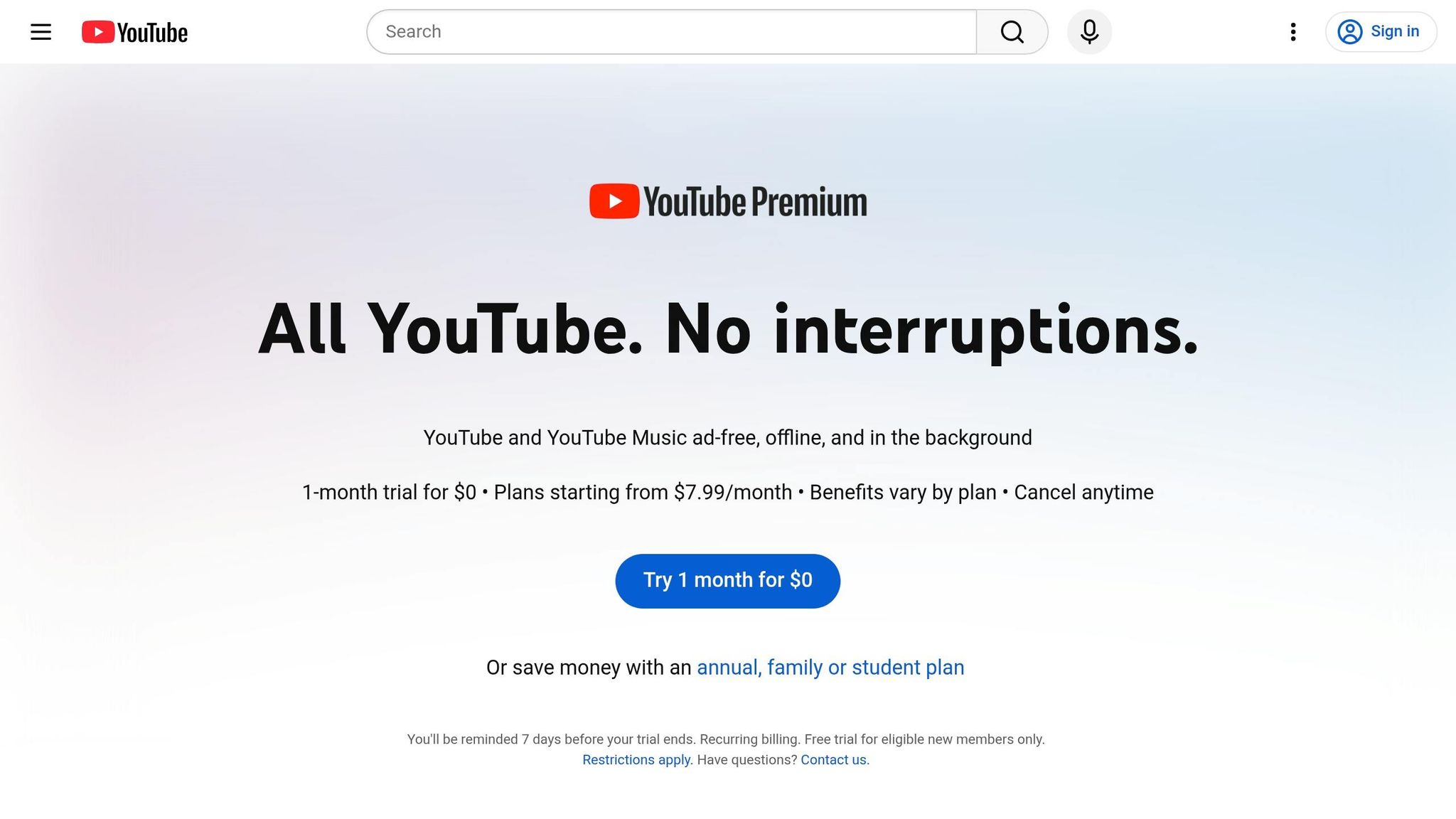
YouTube Premium provides several subscription options tailored to different needs. The Individual plan, priced at $13.99 per month, includes ad-free viewing, background play, offline downloads, YouTube Music Premium, and an enhanced 1080p video bitrate. The Family plan, costing $27.99 per month, extends these benefits to up to six household members aged 13 and older. For students, the Student plan is available at $7.99 per month, though annual verification through SheerID is now required. Starting January 2026, student plans that are not re-verified will automatically switch to full-price Individual plans [20].
A more streamlined option, Premium Lite, is offered at $7.99 per month. This plan focuses on ad-free video but excludes YouTube Music, downloads, and background play. It is currently available in over 22 countries, including the US, UK, and Japan [20]. Additionally, YouTube is trialing a Two-Person plan in markets like India, France, Taiwan, and Hong Kong, priced at approximately $16.00 per month. This tier is aimed at couples or roommates who find the Family plan unnecessary [19][20]. For those seeking long-term savings, the Individual Annual plan costs $139.99 per year, offering a $28 discount compared to monthly payments [20]. YouTube also adapts its pricing and tier options to fit local market conditions.
These diverse plans allow YouTube to cater to a wide audience while offering strategic discounts that enhance the service's appeal.
Price Discounts
The bundling strategy behind YouTube Premium delivers strong value. YouTube Music Premium alone costs $10.99 per month, so upgrading to the full Premium package adds benefits like ad-free video, background play, and downloads for just $3 more [20]. The Family plan becomes especially economical when three or more members use it, and the Student plan offers a discount of 40–50% compared to Individual pricing [22].
By early 2026, YouTube Premium had surpassed 100 million subscribers globally, with subscription revenue estimated at $15 billion annually by late 2024 [19][21]. Combined with ad revenue, YouTube's total income exceeded $50 billion over a four-quarter period ending in late 2024 [21].
Regional Adaptations
YouTube adjusts its pricing significantly across regions to reflect local purchasing power. The Individual plan ranges from as low as $0.90 in Argentina and $1.54 in India to $13.99 in the United States and $21.12 in Switzerland - a price range that spans over 2,000% [19][20].
"YouTube sets prices based on local purchasing power and currency values." – Andre Smith [20]
To maintain these localized pricing strategies, YouTube enforces strict measures to prevent abuse through VPN-based regional pricing [20]. The company has also expanded its Premium Lite tier to more countries and recently increased European Family plan prices from €23.99 to €29.99, reflecting added features [19].
Mastering the Art of Product Bundling | Marcos Rivera (Pricing I/O)
Strengths and Weaknesses
Every platform's bundling approach showcases distinct priorities and compromises. The table below highlights the strengths and weaknesses of Netflix, Spotify, Apple One, and YouTube Premium.
| Competitor | Strengths | Weaknesses |
|---|---|---|
| Netflix | Industry-leading recommendation algorithm with 1,300 clusters; global presence in 190+ countries; prestige international originals; ad-supported tier reached 94 million global monthly active users in Q2 2025 [23][25]. | High debt levels; lacks non-video perks (e.g., shipping or cloud storage); frequent price increases drive 42% churn intent among U.S. users; high show cancellation rate undermines content investment [23][24][25]. |
| Spotify | Market leader with 260 million premium subscribers; achieved first annual operating profit in 2024; curated playlists and listening history build high switching costs [26]. | Cluttered interface due to heavy promotion of podcasts and audiobooks; delayed HiFi/lossless audio for years while competitors offer it for free; price hike from $9.99 to $12.99 tests user loyalty [26]. |
| Apple One | Seamless integration across Music, TV+, Arcade, News+, Fitness+, and iCloud; Individual and Premier plans save users $9 and $29 monthly, respectively; iCloud is a key family utility [17][27]. | Lacks a dominant entertainment driver - Apple Music lags Spotify, and TV+ is still growing; limited to Apple hardware, raising concerns about anti-competitive lock-in [17][27]. |
| YouTube Premium | Combines ad-free video viewing with YouTube Music Premium for an integrated experience [27]. | Free tier lacks background play, making user conversion difficult; most subscribers are motivated by video benefits rather than music-first interest [27]. |
Contextual Analysis
Netflix's strengths lie in its advanced personalization capabilities and vast global reach. However, its 2025 operating margin of 29% comes with significant debt and frequent show cancellations, which can erode subscriber trust over time [25].
Spotify has leveraged its audiobook bundling to support recent price increases. Emma Rogers of WebProNews described this approach as:
"Many subscribers view this bundling as a Trojan horse - a way for Spotify to justify price increases by pointing to 'added value' that a significant portion of its user base never requested"
[26]. This highlights the delicate balance required between adding services and maintaining user-friendly pricing.
Apple One offers real savings for users who engage with multiple services. Yet, as CNET noted:
"the Apple One bundle's real killer app is its least sexy service [iCloud]"
[17]. This underscores how practical utilities like cloud storage can drive value in multi-service bundles, even if entertainment offerings are not the primary draw.
YouTube Premium emphasizes ad-free video and YouTube Music Premium. However, its restrictive free tier, which lacks background play, limits its ability to convert users to paid plans. This demonstrates how overly restrictive free options can hinder premium adoption [27].
These examples show how bundling strategies must carefully align with user preferences, perceived value, and pricing sensitivity across different markets.
Conclusion
Competitor bundling strategies emphasize that focusing on retention creates long-term value. Bundling has proven to significantly reduce churn, as evidenced by leading examples in the industry [1][2]. A standout case is The New York Times, where bundle subscribers account for approximately 71% of subscription revenue. Despite slightly lower ARPU, their lifetime value is 60% higher ($566 vs. $351) [2]. This demonstrates how a few key tactics can drive meaningful results.
These results stem from three main approaches: anchoring bundles with core products (like iCloud in Apple One or ad-free video in YouTube Premium), using tiered pricing to appeal to different willingness-to-pay segments, and incorporating habit-forming features to boost engagement.
Regional pricing adds another layer of complexity. Multi-party bundles, such as Sky's £24/month offering (which includes Netflix, Disney+, HBO Max, and Hayu), require careful modeling of wholesale costs and territory-specific rights [1]. For developers, tools like Mirava provide critical pricing intelligence to set regionally optimized price points. Billing platforms like RevenueCat and Adapty then read those updated store prices automatically for seamless execution.
To refine your bundling strategy, start with low-cost trials to establish a paid mindset, then adjust prices based on user engagement [2]. Family plans can help capture household value without requiring additional content, while modular "core + slot" structures allow users to personalize their bundles. Success should be measured by retention and lifetime value, not just short-term ARPU.
As Cei Sanderson, VP Product at Bango, aptly stated:
"Bundling is rarely about standalone revenue. Its value shows up in retention, acquisition cost and lifetime value."
[1]. This shift from a transactional approach to a retention-driven mindset is the key takeaway from leading subscription bundles today. By leveraging these strategies, mobile app developers can create bundles that not only retain users but also maximize long-term value in a competitive market.
FAQs
How do I know if bundling will reduce churn for my subscription app?
Bundling works to lower churn by increasing the perceived value of your offering, promoting habitual usage, and encouraging consistent engagement. When done effectively, bundles benefit both the business and the customer by delivering strong value, boosting satisfaction, and fostering loyalty. To gauge how well your bundles perform, consider whether they drive repeated usage and if their pricing aligns with what customers are willing to pay. This alignment can play a crucial role in improving retention.
What’s the best way to set regional prices without underpricing my product?
To price your product effectively across regions, it's crucial to base pricing on local economic conditions and purchasing power rather than just converting currencies. Tools like Mirava leverage proprietary data from platforms such as Netflix and Spotify to determine prices that reflect actual digital purchasing habits in each region. By combining Mirava’s data-driven insights with platforms like RevenueCat, Adapty, Purchasely, or Superwall, you can implement dynamic, localized pricing strategies that boost revenue while maintaining a competitive edge.
When should I offer a family plan versus a “core + add-on slots” bundle?
Choose a family plan to promote multi-user accounts, increase engagement, and offer a straightforward solution for users seeking convenience and affordability. If you're aiming to upsell or provide more personalized options, consider a "core + add-on slots" bundle. This approach caters to customers who value flexibility and tailored features. Let customer feedback, attachment rates, and your revenue objectives guide your decision.