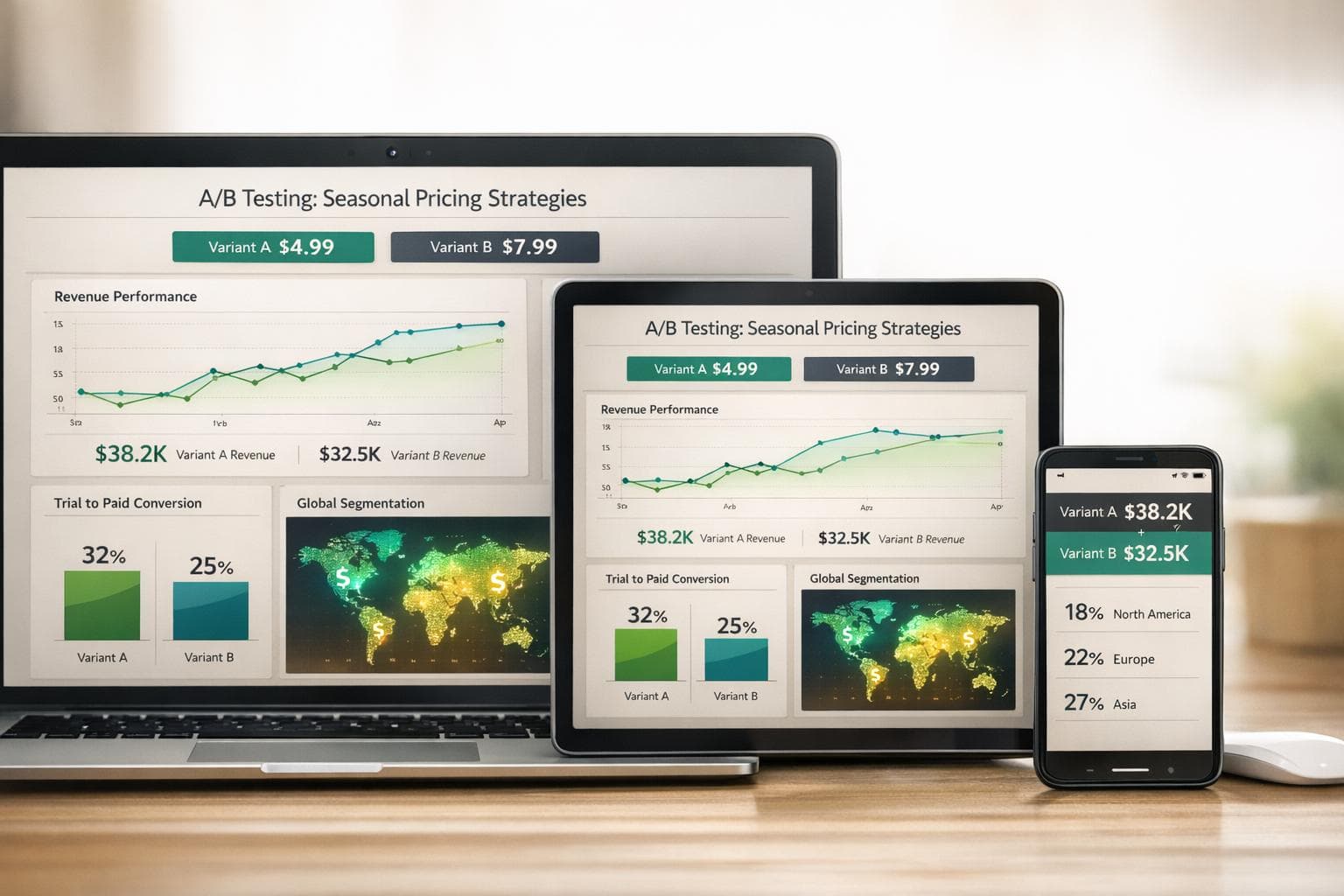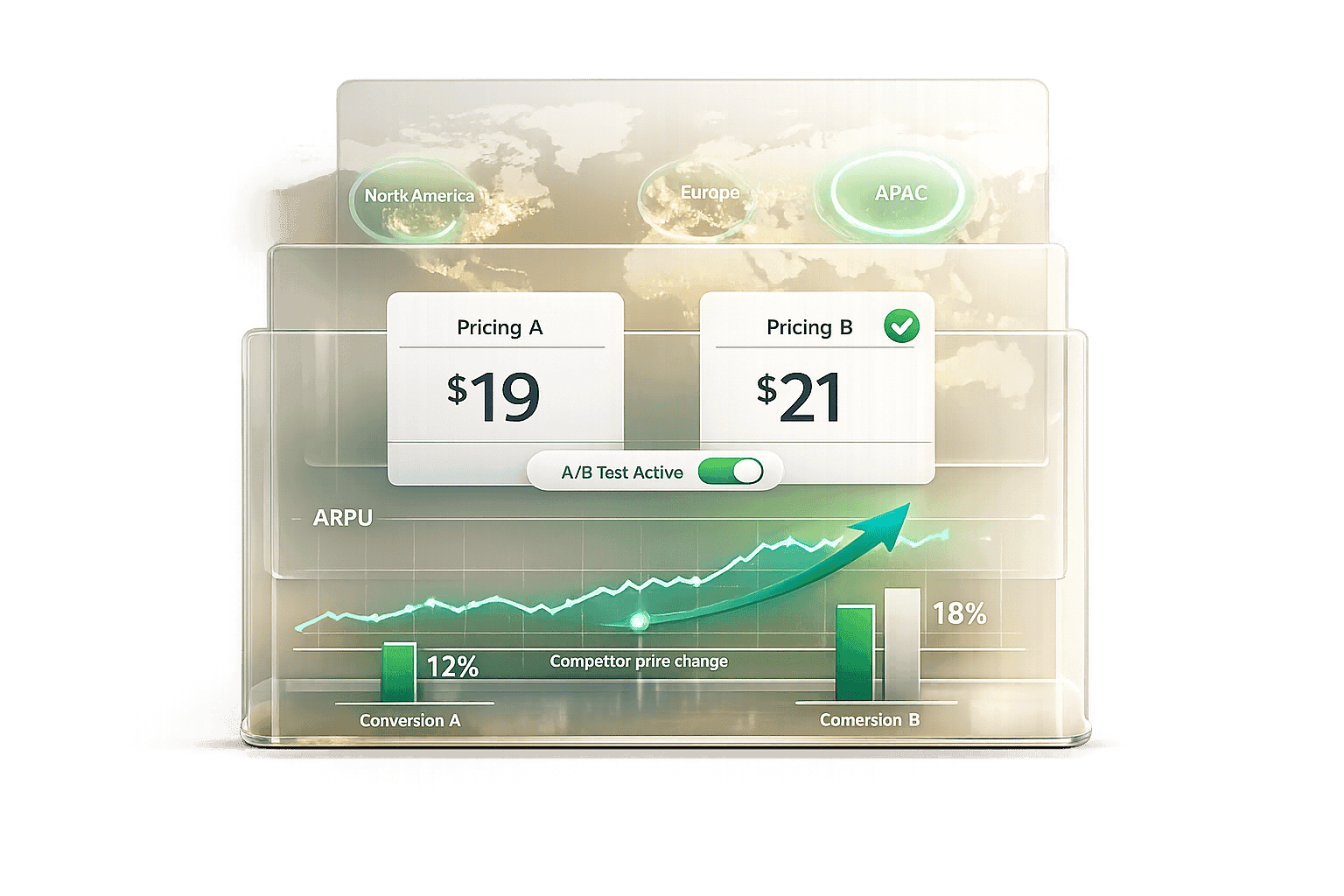
When competitors adjust their pricing, reacting impulsively can lead to costly mistakes. A/B testing offers a smarter, data-driven way to refine your pricing strategy. Here’s the key takeaway:
- Why A/B Testing Matters: Apps running pricing tests see an average of 74% higher monthly recurring revenue (MRR). Pricing experiments outperform visual or UX changes in revenue impact.
- When to Test: Focus on A/B testing when a competitor’s price change is likely to affect your audience, such as subscription cuts or new tiers. Avoid minor adjustments or low-traffic scenarios where results may lack statistical significance.
- How to Test:
- Start with a clear hypothesis, e.g., “Lowering the price to $7.99 will increase conversion by 8% while keeping ARPU above $6.50.”
- Prioritize metrics like ARPU, churn, and lifetime value (LTV) over conversion rate alone.
- Segment your audience (e.g., by region or platform) to capture precise insights.
- Tools and Insights: Use platforms like Mirava for regional price intelligence and tools like RevenueCat or Adapty for paywall management. Regional insights are crucial for tailoring pricing to local markets.
A/B testing transforms pricing responses from guesswork to informed decisions, ensuring every adjustment maximizes revenue without compromising long-term growth.
A/B Price Testing for Mobile Apps
When to Run A/B Tests After a Competitor Price Change
Not every pricing adjustment by a competitor demands an immediate response. The real challenge lies in identifying which changes genuinely influence your audience and which are simply background noise.
Types of Competitor Price Changes
Competitor pricing shifts generally fall into four categories, each creating distinct pressures on your app:
| Type | Example | Potential Impact on Your App |
|---|---|---|
| Subscription price adjustment | A direct competitor reduces their monthly plan from $9.99 to $6.99 | Lowers the perceived value benchmark for your pricing |
| Billing frequency change | Competitor eliminates monthly billing, offering only annual plans | Alters user expectations around payment commitment |
| New tier introduction | Competitor launches a cheaper "Lite" plan | Attracts price-sensitive users, potentially impacting your user base |
| Promotional discount | Competitor offers a limited-time 40% discount for new subscribers | Temporarily increases churn risk and decreases your conversion rate |
Each type of change influences user behavior differently. For instance, introducing a lower-cost tier might not immediately impact your conversion rate, but over time, it could lead to a slow loss of price-conscious users. These varied dynamics require tailored responses, which we’ll delve into further in pricing strategies.
Reactive vs. Proactive Pricing
Reactive pricing happens when you respond to a competitor’s move without fully understanding its impact on your audience. For example, matching a competitor's price cut might seem logical, but it could be unnecessary if your users aren't sensitive to that price difference.
Proactive pricing, on the other hand, involves preparing in advance. By running pricing experiments ahead of time, you can understand your price elasticity across different markets. This way, when a competitor changes their pricing, you’re not scrambling - you already have data to guide your decision.
"The teams that win are the ones iterating fastest." - Liubov Karas, Content Marketing Manager, Adapty [2]
For instance, a team that has already tested $5.99 versus $7.99 monthly pricing in Germany will know the exact trade-offs in conversion rates if they decide to respond to a competitor’s discount. Teams that haven’t tested will lack this clarity and may rely on guesswork.
When A/B Testing Is the Right Tool
A/B testing becomes particularly useful when a competitor’s price change is likely to have a noticeable impact on your users. It’s most effective when you have enough traffic to reach statistical significance within a few weeks and when the pricing change being tested is substantial enough to influence revenue metrics. Testing a minor $0.50 difference in a low-traffic app, for instance, may not yield actionable insights.
However, there are situations where other methods should come first. If a competitor introduces a new tier that you don’t offer, start by gathering qualitative insights. Customer surveys or support ticket reviews can reveal whether users are even aware of or interested in the new tier. Additionally, historical data can show whether similar changes in the past affected churn or conversions. Once you’ve confirmed that the change warrants further analysis, A/B testing can provide controlled, data-driven results.
If a competitor’s move noticeably impacts your conversion funnel or churn rate within two weeks, it’s time to run a test. For less direct or unclear impacts, focus on gathering qualitative data before committing to a full experiment.
Setting Goals, Metrics, and Guardrails for Pricing Tests
Building on our earlier discussion about timing A/B tests, this section focuses on structuring pricing experiments with clear goals, metrics, and boundaries. Before diving into a test, confirm that a competitor's price change or other market shifts warrant experimentation. Then, set precise objectives to ensure the results are actionable.
Writing a Pricing Test Hypothesis
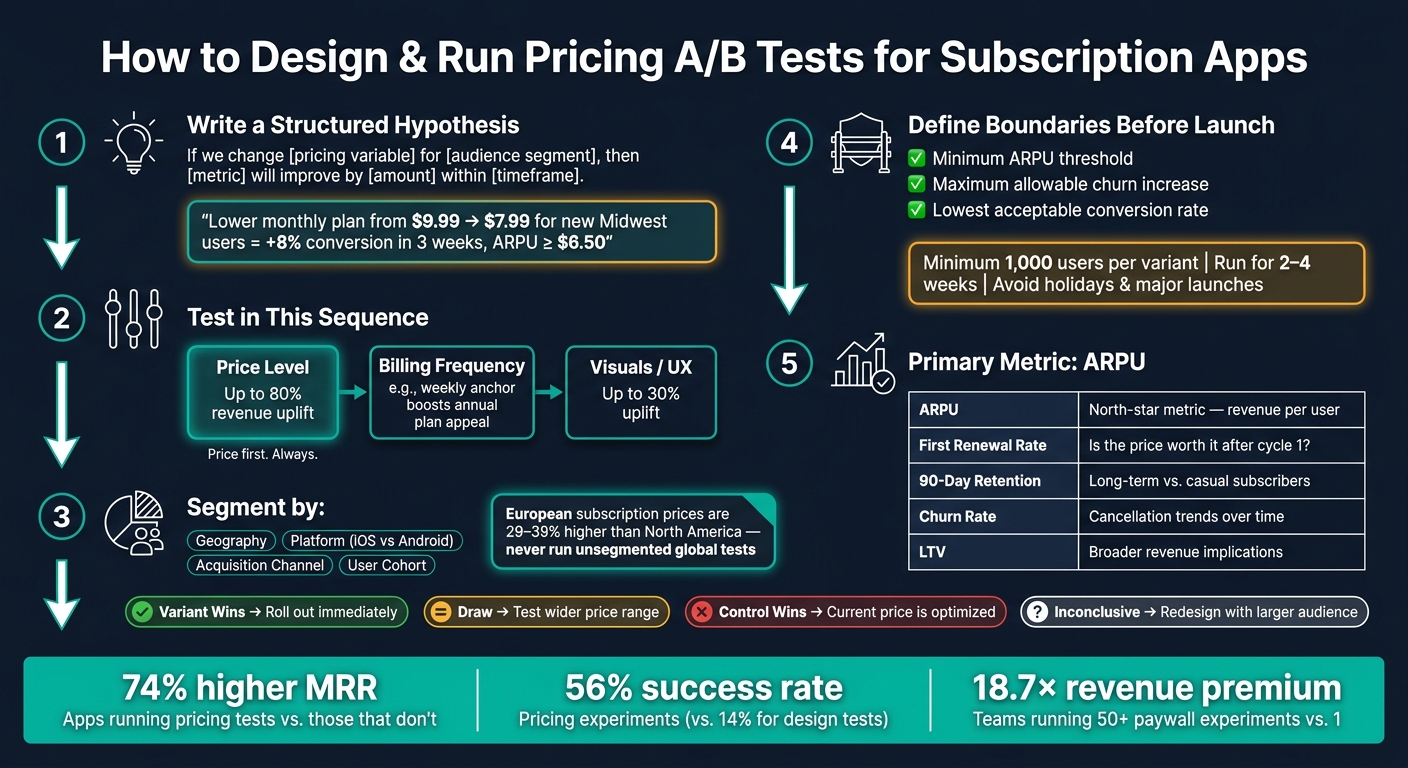
A well-crafted hypothesis is the foundation of a successful pricing test. Use this structure: "If we change [pricing variable] for [audience segment], then [metric] will improve by [expected amount] within [timeframe]." Include constraints to avoid misinterpreting results.
For instance: "If we lower our monthly plan from $9.99 to $7.99 for new users in the Midwest, then our 30-day conversion rate will increase by at least 8% within 3 weeks, while keeping ARPU above $6.50."
Notice the inclusion of a constraint on ARPU. Without such guardrails, you risk celebrating a "win" that ultimately harms your revenue. Guardrails ensure you’re not trading short-term gains for long-term losses.
"The teams that get consistent results run pricing first, then duration, then visuals." - Michal Parizek, Pricing Expert at Mojo [3]
This approach is backed by data. Pricing experiments often yield greater impact than other types of tests. For example, in March 2026, Mojo conducted nearly 40 pricing experiments and reported a 56% success rate in boosting monetization. By contrast, tests focused on design and layout changes had only a 14% success rate [3]. Crafting a strong hypothesis enables this kind of high-volume experimentation.
Key Metrics to Track in Subscription Pricing Tests
When running pricing tests, prioritize ARPU (average revenue per user) as your primary metric. ARPU captures both the volume of conversions and the revenue generated per user, making it a more comprehensive measure than conversion rate alone.
"ARPU is your north-star metric. Conversion rate tells you how many people bought. ARPU tells you whether those purchases generate revenue." - Airbridge [4]
While conversion rate is still important, it can be misleading if considered in isolation. For example, a test variant that drives more sign-ups at a lower price might seem successful - until you notice that ARPU has dropped. As Airbridge explains: "A test result showing higher conversion but lower ARPU is not a win. It means more users bought at a lower effective value per user." [4]
In addition to ARPU and conversion rate, monitor these metrics to gain a full picture of your test’s impact:
| Metric | What It Reveals |
|---|---|
| First Renewal Rate | Whether users find the price worth paying after the first billing cycle |
| 90-Day Retention | If the pricing attracts long-term subscribers or just casual users |
| Churn Rate | How pricing changes influence cancellations over time |
| LTV (Customer Lifetime Value) | The broader revenue implications of your pricing decision |
Apps that regularly revisit and refine their pricing strategies can generate up to 40x more revenue compared to those that set a price and leave it unchanged [5]. Tracking these metrics ensures your pricing tests deliver sustained growth rather than fleeting gains.
Setting Constraints and Guardrails
Guardrails are essential for preventing short-term wins that could harm your app’s long-term health. Before launching a test, set boundaries like a minimum ARPU, a maximum allowable churn increase, and the lowest acceptable conversion rate.
Timing also matters. Avoid running tests during periods that could skew user behavior, such as holidays or major product launches. For instance, data collected during a Black Friday promotion won’t reflect typical purchasing patterns and could lead to flawed conclusions.
For reliable results, aim for a minimum sample size of 1,000 users per variant and run tests for 2–4 weeks. This timeframe allows you to capture critical data on renewals and churn. Additionally, consider testing in specific regions to avoid contaminating your broader dataset.
How to Design and Run Pricing A/B Tests
A/B Testing Pricing Strategy: Step-by-Step Framework for App Subscription Revenue
Once your hypothesis is ready and the boundaries for your test are established, it’s time to build the experiment. Designing an effective test involves selecting the right pricing variables, segmenting your audience carefully, and leveraging market data to determine precise price points. Start by identifying the pricing factors that have the most direct impact on revenue.
Pricing Variables Worth Testing
Not all pricing factors carry the same weight. Price level is the most impactful variable and should be your first focus. Adjusting the subscription price can lead to revenue increases of up to 80%, whereas changes to visuals or UX typically result in about a 30% uplift [1]. Consider testing a 20–30% price increase on your main plan to find the sweet spot between higher ARPU and maintaining conversions.
Once you’ve established a baseline price, explore alternative billing frequencies. For instance, introducing a weekly plan can act as a price anchor, making annual plans appear more appealing. A great example is Text on Pic, which ran sequential tests - starting with pricing, followed by billing frequency and UX adjustments - ultimately increasing subscription revenue by over 30% and ARPU by nearly 50% [2].
The optimal testing sequence is: pricing → billing frequency → visual/UX. This approach ensures that results remain clear and easy to interpret, avoiding unnecessary complexity.
After identifying the right pricing levers, the next step is to refine your test by segmenting your audience effectively.
How to Segment Your Test Audiences
Mixing multiple audience segments in a single test can lead to confusing outcomes. To maintain clarity, segment your test groups by factors like geography, acquisition channel, platform (iOS vs. Android), and user cohort. This approach prevents signal dilution and ensures that each segment delivers statistically reliable insights.
Geography is especially important. For example, subscription prices in Europe tend to be 29–39% higher than in North America [7]. Running a global test without geographic segmentation can obscure these differences, averaging out signals that may be moving in opposite directions. To get clearer insights, isolate key markets and conduct geo-specific tests. Additionally, avoid running tests during periods of unusual user behavior, such as major holidays, to maintain data integrity.
Proper segmentation ensures that your A/B tests generate precise insights, which are essential for adapting to competitor price moves.
Using Regional Pricing Intelligence to Configure Tests
Once your audience is segmented, align your test parameters with the realities of each regional market. Avoid relying on intuition or straightforward currency conversions to set test price points. Instead, use regional pricing intelligence tools to understand what users in each market are willing to pay based on actual purchasing patterns, not just GDP estimates.
Mirava is specifically designed for this purpose. Its pricing indexes are built from subscription data across services like Netflix, Spotify, Apple, and YouTube in over 170 countries. This data provides region-specific price points and insights into willingness-to-pay, ensuring your test scenarios are grounded in real-world behavior. Mirava also simplifies operations by handling psychological price rounding and bulk updates, saving time when running tests across multiple regions. Its price updates are read automatically by platforms like RevenueCat, Adapty, Purchasely, and Superwall - Mirava provides the pricing recommendations while those tools manage billing, paywalls, and entitlements.
If a particular market’s install-to-paid conversion rate significantly exceeds your global average, it could indicate that your price is too low and could be raised [2]. On the other hand, if the conversion rate falls well below the baseline, price might be a barrier. In price-sensitive regions, reducing prices can lead to 15–30% more paid starts without needing additional traffic [8].
sbb-itb-43fe43a
How to Monitor and Analyze A/B Test Results
Once your tests are live and segments are defined, the next step is to focus on tracking real-time results and making sense of the data as it comes in.
What to Watch During a Live Test
With the groundwork in place, it’s crucial to monitor performance metrics closely to identify potential issues early. One of the most important metrics to track is ARPU (Average Revenue Per User), as it provides a more holistic view by combining conversion rates, price points, and plan distribution.
"Conversion rate tells you how many people bought. ARPU tells you whether those purchases generate revenue. They do not always move together." - Airbridge [4]
To gain a full picture, monitor the entire funnel, from trial starts to trial-to-paid conversions and renewal rates. Pay special attention to the 7-day cancellation rate, which serves as an early warning signal. Since over 40% of subscription cancellations happen within the first 7–10 days [3], this metric can predict long-term renewal trends without waiting for a full annual cycle.
It’s also essential to keep an eye on your traffic source mix. If the proportions of Meta, TikTok, or organic installs shift mid-test, results could become skewed, as users from different acquisition channels often exhibit varying levels of price sensitivity [3]. Additionally, break down results by geography, platform (iOS vs. Android), and traffic source to ensure an overall "win" isn’t hiding underperformance in specific segments [4].
Analyzing Results and Choosing a Winner
Once you’ve collected at least 200 paid conversions per variant [4], compare the performance across key metrics like conversion rate, ARPU, and projected lifetime value (LTV). These metrics don’t always align - lowering prices might increase conversions but reduce ARPU if users churn quickly, while higher prices could lower conversions but boost revenue per cohort.
A real-world example comes from Mojo, which conducted nearly 40 pricing experiments over two years under Michal Parizek’s leadership. For instance, cutting prices by 25% in Mexico resulted in a 25% increase in new revenue, while raising yearly prices by 50% in the US and Germany had minimal impact on conversions due to competitors already charging more [3]. These outcomes highlight the importance of tailoring strategies to specific markets.
"Don't assume a winner at day 14 stays a winner. Go back and check those cohorts at 3 and 6 months to see if LTV projections held." - Jacob Rushfinn, Retention.Blog [3]
Here’s a quick guide to interpreting your test outcomes:
| Outcome | What It Means | Next Step |
|---|---|---|
| Variant performed best | Significant revenue increase | Roll out the variant immediately [6] |
| Draw | No meaningful difference between variants | Test with a wider price range [6] |
| Control performed best | Original price outperformed the variant | Your current pricing is likely optimized [6] |
| Inconclusive | Test ended without clear results | Redesign the experiment with a larger audience [6] |
These insights not only help you decide on the current test but also refine future experiments.
Using Test Results to Improve Future Experiments
Each test contributes valuable data for future pricing strategies. Revisit cohorts 3–6 months after the test concludes to confirm whether your LTV assumptions were accurate [3]. Early revenue spikes can sometimes fade, as users may initially react to the novelty of a price change rather than its actual value. This underscores the importance of post-test validation [6].
Consistently running tests sharpens your pricing strategies over time. Teams that conduct 50 or more paywall experiments achieve a median 18.7× revenue premium compared to those running just one [4]. This advantage comes from gradually reducing uncertainty and building a deeper understanding of what users are willing to pay. By leveraging these validated insights, you can confidently implement pricing strategies that drive sustainable growth.
Rolling Out and Scaling Winning Pricing Strategies
How to Roll Out a Winning Pricing Variant
Once a pricing variant meets your statistical benchmarks and demonstrates consistent success across key customer segments, the next step is a gradual rollout. Start with your most profitable markets where the impact will be greatest, then expand to secondary regions, ensuring prices align with local market conditions. Document your findings in a pricing playbook, including the initial hypothesis, the markets tested, validated price points, and the results. This approach not only streamlines future adjustments but also equips your team to respond swiftly to shifts in competitor strategies. By taking a measured, data-driven approach, you ensure that your pricing insights are effectively scaled across diverse markets.
Building a Repeatable Testing Process
A structured testing framework is essential for unlocking pricing opportunities. Begin by setting a baseline price for your top-performing markets, then refine subscription durations and packaging, followed by adjustments to paywall visuals and messaging. This step-by-step method has shown to yield results, with pricing experiments achieving a 56% success rate compared to just 14% for design and copy tests [3].
Adeeb Haddad, founder of Text on Pic, successfully used this approach. He started by testing annual pricing, then introduced a weekly anchor, and finally made visual tweaks. The result? A more than 30% boost in subscription revenue and a nearly 50% increase in ARPU over just four months [2].
"For us, using [Adapty's] Autopilot is not so much about speed, but about courage. The tool gave us the confidence to run pricing tests we would not try manually." - Adeeb Haddad, Founder, Text on Pic [2]
Platforms like Adapty and RevenueCat simplify the execution of these tests at scale by managing paywall delivery, entitlement tracking, and cohort analysis. Tools like Mirava complement this by providing region-specific pricing intelligence. By analysing consumer purchasing patterns from platforms like Netflix, Spotify, Apple, and YouTube, Mirava helps determine the optimal prices for each region. Together, these tools transform ad hoc experiments into a repeatable, scalable system, ensuring your pricing strategy stays grounded in actionable data.
Staying Ahead of Competitors with Regional Pricing Data
Relying on regional insights allows teams to tailor their responses to competitor pricing changes more effectively. The most successful teams aren’t just reacting quickly - they are leveraging detailed, market-specific data to make informed adjustments. For example, AppDevLabs used Adapty's Autopilot to conduct 12 A/B tests over three months. They discovered that one of their utility apps, priced at $9.99 per year, was significantly below the category average of $14.99. By implementing a 67% price increase, they achieved a 28% boost in portfolio MRR [2].
The takeaway is straightforward: if your install-to-paid conversion rates are higher than your category average, it’s often a sign of underpricing. Conversely, low conversion rates may indicate a pricing barrier. Monitoring these metrics on a country-by-country basis, rather than globally, enables teams to respond confidently to competitor moves without relying on guesswork. This localized approach ensures pricing strategies remain both competitive and effective.
Conclusion: Key Takeaways for A/B Testing Competitor Price Changes
When competitors adjust their pricing, the natural reaction might be to respond immediately - whether by matching, undercutting, or holding firm. However, A/B testing provides a more strategic approach: test before making any permanent changes. Over time, consistent testing can turn small, incremental improvements into meaningful revenue growth.
It's important not to treat your entire audience as a single, uniform group. A large portion of app revenue comes from markets outside the United States [2], and a competitor's price drop in one region doesn't mean you need to follow suit globally. By conducting regional tests, you can replace reactive decisions with insights rooted in actual data.
The order of testing is equally important. Begin with price point experiments, then move on to trial durations, and finally test visuals and copy. Price point tests are more likely to deliver actionable results compared to changes in design alone [4]. Testing visuals or messaging on top of unstable pricing can lead to results that are difficult to interpret accurately.
Having the right tools in place ensures a seamless testing process. Mirava plays a key role upstream, analyzing regional purchasing behaviors across platforms like Netflix, Spotify, and Apple in over 170 countries to recommend optimal pricing. Once price points are established, tools like RevenueCat, Adapty, Purchasely, and Superwall take over, managing paywall implementation, entitlement tracking, and subscription infrastructure to turn those price points into revenue.
The most effective pricing strategies emerge from regular testing, regional segmentation, and ongoing refinement. Teams that remain active in their approach typically conduct about 14.7 experiments annually [4], or roughly one every three to four weeks. This consistent pace helps maintain competitive pricing strategies and underscores the importance of data-driven, region-specific decision-making for long-term success.
FAQs
How do I know a competitor price change really affects my users?
To determine whether a competitor’s price adjustment affects your users, implement server-side A/B testing. Divide users into randomized groups, reserving 5–10% as a control group. Over a period of 2–4 weeks, track key metrics such as ARPU (Average Revenue Per User), LTV (Lifetime Value), churn, and renewal rates. This approach helps you isolate and measure the impact effectively.
For more detailed analysis, tools like Mirava can help identify region-specific pricing strategies and update them at the store level, while solutions like RevenueCat and Adapty read the new prices automatically into their billing and paywall systems.
What metrics should decide a pricing test winner besides conversion?
When evaluating success, it’s essential to look beyond simple conversion rates and focus on metrics that provide a clearer picture of long-term financial health and user engagement. One of the most important metrics here is Average Revenue Per User (ARPU), which gives insight into both purchase activity and the revenue generated per user.
To dig deeper into sustainability, track Realized Lifetime Value (LTV). This metric accounts for key factors like subscription renewals, churn rates, and refunds, offering a comprehensive view of how much value each user delivers over time. Alongside this, keeping an eye on churn and refund rates is crucial for understanding retention challenges and areas for improvement.
For pricing strategies tailored to different regions, tools like Mirava provide invaluable insights. Meanwhile, platforms such as RevenueCat and Adapty handle billing and paywall infrastructure, ensuring a seamless user experience. Together, these tools create a robust ecosystem for managing and optimizing subscription models effectively.
How should I segment pricing A/B tests by country or platform?
To run pricing A/B tests effectively, it's crucial to segment by geographic region. This helps prevent cross-regional data contamination and accurately reflects local purchasing habits. Focus on your top 10–20 markets based on download volume, ensuring each variant gets at least 1,000 users over a 2–4 week period for reliable results. Platforms like RevenueCat, Adapty, Purchasely, or Superwall can support cross-platform testing, while Mirava offers tailored, region-specific pricing recommendations and insights into purchasing behavior to refine your approach.