Apple takes 30% of what an app earns. Stay under $1 million a year and that drops to 15% under the App Store Small Business Program. Google Play runs 15% on the first $1 million a developer earns annually.
Most teams find those numbers out late. The decision about how an app makes money usually gets made in week one, by whoever is building it, based on what similar apps appear to be doing. It then quietly sets the ceiling on everything after it: what the app can charge, who it can charge, and how much of that ever lands in a bank account.
Five models are on the table. Three survive contact with real users. Choosing between them has less to do with your category than with a single question about behaviour, and it is not the question most teams ask first.
Start with how often people open it
Open frequency picks the model before revenue does.
An app someone opens daily can charge on a recurring basis. Value shows up again every morning, so the charge keeps feeling fair. Meditation apps, language tools, fitness trackers, budgeting apps. The habit is the product.
An app someone opens three times a year cannot. Tax filing, wedding planning, a moving checklist. Billing monthly for something used seasonally reads as a trap, and churn confirms it within two cycles. Those apps do better with a one-time purchase or a fee per use.
Weekly and monthly usage sits in the middle. That band is where freemium earns its keep, because there is enough contact to demonstrate value but not enough to justify a subscription on day one.
Answer the frequency question honestly and most of the model debate resolves itself.
The five models, and the three that survive
| Model | Earns from | Fits | Falls apart when |
|---|---|---|---|
| Subscription | Recurring fee, monthly or yearly | Daily or near-daily use | Value arrives once, then stops |
| Freemium | Upgrades from a free tier | Weekly use, clear paid ceiling | The free tier is good enough forever |
| In-app purchases | Discrete unlocks or consumables | Games, creative tools | Purchases feel like a toll on progress |
| Paid up front | One purchase at download | Utilities with an obvious job | Nobody can try before paying |
| Advertising | Impressions and clicks | Very high volume, low intent | Audience is small or premium |
Paid up front has narrowed to a small set of utilities where the job is obvious enough to buy sight unseen. Advertising needs volume most apps will never reach, and it competes with the paid experience rather than supporting it. There is a longer breakdown in the seven monetization models piece, and a specific look at monetizing without ads if that route is already ruled out.
The other three carry almost every subscription app worth studying.
Freemium fails on the ceiling, not the price
Freemium apps that struggle usually have a pricing page problem that is really a product problem.
The free tier has to be genuinely useful and genuinely limited. Useful, or nobody stays long enough to convert. Limited, or nobody ever needs to. Most teams get the first half right and lose their nerve on the second, because capping a feature feels hostile when you are trying to grow.
The cap has to sit where usage naturally intensifies. A note-taking app that limits notes to twenty is capping the wrong thing, because the user who has twenty notes has already decided the app is worth keeping. Cap the thing that shows up once someone is committed: multi-device sync, export, collaborators, history.
A free tier that never runs out is a donation model with extra steps.
What the stores actually take
Commission is the part of monetization that no model escapes, and it changes the maths on all of them.
| Situation | Apple | Google Play |
|---|---|---|
| Standard rate | 30% | 30% (15% on subscriptions) |
| Under $1M annual earnings | 15% | 15% on first $1M each year |
| Subscriber past year one (Apple) / any subscription (Google) | 15% | 15% |
The year-two subscription rate is the detail that most changes model selection. A subscriber who renews into a second year is worth substantially more than a first-year subscriber at the same price, because the platform's share halves. That reframes retention work as margin work, not just revenue work. It also makes annual plans more interesting than they look at first glance, since they move subscribers toward that threshold faster.
Anyone weighing store distribution against their own billing should read the fee structure comparison before assuming the web is cheaper. It often is not, once payment processing, tax handling and churn are priced in.
Price is the second decision, and it is not one number
Picking a model settles how you charge. It says nothing about how much.
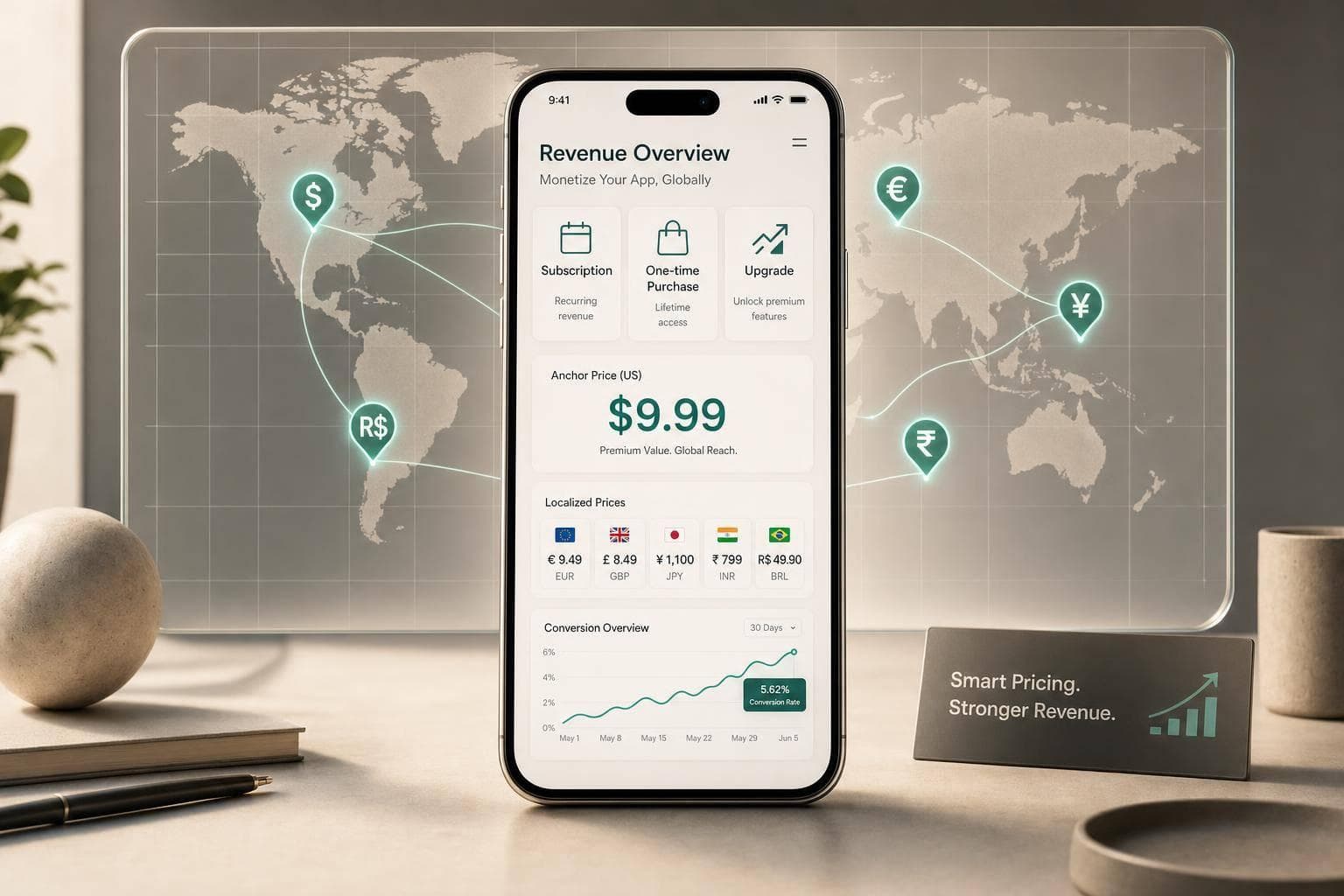
The default is to set one price in dollars and let the stores convert it. That converts currency accurately and willingness to pay not at all. A subscription that reads as reasonable in Toronto reads as a luxury purchase in Jakarta, and the store's exchange-rate conversion has no opinion on the difference. This is where a lot of otherwise well-built apps quietly lose their addressable market outside a handful of wealthy countries.
Netflix and Spotify both worked this out early and price country by country against local conditions rather than against the dollar. The comparison is useful for app teams because those catalogues are identical everywhere. The only variable being tuned is what the market will pay.
Tools like Mirava score each market with the Mirava Index, which is built from what global subscription services actually charge locally rather than from a raw economic ratio, then recommend a price per country that a human approves before anything reaches the stores. The mechanics of setting that up are covered in the regional pricing guide.
One caution worth knowing before touching prices on existing products: Apple notifies current subscribers when a subscription price rises, and those notifications can prompt cancellations. Raising a price is a different operation from setting one, and it deserves its own plan.
Common questions
What is the best way to monetize an app?
There is no single best model. The strongest predictor is open frequency: daily use supports subscriptions, seasonal use supports one-time purchases, and weekly use is where freemium works. Category matters far less than habit.
How much do Apple and Google take from app revenue?
Both charge 30% as standard and 15% for developers earning under $1 million a year, through the App Store Small Business Program and Google Play's equivalent first-million rate. Subscriptions also drop to 15% once a subscriber passes twelve months.
Can an app use more than one monetization model?
Yes, and many subscription apps do. A subscription for core access alongside one-time purchases for extras is a common pairing. The risk is confusing the buyer, so each path needs an obvious reason to exist. There is a fuller treatment in the hybrid monetization guide.
Should a new app launch free or paid?
Free with a paid upgrade path, in almost every case. Paid up front removes the chance to demonstrate value, and for an unknown app that is a steep ask. The exception is a utility solving a problem specific enough that the buyer already knows they need it.
Does the same price work in every country?
Rarely. Store currency conversion matches exchange rates, not local budgets, so a single dollar price lands very differently by market. Pricing per country against local conditions usually widens the addressable market considerably.
Apple's 30% is the number every founder eventually memorises. The one that matters more is 15%, and the fact that it arrives automatically for a subscriber who stays past twelve months. That turns the monetization question into a retention question, which is a better question anyway. Most teams pick a model, ship it, and never revisit it. The ones that revisit it after a year of real usage data tend to find the first guess was close, and wrong in one expensive way.