
Mobile app revenue has reached $540 billion globally, with 97% coming from free apps. Success now depends on hybrid monetization strategies combining subscriptions, in-app purchases, and advertising, tailored to regions and user behavior. A major shift came after the 2025 Epic vs. Apple ruling, cutting platform fees to 3–6%, enabling developers to maximize revenue.
Key Models for 2026:
- Freemium: Free access with regionalized upsell paths.
- Subscriptions: Recurring revenue with hybrid options (e.g., usage-based pricing).
- In-App Purchases: Consumables like tokens and non-consumables like ad removal.
- In-App Advertising: Rewarded ads with value exchange.
- Paid Apps: Free download + one-time unlocks.
- Sponsorships & Affiliates: Indirect revenues from partnerships.
- Hybrid Stacks: Combining models for diversified income.
Key Takeaways:
- Regional Pricing: Essential for higher conversions; adjust prices by market.
- First-Session Engagement: 89.4% of trials start on installation day.
- Tools to Use: Platforms like RevenueCat, Adapty, and Mirava streamline pricing and paywalls.
Tailoring monetization to app type, user habits, and geography is critical for growth in 2026.
How Do Free Apps Make Money? (5 Models That Actually Work in 2026)
sbb-itb-43fe43a
How to Choose the Right Monetization Model in 2026
One common mistake developers make is copying monetization strategies from other apps without considering their own audience. The best approach depends on factors like how often users interact with your app, the app category, user location, and the platform they use.
Start with usage frequency. Apps that users engage with daily - such as fitness trackers, habit-building tools, or AI-driven apps - can support a variety of monetization models. For apps with less frequent engagement, like those used weekly or monthly, ad-based models may fall short due to limited impressions. In these cases, subscriptions or one-time purchases are often more effective. It’s also essential to consider how platform-specific trends impact your revenue potential.
Platform choice is critical. iOS users generate approximately 5.5 times more revenue per subscriber compared to Android users [1]. This underscores the importance of tailoring your pricing strategy and paywall design to the platform where your app can achieve the highest returns.
"How an app makes money is not a marketing decision. It's a product decision." - Arsh Singh, ApsteQ [8]
Geography is another key factor. Subscription pricing should reflect regional spending power. For instance, markets like Switzerland ($28.50 per user) and Qatar ($27.50 per user) support premium pricing tiers, making them ideal for higher-value offerings.
Once you've identified a monetization model that aligns with user behavior, consider tools like RevenueCat, Adapty, and Purchasely to streamline execution. These platforms can manage subscriptions, facilitate A/B testing seasonal pricing, and handle cross-platform billing. Additionally, running localization experiments - such as translating paywalls and adjusting pricing to local currencies - has been shown to boost lifetime value (LTV) by 62.3% [1][2]. Localization remains one of the most impactful strategies for increasing revenues.
1. Freemium with Regionalized Upsell Paths
The freemium model offers users free access to basic features while charging for premium options. By 2026, the most successful freemium apps will do more than just restrict content - they'll integrate region-specific upsell flows that reflect local purchasing power. This targeted approach has proven its effectiveness through measurable conversion rates.
Currently, freemium apps convert between 2% and 5% of free users into paying customers [4][5]. Tests that combine translation with currency adjustments show a 62.3% boost in lifetime value (LTV), compared to a 45.5% increase from price adjustments alone [1][2]. As Karim Idrissi, Lead Developer at Aivensoft, aptly notes:
"The line between 'free enough to attract' and 'limited enough to convert' is thin." [4]
This strategy works particularly well for apps like productivity tools, utilities, cloud storage platforms, and photo/video editors - categories where users can experience tangible value before encountering a paywall. Health & Fitness apps also thrive under this model, though they tend to favor annual subscription plans over weekly ones. To maximize early trial engagement, it's essential to activate a localized paywall from a user's very first session.
Regional pricing represents a major opportunity that many developers overlook. A flat global price often leads to missed revenue, as it can either overcharge users in markets like India or Brazil - where prices need to be 50–70% lower than U.S. rates to drive conversions [6] - or undercharge in affluent markets like Switzerland (median one-year LTV: $28.50) and Qatar ($27.50), where users expect higher pricing [2]. Tools such as Mirava provide a pricing intelligence layer, using purchasing power data from over 170 countries to recommend optimal price points for each region. Platforms like RevenueCat, Adapty, Purchasely, and Superwall then handle billing, paywall rendering, and entitlement management based on these insights.
However, implementing regionalized freemium pricing requires careful planning. You'll need to manage localized paywall designs, multiple pricing SKUs, and regional A/B testing. Relying on a single global price can leave 30–50% of potential revenue untapped in key markets [12]. While the setup may be moderately complex, the potential gains make it worthwhile.
2. Subscriptions and Hybrid Subscriptions
Subscriptions continue to be the backbone of app revenue, but the traditional flat-rate model is showing its limitations, especially with the integration of AI features. Unlike software with negligible marginal costs, Large Language Model (LLM) APIs introduce real, variable costs that can escalate with heavy usage.
"The zero marginal cost era of software is over the minute you touch LLM APIs. AI has real COGS and it is something we will have to learn to deal with." - Anh Tho Chuong, CEO & Co-founder of Lago [13]
To address these challenges, hybrid subscriptions have emerged as the standard by 2026. This model combines a recurring base fee with usage-based or consumable pricing, balancing predictable revenue with charges that scale alongside user activity. This approach also aligns well with the need for pricing strategies tailored to different regions.
Hybrid subscriptions are one slice of a wider shift. The full playbook for combining subscriptions, in-app purchases and ads in a single app is covered in the guide to hybrid monetization.
Weekly subscription plans have seen a dramatic rise, now contributing 55.5% of all app subscription revenue, compared to 43.3% in 2023 [1][10]. However, annual plans remain dominant in specific categories. For instance, Health & Fitness apps generate 60.6% of their subscription revenue from annual plans [1][10].
Regional pricing adds another layer of sophistication to hybrid models. Subscription rates can vary by as much as 4× between countries, highlighting the importance of region-specific strategies. Tools like Mirava's pricing intelligence layer leverage data from over 170 countries to determine ideal price points, while platforms such as RevenueCat, Adapty, Purchasely, and Superwall streamline billing and paywall management.
Trials also play a pivotal role in subscription success. Similar to freemium models, effective localization from the outset is key. Longer trial periods, ranging from 17 to 32 days, significantly improve conversion rates compared to shorter trials. This underscores the importance of a carefully timed, localized paywall during a user's first interaction with the app [14].
3. In-App Purchases and Consumables
In-app purchases (IAPs) are projected to generate over $150 billion in 2026, with mobile gaming accounting for 65% of that figure [5]. To maximize revenue, pricing strategies need to balance impulse buys with more strategic, planned purchases.
Consumables - items like coins, AI tokens, or extra lives - encourage repeat spending, as users tend to exhaust them quickly and return for more. On the other hand, non-consumables, such as ad removal or premium filters, deliver lasting value through one-time purchases. A growing trend is the à la carte model, where users pay for specific content like articles, recipes, or templates. This approach is gaining popularity, especially in lifestyle and education apps. For instance, lifestyle apps saw one-time purchases grow from 5.9% of total revenue in 2023 to 26.3% by 2026 [1]. Similarly, token packs for AI-driven apps allow developers to cover real API costs without overburdening users with high subscription fees.
Strategically tiered pricing further boosts conversions. The $0.99 price point remains the most frequently purchased, with the $2.99–$4.99 range acting as a sweet spot. However, purchases drop significantly for price points above $9.99 [5]. A "Goldilocks" strategy - offering three tiers with the middle option positioned as the best value - often outperforms single-price models by appealing to a broader range of users. Developers can validate these structures by running pricing experiments to find the optimal balance.
Localizing prices to match purchasing power is equally crucial [1]. For example, U.S.-based price points often fail in regions like MENA or Southeast Asia, where prices need to be adjusted 50–70% lower to attract buyers [1]. Tools like Mirava's pricing intelligence layer analyze willingness-to-pay across 170+ countries, while platforms such as RevenueCat, Adapty, Purchasely, and Superwall streamline purchase restoration and analytics across platforms [7]. This combination of data-driven pricing and localized strategies is shaping the future of app monetization, making tailored approaches a necessity for success.
"Translating your paywall into your top 5 revenue market languages delivers 37% more LTV uplift than changing a price." - Victoria Kharlan, Adapty [1]
4. In-App Advertising with Value Exchange
A vast majority of users - between 95% and 98% - avoid subscriptions or one-time purchases. This is where value-exchange advertising steps in, offering a way to monetize these users without pushing them away. The concept is simple: users willingly watch an ad in return for a reward, such as virtual currency, bonus content, extra lives, or temporary access to premium features. Since participation is voluntary, users tend to respond more positively compared to intrusive formats like forced banners or interstitial ads.
Rewarded video ads dominate this space, boasting impressive performance metrics. In the U.S., eCPMs for rewarded videos typically range from $15 to $30, far surpassing the $0.50–$3 range of banner ads [5]. This format can generate as much as 20 times more revenue per thousand impressions and achieve engagement rates that are 3 to 5 times higher than other ad types [5].
This advertising model thrives in app categories like gaming (offering coins, lives, or power-ups), fitness (unlocking specific workouts), education (providing bonus lessons), and utility apps (granting one-time access to premium tools). These apps naturally include pause points - such as between levels, after completing a workout, or before using a locked feature - making them ideal for placing rewarded ads. However, placement and frequency are crucial; apps that show more than three full-screen ads per session risk a 15–25% increase in uninstall rates [5]. Smart timing and capping ad frequency are essential to avoid alienating users.
Regional differences in eCPM also play a critical role in revenue potential. For instance, traffic from the U.S. and Western Europe can earn 3 to 5 times more than traffic from Southeast Asia or South America [5]. Mirava’s pricing intelligence system takes these regional variations into account, helping developers align revenue expectations with their user demographics. Tools like RevenueCat and Adapty can then manage entitlement logic, ensuring that users who pay to remove ads are not shown them.
To ensure rewards are granted fairly and prevent fraud, server-side verification is necessary to confirm ad completion [9]. Using a mediation platform like Google AdMob, combined with an additional ad network, can help developers maximize fill rates and eCPM. This value-exchange model works seamlessly alongside other monetization strategies, which will be explored next.
5. Paid Apps and One-Time Unlocks
The popularity of paid downloads has plummeted by 85% since 2018, as users increasingly lean toward trying apps before committing financially [6]. Currently, only about 3% of apps on major platforms rely on the paid download model [5]. This shift doesn’t mean one-time payments are obsolete but reflects a change in strategy.
A more effective approach in 2026 is the "free download + one-time Pro unlock" model. With this setup, users can explore the app’s core features for free and then pay a single fee to permanently unlock the full version. This method removes the initial barrier of a paid download while maintaining the simplicity of a one-time payment. For productivity apps, the average conversion rate for these one-time in-app purchases sits at around 2.4% [7] - a modest figure but with the advantage of no churn risk after purchase.
This model is particularly suited for niche utilities (like file managers, code tools, or surveying calculators), premium creative tools such as high-end photo editors and music production apps, and apps focused on privacy, offering an ad- and tracking-free experience [5][6]. However, it’s less effective for apps that deliver continuous value, such as content libraries or fitness coaching, where subscriptions are better suited to ongoing service.
Pricing for one-time unlocks varies widely. Consumer-focused apps typically charge between $0.99 and $4.99, while professional tools range from $9.99 to $49.99 [5][6]. Mid-tier pricing ($5–$9.99) often struggles to perform. For apps offering both a lifetime unlock and a subscription, setting the unlock price at 2.5× to 3× the annual subscription cost can help maintain the subscription’s perceived value [11]. Fine-tuning these price points based on regional economic conditions can further improve results.
Regional pricing is essential for maximizing conversions. In markets like India and Brazil, one-time unlock prices often need to be set 50–70% below U.S. levels to match local purchasing power [6]. Mirava’s pricing intelligence uses Purchasing Power Parity data to identify optimal price points, while tools like RevenueCat or Purchasely handle entitlement logic and the required "Restore Purchases" functionality for non-consumable unlocks [7].
"One-time purchase (paid upfront) - frictionful, but premium positioning." - ASOhack [12]
For apps relying on one-time purchases, avoid paid user acquisition campaigns unless the ARPU exceeds $10, as the economics are rarely favorable below this threshold [12].
6. Sponsorships, Affiliates, and B2B Licensing
Indirect monetization models can bring in revenue without directly charging users. Approaches like sponsorships, affiliate marketing, and B2B licensing can be particularly effective when your app resonates with a specific audience.
Sponsorships are especially effective for apps in niche markets like fitness, personal finance, or outdoor activities. These deals often complement direct monetization strategies by providing additional income streams. To attract sponsorships, apps typically need at least 100,000 Monthly Active Users (MAU) [7]. Sponsorship deals can range from $500 to $50,000, depending on the app’s niche and user engagement. For instance, a fitness app could incorporate Nike-recommended gear into its workout routines, offering a more integrated and natural brand experience compared to traditional banner ads [4].
"Sponsorship deals (in-app brand integration, sponsored content) only work above 100k MAU and require significant ops to manage." - Daniel Park [7]
Affiliate marketing is a strong fit for content-driven apps like those focused on travel, shopping, comparisons, or reviews. These apps can earn between $0.05 and $2.00 per user. The most effective placements occur during key user actions, such as showing a hotel booking link immediately after a user searches for a destination [5].
B2B licensing involves selling your app’s technology or data to businesses, which requires a more hands-on sales approach - an app store listing alone won’t suffice [9]. Apps offering professional tools can charge $5–$25 per seat monthly, while those with unique datasets can sell anonymized insights for $0.01–$0.10 per user per month [5]. However, compliance with privacy regulations like GDPR and CCPA is crucial [6]. To remain competitive in global markets, region-specific pricing is essential. Using a pricing intelligence layer can help determine optimal rates for different regions, ensuring competitive pricing in emerging markets while maximizing revenue in premium ones.
Below is a comparison of these models, highlighting their suitability, revenue potential, and complexity:
| Model | Best App Categories | Revenue Range | Complexity |
|---|---|---|---|
| Sponsorships | Fitness, Finance, Niche Enthusiast | $500–$50,000 per deal | High (ops-heavy) |
| Affiliate | Shopping, Travel, Reviews, Content | $0.05–$2.00 per user | Low to Medium |
| B2B Licensing / Data | Weather, Analytics, Health, Traffic | $0.01–$0.10 per user/mo | Medium (legal/compliance) |
| B2B SaaS (per-seat) | Productivity, Project Management | $5–$25 per seat/mo | Medium (requires sales) |
7. Hybrid Monetization Stacks Built for 2026
By 2026, relying on a single monetization model will no longer be enough to maximize revenue. As we've explored earlier, each model - subscriptions, in-app purchases, and advertising - has its strengths, but their limitations become evident when used alone. The key to sustainable growth lies in combining these models into a hybrid monetization stack, where each element complements the others to create a more balanced and effective strategy.
Subscriptions provide steady, predictable income, while consumables or usage-based purchases tap into the spending power of your most engaged users. Meanwhile, rewarded video ads monetize the broader base of free users, ensuring no audience segment is left unaddressed. Take, for instance, a fitness app with 100,000 monthly active users employing this hybrid approach: 3,500 subscribers paying $7.99 per month, 8,000 occasional purchasers, and 88,500 free users engaging with rewarded ads. Together, this setup generates approximately $47,930 in monthly revenue - a figure no single model could achieve on its own [5].
The rise of AI-driven features has made this hybrid approach essential. A smart strategy separates access from consumption. Subscriptions can grant users access to core features, while consumables meter high-cost usage, allowing you to monetize heavy users effectively without driving up costs unnecessarily.
Regional pricing also becomes increasingly important when managing hybrid revenue streams. A model optimized for the U.S. won’t necessarily succeed in emerging markets like Brazil or Southeast Asia. Localizing paywalls with translated content and adjusting for local currencies has been shown to boost lifetime value by 62.3% compared to simply tweaking prices [1]. Tools like Mirava play a crucial role here, analyzing purchasing data from over 170 countries to recommend optimal regional pricing. Once these insights are in place, platforms like RevenueCat, Adapty, Purchasely, or Superwall can seamlessly manage paywalls, entitlements, and subscriptions.
While hybrid stacks bring added complexity, the potential rewards make them worthwhile. Leveraging multiple SDKs and running frequent experiments - testing variables like plan durations, trial structures, and localized features - can significantly enhance outcomes. Apps conducting 50 or more experiments achieve 18.7x higher earnings compared to those running just one [1]. However, this level of experimentation demands pricing and paywall systems designed for flexibility and rapid iteration from the start.
Comparison Table
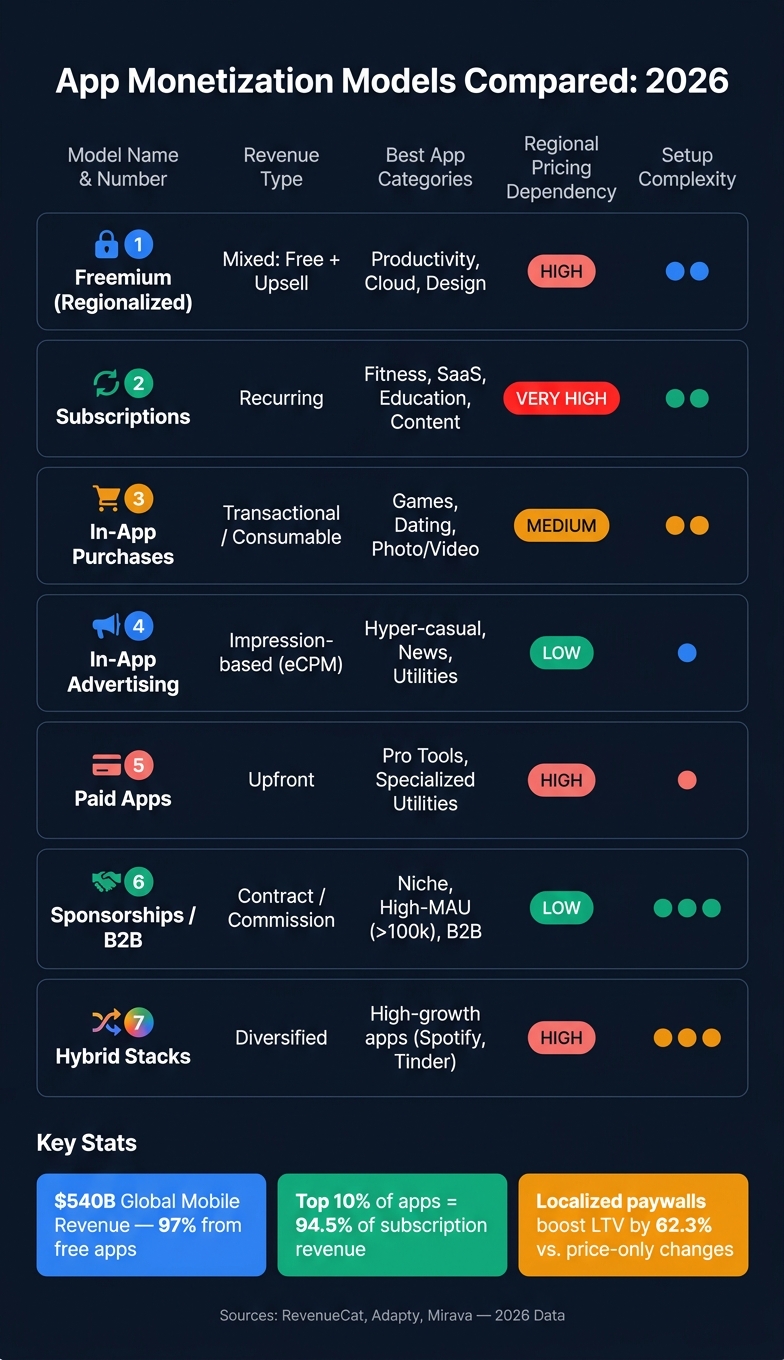
App Monetization Models Compared: Revenue, Complexity & Regional Pricing (2026)
It’s clear that no single monetization model works universally for every app. Below is a breakdown of the models discussed, highlighting their strengths and considerations.
| Monetization Model | Revenue Type | Best App Categories | Regional Pricing Dependency | Setup Complexity |
|---|---|---|---|---|
| 1. Freemium (Regionalized) | Mixed (Free + Upsell) | Productivity, Cloud, Design | High - upsells need to align with local purchasing power | Medium |
| 2. Subscriptions | Recurring | Fitness, SaaS, Education, Content | Very High - LTV can vary by over 2x between regions [2] | Medium |
| 3. In-App Purchases | Transactional / Consumable | Games, Dating, Photo/Video | Medium - standard price tiers ($0.99, $4.99, $9.99) remain effective [5] | Medium |
| 4. In-App Advertising | Impression-based (eCPM) | Hyper-casual, News, Utilities | Low - eCPMs depend on market conditions rather than developer control | Low |
| 5. Paid Apps | Upfront | Pro Tools, Specialized Utilities | High - price directly impacts download rates | Low |
| 6. Sponsorships / B2B | Contract / Commission | Niche, High-MAU (>100k), B2B | Low - negotiated on a per-brand or per-deal basis [5] | High |
| 7. Hybrid Stacks | Diversified | High-growth apps (e.g., Spotify, Tinder) | High - requires extensive multi-region testing | High |
Key Insights
- Subscriptions and freemium models show the highest dependency on regional pricing. For instance, median Year 1 revenue per payer is $32 in North America but drops to $14 in regions like India and Southeast Asia [2]. Tools like Mirava analyze purchasing behaviors across 170+ countries, offering region-specific price recommendations that can be applied through platforms like RevenueCat, Adapty, Purchasely, or Superwall.
- Hybrid stacks are the most complex to implement but are crucial for apps aiming to scale globally. This approach mirrors the strategies of the top-performing 10% of apps, which account for 94.5% of subscription revenue [1][2].
- Paid apps and in-app advertising represent opposite ends of the spectrum in terms of complexity. Paid apps require minimal technical setup but face significant challenges in user discovery. Ad-based models, on the other hand, are easy to integrate using SDKs like AdMob. However, revenue from U.S. rewarded video ads ($10–$30 eCPM) declines sharply in other markets [5], making global scaling less predictable.
These patterns emphasize the importance of tailoring monetization strategies to both regional dynamics and specific user behaviors.
Conclusion
There’s no universal monetization model that works for every app. The best approach depends on factors like your app’s category, target audience, and the regions you operate in. A fitness app catering to North American users will have a vastly different revenue potential compared to a casual game aimed at Southeast Asia. Getting this alignment right from the start can save you months of course correction.
Several trends stand out: converting users during their first session is crucial, as early trial starts often dictate long-term success [1][2]; regional pricing strategies are non-negotiable; and consistent experimentation leads to compounding growth over time [1][2]. These findings highlight the need for thoughtful, localized monetization strategies.
"Monetization is not a feature - it's the foundation." - Gautier Siclon, Co-founder, Apparence.io [3]
Start by nailing down your subscription structure and trial setup before diving into price optimization. Once that’s in place, focus on localizing your paywall. Translating it into the top five languages of your revenue markets can boost lifetime value (LTV) by 62.3%, a result that far outpaces the 37% improvement seen from simple price adjustments [1][2]. After solidifying your foundation, use a pricing intelligence platform like Mirava to set data-driven, region-specific price points across over 170 countries. Meanwhile, tools like RevenueCat, Adapty, Purchasely, and Superwall can handle billing, paywall setups, and entitlement management.
It’s worth noting that the top 10% of apps dominate 94.5% of subscription revenue [1][2]. This success isn’t just about having better features; it’s about making sharper, faster, and more frequent monetization decisions. Use these insights to position your app for revenue growth in 2026.
FAQs
Which monetization model fits my app best?
The right monetization strategy hinges on your app's category and how users interact with it. Subscription models are ideal for apps in productivity, fitness, education, and creative niches, while in-app ads tend to perform better in utilities or hyper-casual games. Some apps find success by blending approaches, such as offering a freemium tier alongside subscriptions or incorporating in-app purchases. Tools like Mirava help fine-tune pricing strategies, while platforms like RevenueCat, Adapty, Purchasely, and Superwall handle paywalls, billing, and entitlements. Continuously testing and adjusting your strategy is key to achieving the best results.
How do I set regional prices without hurting revenue?
To tailor regional prices effectively, prioritize Purchasing Power Parity (PPP) over straightforward currency conversion. This approach ensures your pricing aligns with the local market's affordability. Tools like Mirava are invaluable for identifying the right pricing tiers for each region. Once determined, you can implement these adjustments using platforms such as RevenueCat, Adapty, Purchasely, or Superwall.
It's also crucial to safeguard your existing subscribers by leveraging Apple’s Preserve Price feature. Additionally, while pricing adjustments play a role, focusing on refining paywalls, trial structures, and subscription plans often yields more impactful LTV gains.
What’s a good hybrid stack to start with?
A well-rounded hybrid monetization strategy for 2026 should blend recurring subscriptions with usage-based or consumable in-app purchases. This approach balances steady income with the flexibility to cover variable costs, such as those tied to AI-driven features.
For managing billing and paywalls, consider tools like RevenueCat, Adapty, Purchasely, or Superwall. These platforms handle the operational side, while Mirava serves as the upstream pricing intelligence layer, helping you refine pricing strategies. Start by fine-tuning paywall components - such as trial lengths, subscription durations, and plan offerings - before making direct pricing adjustments for optimal results.