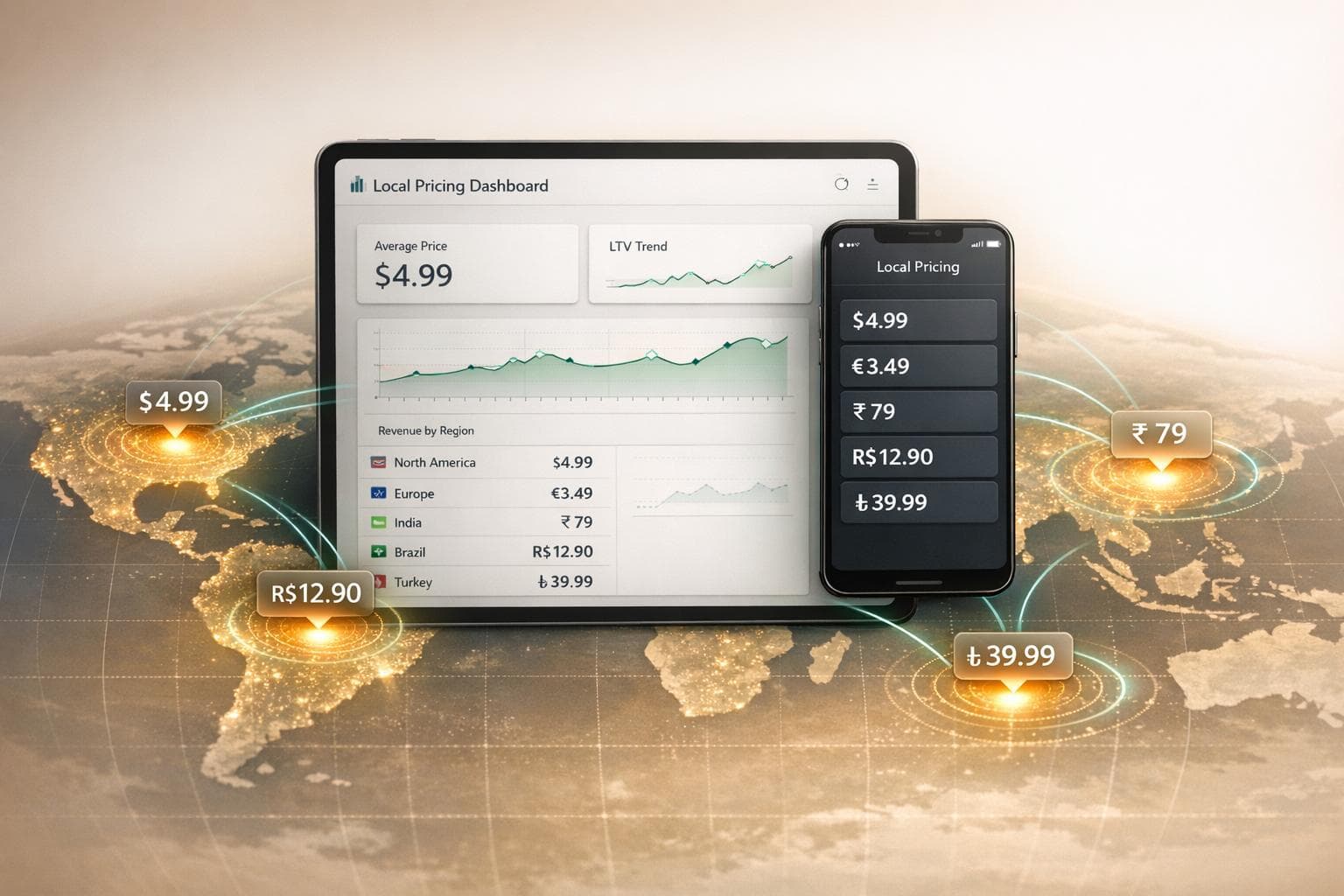
Local pricing for apps is a critical strategy to maximize revenue and user adoption globally. By tailoring prices to each market's purchasing power, you can make your app more affordable and competitive while boosting conversion rates. Here's what you need to know:
- Why Default Pricing Fails: App store pricing often relies on exchange rates, ignoring local income levels. A $19.99 subscription in the U.S. can feel 6–11% of monthly income in emerging markets like India or Brazil.
- Benefits of Localized Pricing: Apps adopting local pricing based on Purchasing Power Parity (PPP) have seen international revenue grow by 20–50%. Tailored pricing also improves app store rankings and user retention.
- How to Implement: Use tools like Mirava to analyze PPP, competitor benchmarks, and local economic factors. Adjust prices regionally while considering psychological pricing conventions (e.g., ₹499 in India, R$9,99 in Brazil).
- Key Metrics to Monitor: Track conversion rates, Lifetime Value (LTV), and refund rates to evaluate pricing effectiveness. Adjust prices quarterly in stable markets and monthly in inflation-sensitive regions.
Localized pricing isn't just about affordability; it aligns your app with local market realities, driving both revenue and user growth. Start with a strong base price (e.g., U.S.), build a global pricing index, and prioritize emerging markets like India and Brazil for maximum impact.
Core Principles of Regional Pricing Strategy
Inputs for a Regional Pricing Model
Crafting a solid regional pricing model starts with accurate data collection, and Purchasing Power Parity (PPP) is a key factor. PPP measures what a price feels like to a local user rather than simply converting it into their currency. For instance, the PPP conversion rate for India is around 22–25 INR per international dollar, while the market exchange rate hovers near 83 INR/USD. This disparity underscores why direct currency conversions often fail to capture true affordability.
In addition to PPP, competitor benchmarks are essential. Analyze around 10 globally relevant apps with similar business models to gauge what users in a specific region are willing to pay. Also, take into account local costs such as ad inventory, platform fees, and taxes. These costs are typically lower in emerging markets, allowing for reduced pricing while maintaining profitability [2].
A third factor is perceived value, which varies across markets. For example, Duolingo charges more in Spain and France than in the U.S. because learning English has greater professional and academic value in those countries, compared to the more casual use cases in the U.S. [2]. Pricing strategies must reflect these contextual differences to align with local user priorities.
With these inputs, you can evaluate different pricing strategies to find what works best for your app.
Common Approaches to Regional Pricing
Once you’ve gathered PPP insights and competitor data, you can explore various pricing strategies that balance simplicity with economic relevance.
Default pricing is the simplest approach, as it automates tax handling, but it overlooks local affordability and often results in inappropriate price points. A more nuanced option is PPP-based pricing, which uses the formula:
Country price = (PPP_country / PPP_base) × base_price.
This method aligns affordability across regions and generally lifts global App Store revenue compared with a single converted price.
The core idea is simple: localized pricing relies on PPP rather than exchange rates. PPP asks what local price produces roughly the same affordability burden for a user in one country as $19.99 does for a US user.
Other models, like the Big Mac Index, Netflix Index, or Spotify Index, provide shortcuts but have limitations. For instance, the Big Mac Index is tied to physical costs, making it less relevant for digital goods. Similarly, Netflix pricing is influenced by content licensing, and Spotify’s model prioritizes monthly retention over annual subscriptions [2]. A more reliable approach is a custom data-driven model that combines PPP, competitor benchmarks, FX corrections, and market-specific rounding. Mobile app pricing tools like Mirava excel here, leveraging proprietary indexes based on pricing behaviors from platforms like Netflix, Spotify, and YouTube to reflect real purchasing patterns.
To simplify global pricing, many apps use a four-tier market structure:
- Premium markets (e.g., U.S., UK, Japan) at full price
- Established markets (e.g., France, Spain, Italy) at near-full price
- Growth markets (e.g., Brazil, Mexico, Turkey) at around $4.99 equivalent
- Emerging markets (e.g., India, Indonesia, Vietnam) at $1.99–$2.99 equivalent
This approach keeps pricing manageable across over 175 territories without needing to treat each country as a unique case.
Psychological Pricing Considerations
Precision in pricing must go hand in hand with psychological appeal. Pricing conventions differ widely by region, and ignoring these nuances can make prices seem impersonal or untrustworthy.
For example:
- In the U.S., prices typically end in
.99. - In India, whole numbers ending in
99(e.g., ₹499 or ₹999) feel more natural. - Japan prefers rounded hundreds or thousands (e.g., ¥1,500).
- Turkey leans toward rounded tens or twenty-fives (e.g., ₺75 or ₺125).
- In Brazil, commas are used as decimal separators (e.g., R$9,99).
Subscription tiers should also align with regional buying habits. For instance, in Brazil, the app Impulse shifted its focus from annual subscriptions to weekly or lifetime options, which resonated better with local purchasing patterns [2].
As a rule of thumb, raising prices in high-income countries and lowering them in low-income countries - done at the same time - tends to increase total revenue.
One caution: for premium apps targeting affluent users, drastic price cuts can backfire. In some regions, very low prices may signal inferior quality and deter the very audience you’re trying to attract [2].
sbb-itb-43fe43a
Designing a Data-Backed Regional Pricing Model
Setting a Base Market and Defining Key Metrics
Start your global pricing strategy with the U.S., recognized for its high revenue potential and stable economic conditions. This market serves as a reliable foundation for testing pricing strategies before scaling globally. Experiment boldly - test price points like $39 versus $69 - to uncover how sensitive users are to price changes and find the sweet spot for revenue.
After solidifying your U.S. pricing, shift focus to other regions by examining the gap between user engagement and conversion rates. If users in a certain market frequently use your app but rarely subscribe, it’s likely a pricing issue rather than a product flaw.
"A conversion rate in India that is five times lower than in Canada, Australia, or the U.S. clearly indicates a pricing mismatch." - Jacob Rushfinn, Founder, Rushfinn Consulting
When evaluating pricing performance, don’t stop at basic conversion rates. Metrics like Lifetime Value (LTV) reveal whether lower prices result in longer retention and higher overall revenue. Meanwhile, Average Revenue Per Paying User (ARPPU) ensures your margins remain sustainable. Keep an eye on refund rates, too, as they can signal “price regret,” where users feel the cost didn’t match the perceived value. Allow 3–6 months for pricing experiments to yield meaningful insights.
With these metrics in place, you’re ready to develop a comparative pricing framework.
Building a Global Pricing Index
A global pricing index helps you compare pricing across regions while accounting for local purchasing power. Start by selecting 10 globally successful apps as benchmarks and recording their local prices (using a VPN if necessary). Then, adjust these prices using World Bank PPP (purchasing power parity) data to create a fair-value baseline. Finally, apply local pricing conventions - such as whole numbers in Japan, .99 endings in the U.S., or ₹499/₹999 in India.
Mirava simplifies this process by offering a detailed view of PPP-adjusted and locally rounded prices across 175+ regions. Its pricing indexes, built on real purchasing data from platforms like Netflix, Spotify, Apple, and YouTube, let you confidently adjust prices in bulk. Additionally, the tool integrates seamlessly with paywall and billing platforms like RevenueCat, Adapty, Purchasely, and Superwall.
"Value isn't universal - it's relative. You're not just competing with other apps, you're competing with the local economy." - Demian Voorhagen, Mirava
By using this index, you can align your pricing with local economic realities, ensuring your app remains competitive and accessible in every market.
Identifying High-Priority Markets
Once your global pricing index is ready, focus on markets where pricing mismatches are most evident. Start by analyzing your top 10–20 markets by download volume, then pinpoint regions where conversion rates significantly trail U.S. benchmarks - a clear sign of pricing misalignment.
India, Brazil, and Turkey frequently emerge as priority markets. In India, for instance, $1 USD has roughly 3.6 times the purchasing power of its market exchange rate. Yet default pricing often reflects only a modest 21% discount compared to U.S. prices. Successful apps in this market typically price 50–80% lower to better match local buying power.
Brazil presents another opportunity, with non-gaming app spending surging by 31% recently. Meanwhile, Turkey’s volatile currency demands monthly pricing reviews to keep pace with economic shifts. A tiered rollout strategy works best - start with 8–12 high-potential emerging markets, evaluate revenue impact over 3–6 months, and then expand globally. For example, Flo’s targeted pricing adjustments in Brazil transformed it into a key growth market for their non-English-speaking audience.
How to price your subscription app globally - Featuring Jacob Rushfinn
Implementing Local Pricing on App Store and Google Play
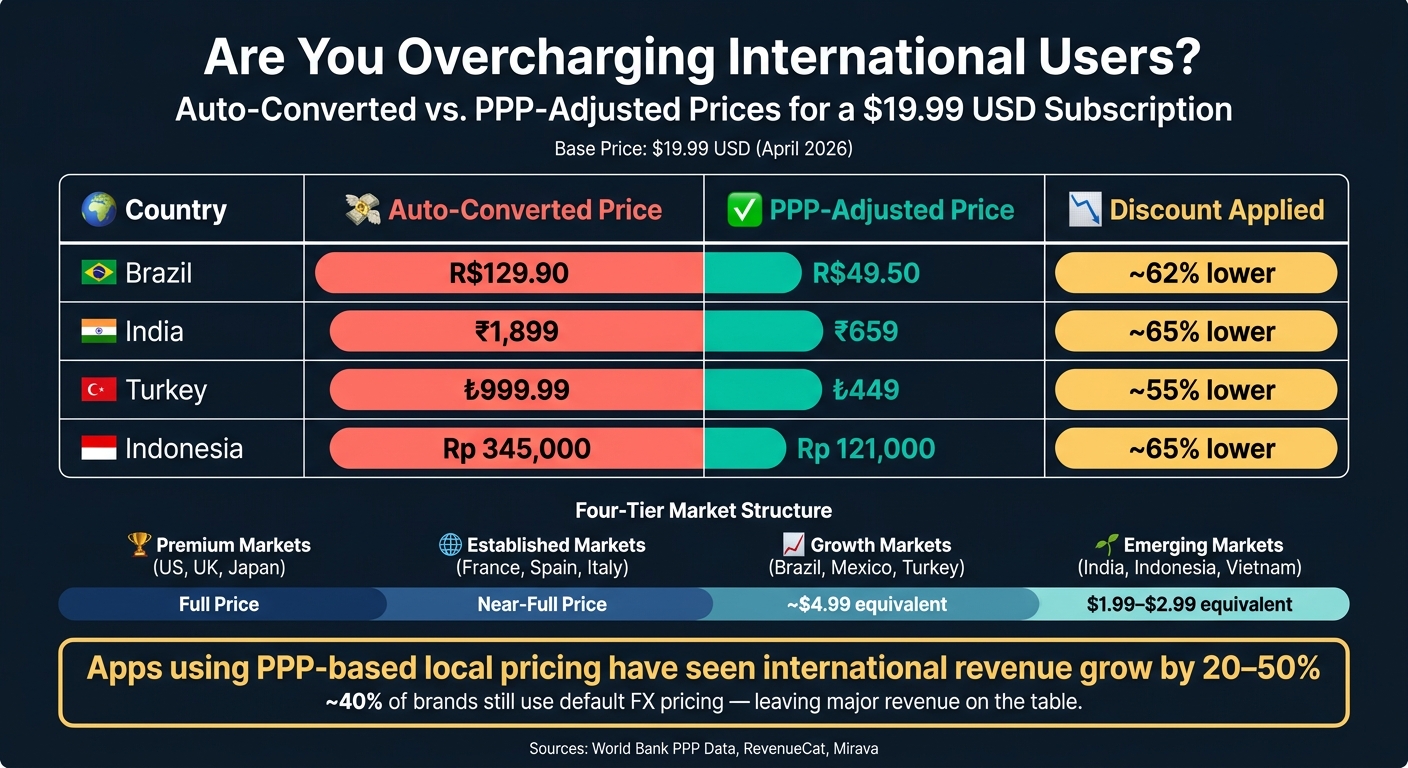
App Pricing Localization: Auto-Converted vs. PPP-Adjusted Prices by Market
Once you've developed a solid, data-driven pricing strategy, the next step is to implement those localized prices on both the App Store and Google Play.
Configuring Pricing on the Apple App Store
Apple uses a structured pricing system with approximately 900 predefined tiers across 175 storefronts and 43 currencies. Since you can't set arbitrary prices, you'll need to choose the closest tier to your desired price. This is particularly critical when applying localized prices based on purchasing power parity (PPP).
Keep in mind that a tier is a reference point rather than the actual price: when Apple updates the tier table, your prices shift automatically in the affected territories.
Apple supports three types of price changes:
- Global Price Change: Adjusts the base price for all regions.
- Temporary Price Change: Ideal for limited-time promotions.
- Custom Price Change: Allows manual adjustments for specific regions with defined start and end dates.
For localized pricing, the Custom Price Change option is most relevant, as it lets you override Apple's default auto-converted prices. Keep in mind that subscription prices on the App Store do not auto-adjust for currency fluctuations. This means you'll need to update them manually, ideally every quarter, especially in markets with volatile currencies like Turkey or Argentina. Additionally, ensure your prices align with regional rounding conventions for a seamless customer experience.
Now, let’s explore how Google Play's pricing system handles localization.
Configuring Pricing on Google Play
Google Play offers more flexibility compared to Apple, as developers can set specific prices in local currencies without being confined to fixed tiers. You can configure these prices in the "Monetize > Products" section of the Play Console.
However, starting in October 2025, Google removed pricing templates, requiring developers to make adjustments individually rather than in bulk[3]. On the plus side, Google now supports sub-dollar pricing in 20 markets across Latin America, EMEA, and APAC, enabling more precise adjustments in regions with lower purchasing power[3].
As an illustration, a $19.99 subscription in the U.S. might auto-convert to roughly ₹1,899 in India, while a PPP-adjusted price would land considerably lower to reflect local affordability:
| Country | Auto-Converted Price | PPP-Adjusted Price |
|---|---|---|
| Brazil | R$129.90 | R$49.50 |
| India | ₹1,899 | ₹659 |
| Turkey | ₺999.99 | ₺449 |
| Indonesia | Rp 345,000 | Rp 121,000 |
(Illustrative example based on a $19.99 USD base price.)
Integrating with RevenueCat, Adapty, Purchasely, and Superwall
Mirava acts as the upstream pricing intelligence solution, optimizing prices for each market and pushing updates directly to App Store Connect and the Google Play Console. Meanwhile, tools like RevenueCat, Adapty, Purchasely, and Superwall handle billing, paywalls, and entitlements. This integration requires no changes to your SDK, app builds, or paywall logic.
Mirava updates prices at the store level, and tools like RevenueCat and Adapty read those changes automatically, so your paywalls, trials, and entitlement logic stay exactly as they are.
Mirava simplifies the process by importing your existing SKUs via API, generating PPP-based pricing recommendations, and offering a side-by-side comparison of old and new prices. Once approved, updates are synced seamlessly to both app stores and your billing provider. This ensures that ongoing experiments, A/B tests, and subscription flows remain unaffected, with only the price metadata being updated.
In effect, pricing becomes a separate, safer layer your team can manage without shipping code.
Measuring and Optimizing Regional Pricing Over Time
After implementing localized pricing on the App Store and Google Play, the next step is to ensure these adjustments remain aligned with market conditions. Continuous monitoring and refinement, supported by validated metrics and experiments, can lead to better revenue outcomes and improved user engagement over time.
Key Metrics to Track
Once localized pricing is in place, the real work begins. Pricing isn't a set-it-and-forget-it task - it requires ongoing analysis and adjustments based on market feedback.
One of the most important metrics to monitor is the install-to-purchase conversion rate, broken down by region. For example, if the conversion rate in India is five times lower than in Canada, Australia, or the US, it indicates a pricing issue that needs immediate attention. Beyond conversion rates, tracking Lifetime Value (LTV) and Average Revenue Per User (ARPU) by region helps confirm whether lower prices in certain markets are balanced by better retention. Additionally, a high refund rate in a specific region is a clear signal to revisit pricing strategies.
Mirava’s dashboard offers insights into FX drift, which highlights the gap between your set price and fair market value as exchange rates fluctuate. Meanwhile, tools like RevenueCat and Adapty provide cohort-level data on LTV and churn, enabling a deeper understanding of user behavior across regions.
Once you’ve identified areas for improvement, controlled pricing experiments can help validate any adjustments.
Running Pricing Experiments
Testing different price points - such as $39 versus $69 - can reveal how sensitive users are to pricing changes [2]. To see long-term effects on retention and LTV, run experiments over a period of three to six months. Before starting, calculate your Minimum Detectable Effect (MDE) to ensure your sample size is large enough to produce statistically meaningful results.
A great example of this approach comes from Flo Health. According to co-founder Dmitri, significantly reducing prices in Brazil helped the market become Flo’s third largest, driving 80% growth in non-English-speaking markets within a year [2].
Compliance and Risk Management
While pricing experiments can guide ongoing adjustments, staying compliant with regional regulations and platform policies is critical. Both Apple and Google fully support localized pricing, but there are some risks to navigate.
Two common challenges are FX drift and tax changes. Apple periodically updates prices to reflect new local taxes - for instance, introducing or raising VAT in specific countries. Manual price overrides require regular reviews to ensure consistency with store-wide updates. To avoid discrepancies between listed and post-tax prices, schedule quarterly reviews of localized pricing, with monthly checks in high-inflation markets like Turkey and Argentina.
When increasing prices, tread carefully with existing subscribers. Apple’s price increase thresholds require users to manually opt in to higher rates, which can lead to churn. To mitigate this, use Apple’s "Preserve Price" feature to maintain current rates for existing users while applying new pricing only to new subscribers. As Jacob Rushfinn advises:
"Moving users to a new price point can trigger more churn than it's worth. If you do decide to migrate users... invest time in clear, thoughtful communication." [2]
Conclusion
Regional pricing boosts revenue and acts as a game-changer for ROI, making it a must-have strategy for app developers aiming to scale globally. Daphne Tideman sums it up perfectly:
"Every global app should take the time to consider if it's worth improving price localization... This is such a major opportunity for you to maximize your revenue and get more out of your app without having to build a single additional feature." [2]
Her perspective underscores why moving beyond default FX-based pricing to purchasing power parity (PPP) models is a defining factor for global success. Despite this, around 40% of brands still rely on default pricing, leaving a vast untapped potential for those ready to embrace a more tailored approach [2].
By following a structured framework - establishing a robust base price, creating a global pricing index, and focusing on emerging markets with high growth potential - developers can replace guesswork with a scalable strategy. This method becomes even more impactful over time as optimizations are applied across more regions [2].
To maintain effectiveness, regular reviews are key: quarterly audits, monthly checks in inflation-sensitive markets, and consistent tracking of Lifetime Value (LTV) ensure the strategy adapts to shifting currencies and tax regulations. Mirava provides the pricing intelligence needed to define optimal price points, while tools like RevenueCat, Adapty, Purchasely, and Superwall handle billing and paywalls. Together, these tools and practices support the ongoing refinement of a localized pricing strategy, ensuring it evolves alongside market dynamics.
FAQs
How do I prevent users from abusing cheaper regional prices?
Apple and Google Play restrict users to viewing the storefront associated with their account's region, ensuring they only see prices and offers specific to their country. To maintain profitability while considering local purchasing power, Mirava allows you to set minimum and maximum price limits. This approach helps avoid unintended pricing discrepancies that might lead to misuse, all while fine-tuning your pricing to align with regional affordability.
How do I localize prices without hurting my brand or perceived quality?
To ensure your pricing strategy aligns with local expectations without compromising your brand's image or perceived value, avoid applying a single, uniform price across all regions. For premium apps, leveraging Purchasing Power Parity (PPP) is key. This approach helps you establish fair, region-specific prices that are accessible to users while still reflecting the app's premium nature.
You can use tools like Mirava to determine the most effective pricing for each market. Meanwhile, platforms such as RevenueCat, Adapty, Purchasely, and Superwall can manage the billing side of things seamlessly. Additionally, applying local rounding conventions (like ending prices in .99) ensures your pricing feels polished and aligns with consumer expectations.
What’s the safest way to raise prices without losing existing subscribers?
To adjust pricing without losing subscribers, consider phased regional A/B testing instead of implementing sudden global changes. Begin by establishing a baseline using Purchasing Power Parity (PPP) as a reference. Test three pricing tiers: the baseline, one set 20% higher, and another 20% lower. Run these tests over 2–4 weeks with a sample size of at least 1,000 users. Once you identify the most effective price point, gradually expand its rollout while maintaining a control group for comparison. Tools like Mirava can help fine-tune pricing strategies, while platforms such as RevenueCat manage billing and paywall integration seamlessly.