Purchasing Power Parity (PPP) pricing adjusts product costs based on local economic conditions, making goods and services more affordable in regions with lower income levels. This form of price localization is crucial for businesses, especially app developers, aiming to expand globally without alienating price-sensitive markets. Here's an overview:
- What is PPP? It measures the buying power of currencies by comparing the cost of goods across countries.
- Why it matters: It ensures fair pricing, increases accessibility, reduces piracy, and expands market reach.
- Steps to implement:
- Establish a USD base price.
- Use reliable PPP data (e.g., World Bank, OECD).
- Adjust regional prices using PPP multipliers.
- Test and refine pricing based on user feedback and performance metrics.
Tools like Mirava simplify PPP pricing by automating adjustments and managing compliance, making it easier for businesses to implement and maintain effective global pricing strategies.
Purchasing Power Parity Explained
Getting Ready for PPP Pricing
Before you can dive into implementing a PPP (Purchasing Power Parity) pricing strategy, you need to lay the groundwork. This involves gathering dependable economic data, setting a solid baseline price, and understanding the tools that can make your pricing strategy effective.
Finding PPP Data and Economic Information
Accurate data is essential for making informed PPP pricing decisions. Fortunately, several key resources provide reliable datasets to guide this process.
The World Bank's International Comparison Program (ICP) is the go-to source for global PPP data. This program conducts extensive price surveys across countries, offering reliable PPP measurements updated every few years [1][6].
For more frequent updates, the World Bank's World Development Indicators (WDI) offers extrapolated PPP data dating back to 1990. GDP-level PPPs are updated twice a year, while private consumption PPPs are refreshed several times annually, making it a practical choice for developers needing up-to-date information [2].
The OECD Purchasing Power Parities database is another valuable resource, especially for developed markets. The OECD provides "flash" PPPs for recent years and updates comparative price levels monthly, with the next update scheduled for October 1, 2025 [3]. Their 2023 data highlights significant economic disparities, with GDP per capita in PPPs ranging from 242% to 38% of the OECD average [3].
For those interested in long-term trends, the Penn World Table (PWT) is ideal. Version 10.01, released in 2023, covers 183 economies from 1950 to 2019. While it may not offer the latest data, it provides a valuable historical perspective [2].
The IMF's World Economic Outlook (WEO) is another key resource, publishing PPP forecasts twice a year. This is particularly useful for forward-looking pricing strategies, helping developers anticipate market shifts [2].
For a more informal approach, The Economist's Big Mac Index offers an illustrative comparison of purchasing power. Updated twice a year since 1986, this index uses McDonald's Big Mac prices to highlight currency over or undervaluation. For example, as of January 2025, Switzerland had the most expensive Big Macs globally, while U.S. prices were comparatively lower [8][9].
Once you've secured reliable PPP data, the next step is to establish a strong baseline price in U.S. dollars.
Creating Your US Dollar Base Price
Your USD base price is the cornerstone of your pricing strategy. It serves as the benchmark for all regional adjustments, so getting it right is critical. To do this, you’ll need to consider market standards and your app’s unique value.
Recent trends in subscription pricing reveal considerable variation across platforms. For instance, in 2021-2022, average iOS app subscription prices were $6.00 for weekly and monthly plans, $27.00 for quarterly and six-month plans, and $27.00 for annual subscriptions. In contrast, Android annual subscriptions averaged $18.00 [5]. Regional differences also stand out, with annual subscriptions averaging $26.10 in the USA, $31.00 in the European Union, and lower price points in markets like Brazil ($18.00), Indonesia ($14.80), and Turkey ($18.00) [5].
When determining your base price, think about how often users engage with your app. Apps used daily can typically justify higher prices than those used less frequently [5]. The pricing model you choose - whether it's "pay to use", freemium, or "pay to pay less" - also plays a role [5].
A/B testing can help fine-tune your base price. For example, OctaZone, a fitness app, added a 3-month subscription priced $10.00 higher than their annual plan. This strategy successfully shifted users toward the 3-month option, boosting their Lifetime Value (LTV) by 30% [5].
Keep in mind that most purchases (around 80%) occur at the first paywall, often within the first five minutes of user interaction [5]. Your base price needs to feel reasonable during this crucial window.
With your base price established, the next step is to leverage tools that can simplify regional pricing adjustments.
PPP Pricing Tools and Resources
Several tools can make calculating and managing PPP pricing more efficient, ensuring accuracy across different markets.
- Online PPP calculators: Tools like the Omni Calculator use Price Level Indices from the World Bank's DataBank to provide quick conversions. For example, based on 2022 data, someone earning $6,000.00 USD per month in the U.S. would need 6,739.00 CAD in Canada to maintain a similar lifestyle [7].
- Methodological guides: Resources like the Eurostat-OECD Methodological Manual on Purchasing Power Parities (2023 edition) and the World Bank's "Purchasing Power Parities for Policy Making" offer detailed guidance on interpreting and applying PPP data [2][3].
- Platform-specific pricing tools: Apple and Google Play provide regional pricing recommendations based on their transaction data. While helpful, these should be combined with external PPP sources for the most accurate results.
- Aggregated datasets: Platforms like Our World in Data compile data from sources like Eurostat, OECD, IMF, and the World Bank. Their GDP per capita data was most recently updated on September 8, 2025, with the next update expected in September 2026 [4].
When comparing data from different sources, remember that methodologies can vary. For example, the ICP provides comprehensive benchmark data, while WDI and WEO rely on extrapolation for more frequent updates [2].
How to Set Up PPP Pricing
Now that you’ve laid the groundwork, it’s time to bring your PPP pricing strategy to life. Below are four key steps to take your plan from concept to execution.
Set Your App's Base Price
Start with the USD base price you’ve already determined, then refine it by comparing your app’s value to similar offerings in the market. Research competitor pricing to establish a realistic range. For instance, basic utility apps often fall between $0.99 and $4.99, while more feature-rich apps can command $9.99 to $50.00 or higher. Subscription models typically range from $2.99 to $7.99 weekly, $4.99 to $14.99 monthly, and $29.99 to $99.99 annually [12].
Understanding your audience’s willingness to pay is crucial. Tools like the Van Westendorp Price Sensitivity Meter can help pinpoint an optimal price range by asking users about their pricing thresholds - from what feels "too expensive" to what’s seen as "a great deal" [10][11][12]. This approach ensures your pricing aligns with both user expectations and revenue goals.
"An app pricing model is how you monetize active users. There are many ways to go about it and many factors to consider to achieve your business goals. It needs to be affordable for users, built on a sustainable financial model, take competitor pricing into account, and provide a higher perceived value than its cost."
- Nicolas Tissier, Co-founder & CPO at Purchasely [10]
Don’t forget to factor in your operating costs - development, marketing, and platform fees - to ensure profitability [11][12]. Starting with a conservative base price is often a smart move. You can always adjust later using A/B testing to gather insights from small user groups [10][13].
Calculate Regional Prices with PPP Data
Once your base price is set, use regional PPP multipliers to adjust for local purchasing power. For example, if your app costs $9.99 in the U.S. and Brazil’s PPP multiplier is 0.6, the Brazilian price would be approximately $6.00 [15].
Round these numbers to fit local pricing conventions. Instead of exact conversions, use figures like ₱199, ₹349, or R$49 to make prices feel more natural to users [17].
Regional adjustments can make a big difference. Apps that implement localized pricing in lower-income regions - for example, meditation or wellness apps adjusting prices for Latin America or Southeast Asia - often see notable increases in subscriptions and conversions. Cutting prices substantially to match local purchasing power can grow the number of paying users and open up otherwise untapped markets.
Match Platform Pricing Requirements
After calculating regional prices, ensure they fit within the pricing tiers of app platforms.
Set up unique price IDs for each region and map your PPP-adjusted prices to the nearest available tier. For instance, if your calculated price is $4.30 but the platform offers $3.99 or $4.99 tiers, consider user sensitivity and local competition when making your choice, checking the Apple price tiers cheat sheet if you need the exact grid.
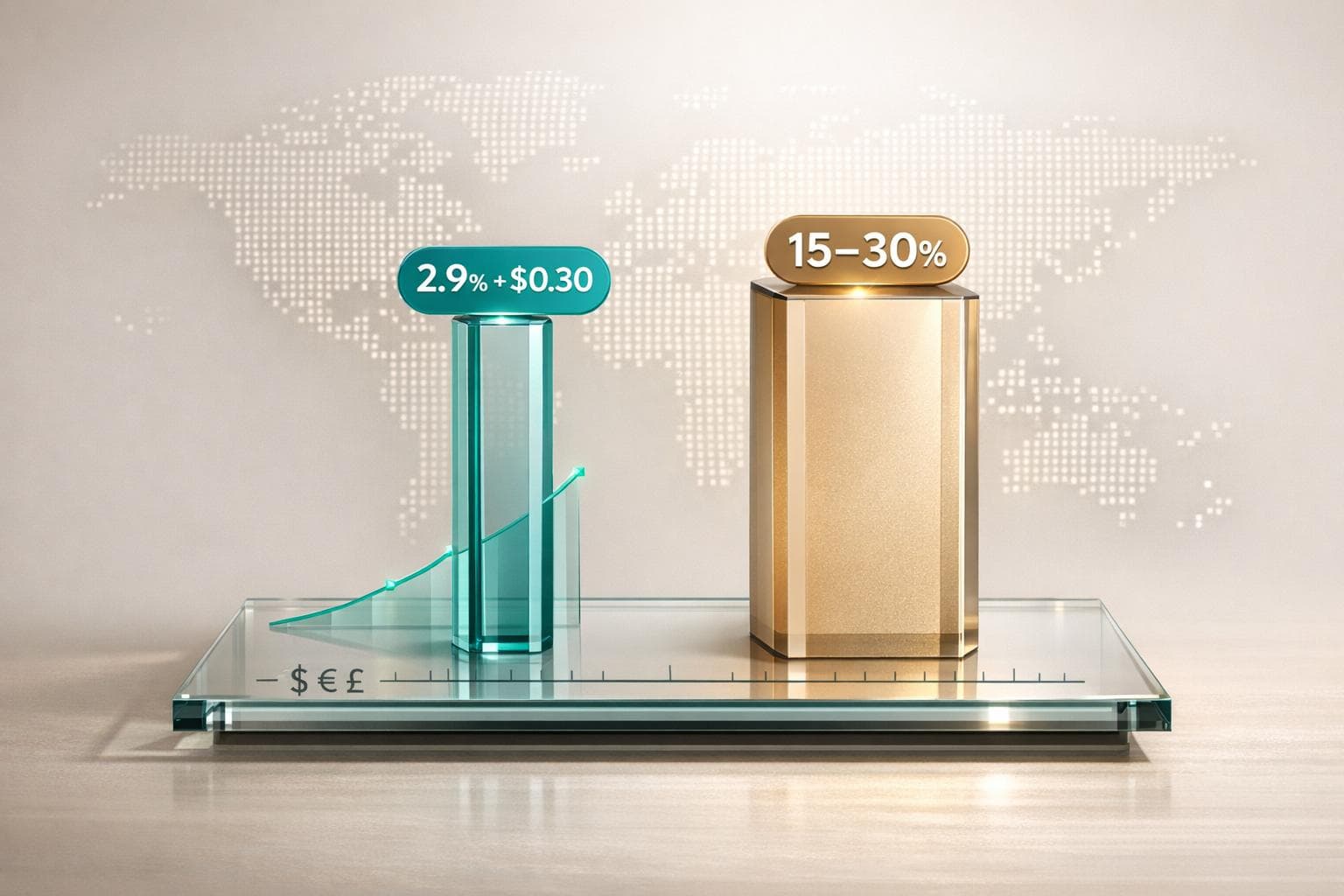
Account for platform fees and taxes in your calculations. Most app stores take a 30% commission, though small developers may qualify for a reduced rate of 15%. If you also sell on the web, weigh that against how Stripe's fees compare. Additionally, tax rates on digital products vary by country, so your pricing should cover these costs while still meeting revenue goals.
To prevent misuse of regional pricing, implement safeguards like IP checks, local payment method requirements, and billing address validation. These measures help ensure users aren’t exploiting pricing differences via VPNs or fake location data [15][16][17].
Test and Improve Your Pricing
Once your pricing is live, continuous refinement is key. PPP pricing isn’t a one-and-done process.
Use A/B testing in select markets to evaluate different price points. Start small - test two or three key markets - and compare results against your PPP-based prices. Measure conversion rates, user retention, and lifetime value (LTV) to assess the impact of your adjustments [11][5][13]. Our app revenue estimator is a quick way to sanity-check that math. Even slight price changes can influence revenue by 20–50% [18].
Keep an eye on performance metrics like average revenue per user (ARPU), churn rates, and customer acquisition costs. These indicators can reveal which regions are thriving and which may need pricing tweaks.
Regular updates to your pricing strategy are essential. For example, SaaS companies that adjusted prices quarterly saw four times more ARPU growth over five years compared to those that only updated annually [16][17]. Small, consistent changes can lead to meaningful revenue gains.
When expanding successful pricing strategies to new markets, focus first on regions with similar economic conditions. This phased approach minimizes risk while maximizing the benefits of optimized pricing.
Avoid common mistakes like offering discounts larger than 20%, as steep cuts often lead to higher churn rates [18]. For annual plans, promotions like “one month free” tend to be more effective than percentage discounts [18].
Lastly, be transparent with users about regional pricing differences. Clear communication helps build trust and manage expectations, ensuring your pricing strategy maintains credibility [15][16].
sbb-itb-43fe43a
Mirava: Your PPP Pricing Solution
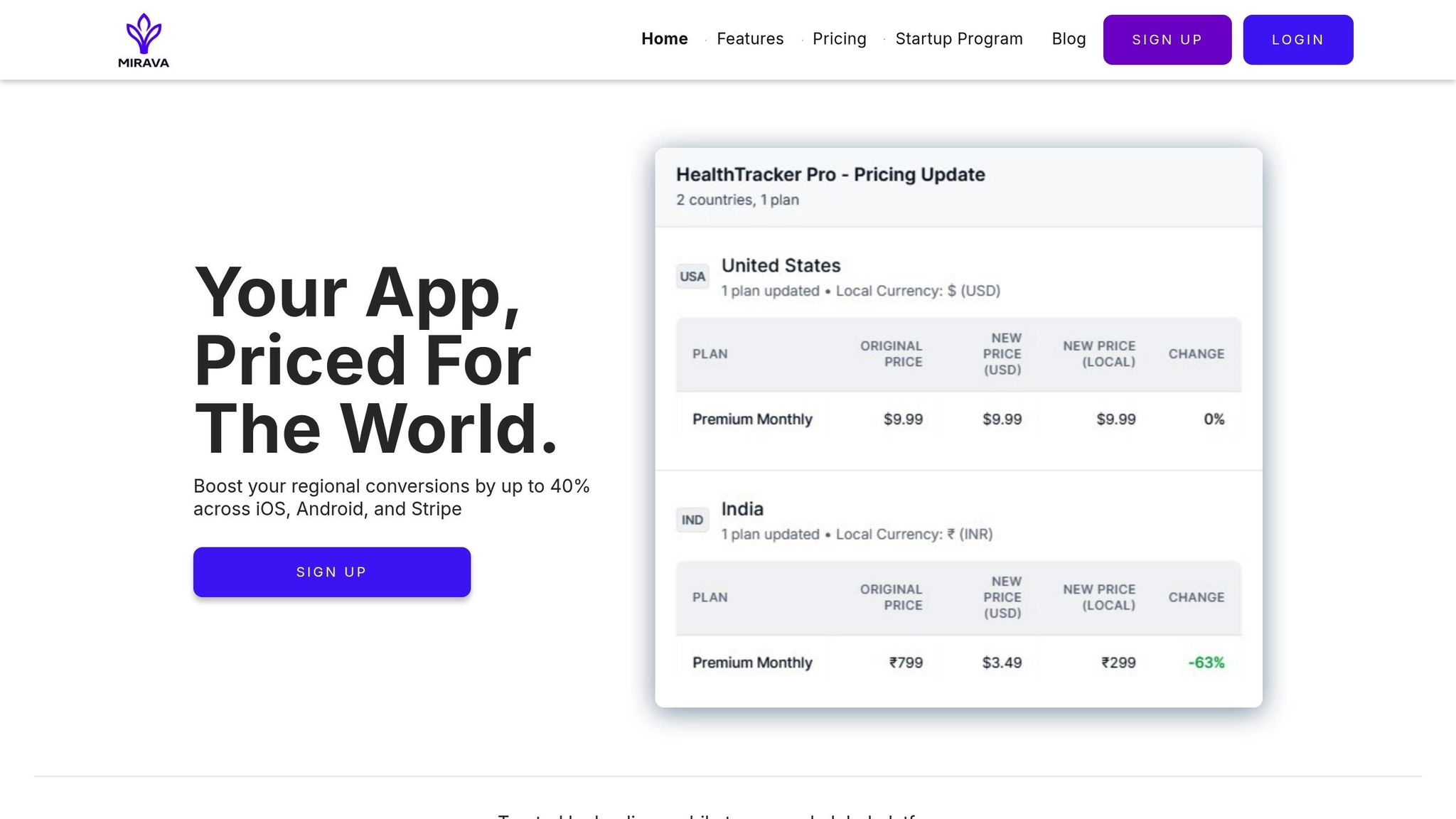
Handling PPP (Purchasing Power Parity) pricing manually can be a daunting task, especially when scaling globally. Mirava simplifies this process by turning a complex, time-consuming workflow into an automated and efficient system, ensuring both accuracy and compliance.
Mirava's Main Features
Mirava's platform excels at automating pricing updates. It provides automatic price recommendations across more than 175 countries by using advanced data sources, including Apple Index metrics and local currency standards [20].
A standout feature is the unified dashboard, which consolidates pricing management for iOS and Android. This significantly reduces the risk of inconsistencies. The system also maps PPP-adjusted prices to the nearest available platform price tier, helping you maximize revenue potential [19]. Additionally, its comprehensive analytics tools allow you to visualize pricing tiers across regions, identify outliers, and receive actionable suggestions for fine-tuning your strategy [20].
How Mirava Simplifies PPP Pricing
Mirava’s automation cuts what used to take hours into just minutes. Simply set your base price in USD, and the platform takes care of the rest - applying PPP adjustments, currency conversions, and platform-specific rules once you approve the changes or within the caps you set. No spreadsheets, no manual uploads [20]. Plus, compliance automation ensures your pricing aligns with Apple and Google guidelines [19].
The platform also empowers teams to experiment with pricing strategies, regardless of size. You can quickly test and measure new approaches across different regions without worrying about the technical or administrative burden.
These capabilities make Mirava a powerful tool for businesses looking to streamline their pricing processes and experiment with regional strategies.
Mirava Pricing Plans
Mirava’s pricing options are designed to be flexible, catering to businesses at different stages of growth.
| Plan | Price | Best For | Key Features |
|---|---|---|---|
| Free | Free | Indie developers starting out | Connect accounts, price audit, flat price updates, email support |
| Premium | $49/app/month ($499/year, 2 months free) | Growing developers with multiple products | Advanced PPP conversion, batch updates, priority support |
| Enterprise | Custom pricing | Large publishers with complex needs | Advanced analytics, API access, dedicated account manager, 24/7 support |
The Premium plan is ideal for developers who are actively implementing PPP pricing, offering advanced conversion tools and batch updates [19]. For startups, Mirava provides a special Startup Program: 50% off the yearly plan (code STARTER50) for apps earning less than $5,000 in monthly revenue.
Applying regional, PPP-adjusted pricing strategies can help apps better align prices with local purchasing power and open up revenue in markets where flat global pricing leaves conversions on the table.
Best Practices and Rules to Follow
Setting up PPP pricing is just the first step. The real challenge is keeping your pricing strategy effective and compliant with ever-changing platform guidelines and tax regulations. To stay both profitable and legally compliant, you’ll need to regularly assess and adjust your approach.
Update Prices When Markets Change
Economic conditions are always in flux, and your pricing should reflect those changes. While PPP deviations often correct themselves within 3–5 years [21], exchange rates can be about four times more volatile than relative prices on a yearly basis. This volatility tends to stabilize after 6–7 years [21].
Timing matters. SaaS companies that adjust pricing quarterly see about four times more ARPU growth over five years compared to those that only reprice annually [16][17]. Even a small improvement in monetization - just 1% - can boost your bottom line by as much as 12.7% [17]. To stay ahead, create a regular review schedule: quarterly updates for most markets and monthly reviews for currencies that are especially volatile. Keep an eye on inflation, exchange rates, and other economic indicators that impact your customers’ purchasing power.
Understanding how prices behave in your market can make your updates more effective. Products with flexible pricing, like airline tickets or new cars, respond quickly to market changes and require frequent updates. On the other hand, products with “sticky” prices, like newspapers or elderly care services, don’t need as frequent adjustments [22]. If your app falls into the flexible category, plan for more frequent changes, while sticky-price products allow for longer intervals.
Finally, measure the impact of your adjustments by analyzing regional data and customer feedback.
Track Regional Data and Customer Response
Monitoring the right metrics is critical to ensuring your PPP strategy works across different markets. A well-designed regional dashboard can help you track key performance indicators that reveal the effectiveness of your pricing.
Focus on these areas:
- Revenue Metrics: Metrics like signup-to-paid conversion rates, ARPU by region, MRR by country, and total sales volume per region give you a clear picture of financial performance [16][17].
- Customer Feedback: Gather insights through surveys, in-app forms, interviews, and even social media sentiment to understand how users perceive your pricing [17].
- Market Intelligence: Keep tabs on competitor pricing, regional sales trends, and local search behaviors.
- External Factors: Monitor inflation, unemployment rates, supply chain disruptions, and seasonal events that might affect purchasing power.
| KPI Category | Key Metrics to Monitor |
|---|---|
| Revenue Metrics | Signup-to-paid conversion, ARPU/ARPA per region, MRR by country, sales volume |
| Customer Feedback | Survey responses, in-app feedback, interview insights, social media sentiment |
| Market Intelligence | Competitor pricing, regional sales reports, local search trends, inventory levels |
| External Factors | Inflation rates, unemployment data, supply chain disruptions, seasonal events |
Make sure these metrics align with your overall strategy for testing and refining your pricing. Actively seek feedback from your international users about pricing, perceived value, and overall experience [17]. Also, remember that around 40% of consumers are less likely to buy from websites not available in their native language [17]. This highlights the importance of combining pricing strategies with localization efforts.
Be on the lookout for users exploiting geo-discounts through VPNs. Set up systems to detect unusual purchasing patterns from specific regions or IP addresses [16][17].
Follow Tax and Platform Rules
Once your pricing adjustments are in place, the next step is ensuring compliance with tax laws and platform-specific requirements. Staying on top of these rules is just as important as setting the right price.
Tax laws and platform policies can be incredibly complex and change frequently. For instance, as of February 6, 2025, Azerbaijan and Peru introduced an 18% VAT, Slovakia raised its VAT from 20% to 23%, and Estonia increased its reduced VAT rate for certain digital products from 5% to 9% [25].
Platform-specific rules add another layer of complexity. The App Store, for example, supports 44 currencies across 175 storefronts. Apple handles tax collection for in-app purchases, but if you use alternative payment methods, the responsibility for tax calculation, collection, and remittance falls on you [23][24].
"For in-app purchases made using alternative payment processing or link out to your webpage, you're responsible for taxes, including (but not limited to): Determining if a transaction is taxable; Charging and collecting the taxes at the applicable rate; Remitting the taxes to the appropriate taxing authority; Providing any required documentation to the users or appropriate taxing authority; and Meeting all other country-specific tax compliance obligations imposed as a result of making in-app sales subject to tax in the storefront country and/or your country of residence."
– Apple Developer [23]
The regulatory landscape is evolving rapidly. Starting April 1, 2025, developers outside Japan selling paid apps or in-app purchases in Japan will face a 10% consumption tax, which Apple will collect and remit on their behalf [25]. In the EU, the Digital Markets Act designates Apple and Google as "gatekeepers", introducing new compliance requirements and fee structures [26].
To simplify tax management, automate wherever possible. Many e-commerce platforms can handle international tax calculations, collection, and remittance. However, if you rely on third-party payment providers, tax compliance often remains your responsibility [24]. Managing this manually can quickly become overwhelming given the frequent changes in tax laws.
Regularly test your localized purchasing funnels using VPNs or proxy services to ensure accurate currency displays, pricing, language settings, and tax calculations [17]. For regions undergoing currency changes, communicate both the old and new prices clearly to your customers during the transition [25]. If you process payments directly from U.S. users, stay informed about economic nexus thresholds in different states [24].
Conclusion
Setting up pricing based on Purchasing Power Parity (PPP) becomes much simpler when you start with a strong USD base price, reliable PPP data, and the right calculation tools. From there, it’s all about keeping your pricing updated, listening to customer feedback, and adhering to platform rules and tax regulations.
Tools like Mirava make the process even easier by automating price conversions and PPP adjustments. With flexible plans, Mirava caters to everyone - from indie developers to larger agencies.
To recap, a solid pricing strategy relies on clear foundations. Achieving success with PPP pricing means staying consistent while adapting to changes. Build a transparent pricing structure, monitor important metrics, and adjust as economic conditions shift. With a clear approach and tools like Mirava, you can tackle regional pricing challenges and turn them into opportunities for global growth.
FAQs
How can I keep my PPP pricing strategy effective and up-to-date with economic changes and platform rules?
To keep your PPP pricing strategy effective, it's important to stay on top of economic trends and adjust your prices as local purchasing power shifts. Tools like PPP calculators and platform-specific pricing features can help you fine-tune your rates to remain competitive while adhering to platform rules.
Make it a habit to stay updated on platform regulations and legal requirements by consulting official guidelines and trusted industry resources. Keeping an eye on these changes not only helps you avoid compliance problems but also ensures your pricing strategy remains optimized for the long haul.
How can I gather and use PPP data to set fair and competitive prices for my app in different regions?
To establish fair and competitive prices across different regions, begin by gathering reliable purchasing power parity (PPP) data. Trusted sources like global economic reports or specialized market research tools can provide the insights you need. Leverage PPP calculators to assess regional economic conditions and fine-tune your pricing strategy.
Next, test your pricing adjustments with A/B testing to understand how users react to various price points. This helps ensure your approach resonates with your audience. Keep your pricing strategy dynamic by regularly reviewing and updating it to reflect shifts in local economies. Gathering user feedback is also crucial - it helps you maintain pricing that feels fair and aligns with customer expectations.
How does Mirava help streamline PPP pricing for apps and digital products across different regions?
Mirava streamlines the management of Purchasing Power Parity (PPP) pricing by automating crucial tasks. It takes care of currency conversions, implements pricing strategies tailored to local economic conditions, and adjusts prices to match platform-specific tiers, such as those on the Apple App Store and Google Play.
By minimizing manual effort, Mirava ensures your pricing remains competitive and accessible worldwide. This approach helps you boost revenue while keeping your products affordable for users across different markets.